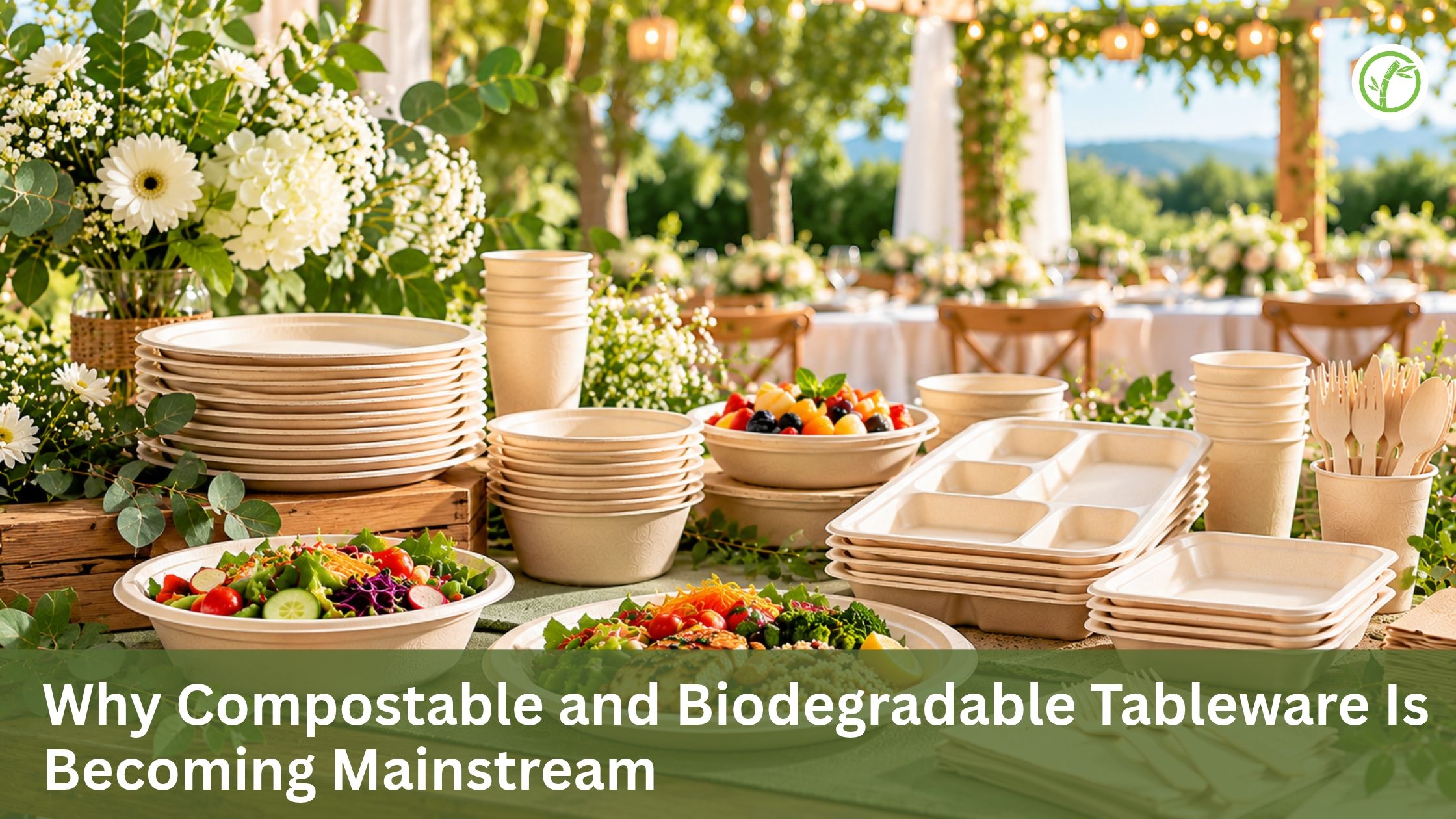
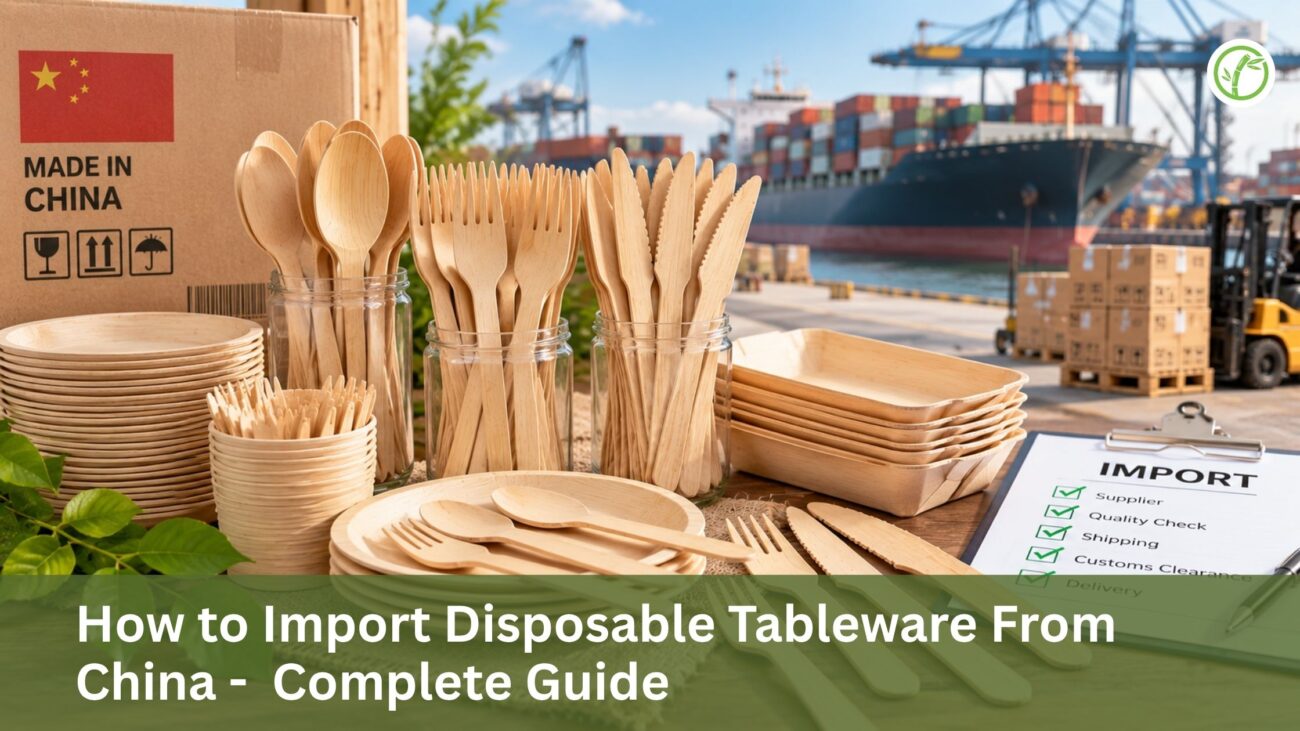
The global disposable tableware market is in the middle of the largest material transition in its history. Polystyrene is banned. Plastic is restricted. Paper has a PFAS problem. And every restaurant, hotel, QSR chain, caterer, airline, school cafeteria, and food delivery platform in the world still needs disposable plates, bowls, cups, cutlery, containers, trays, straws, and stirrers billions of pieces every single day.
The replacement materials — bamboo, bagasse, wood, and palm leaf are overwhelmingly manufactured in China. If you are an importer, distributor, wholesaler, or brand owner looking to supply the post-plastic disposable tableware market, your supply chain runs through Chinese manufacturing.
This guide covers how to import disposable tableware from China in 2026, which materials to choose, how to navigate the regulatory landscape that has made this market so dynamic, how to find a manufacturer that actually makes what they claim to make, and how to get tableware from a Chinese factory to your warehouse without losing your margin to hidden costs.
The Disposable Tableware Material Decision
Before you import a single plate, you need to decide which materials to carry. This is not a product decision. It is a market-positioning decision that determines which customers you can serve, which price tier you compete in, and which regulations you need to satisfy.
The disposable tableware market in 2026 has four viable eco-friendly materials, each with different strengths, price points, and buyer profiles.
Bamboo — The Premium Tier
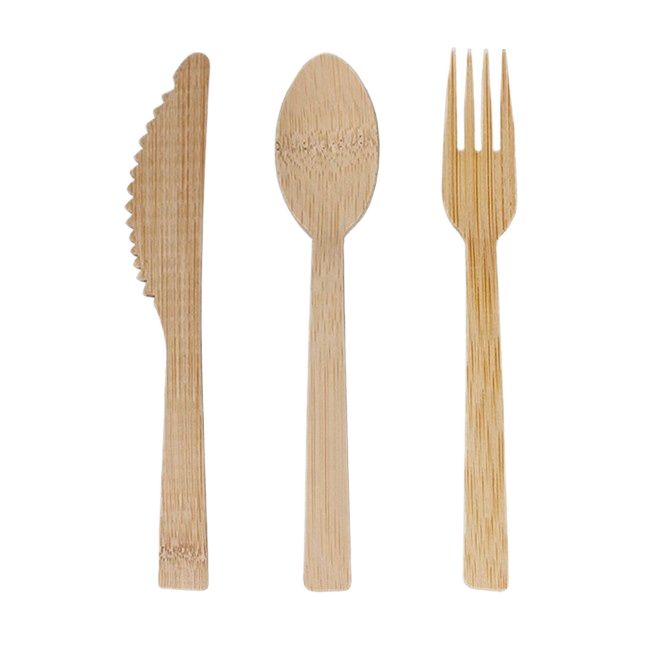
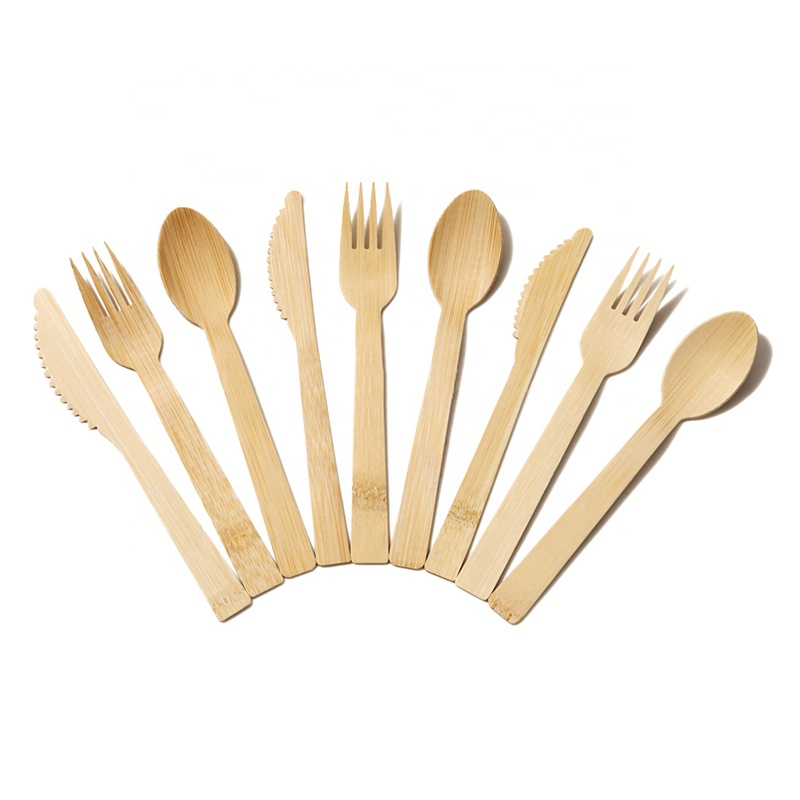
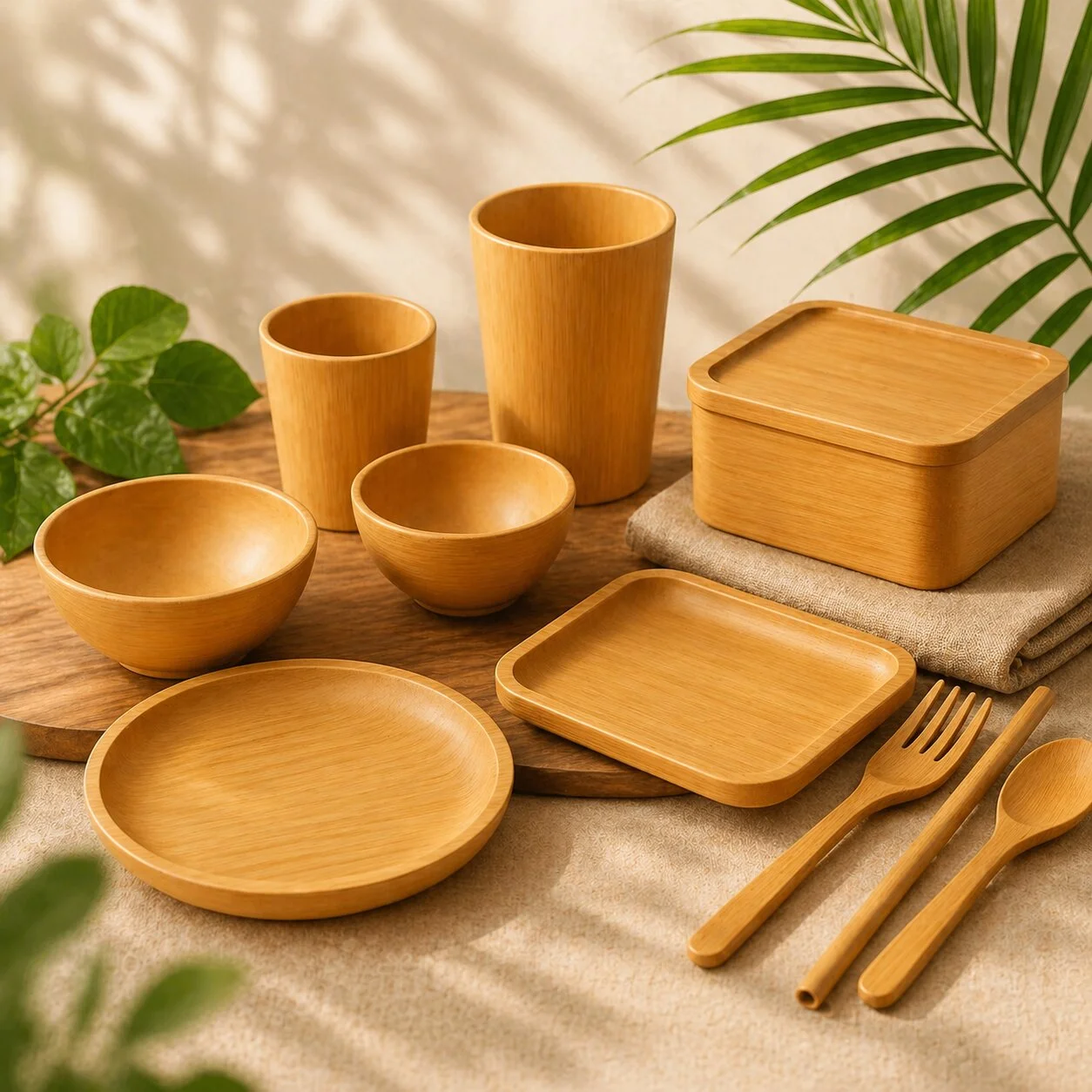
Bamboo disposable tableware is the strongest, smoothest, and most taste-neutral eco material. Bamboo cutlery does not snap. Bamboo chopsticks do not splinter. Bamboo straws do not go soggy. Every product has a premium look and feel that justifies premium pricing downstream.
Best for: Hotels, premium restaurants, branded cafes, cocktail bars, events, airlines, and any operation where the customer directly touches and handles the utensil. Premium per-unit cost, premium per-unit margin.
Product range from China: Cutlery, chopsticks, skewers, straws, plates, picks, toothpicks, coffee stirrers, ice cream sticks, fruit forks, fruit sticks, and poles. See 80+ bamboo products →
Bagasse (Sugarcane) — The Volume Replacement Tier
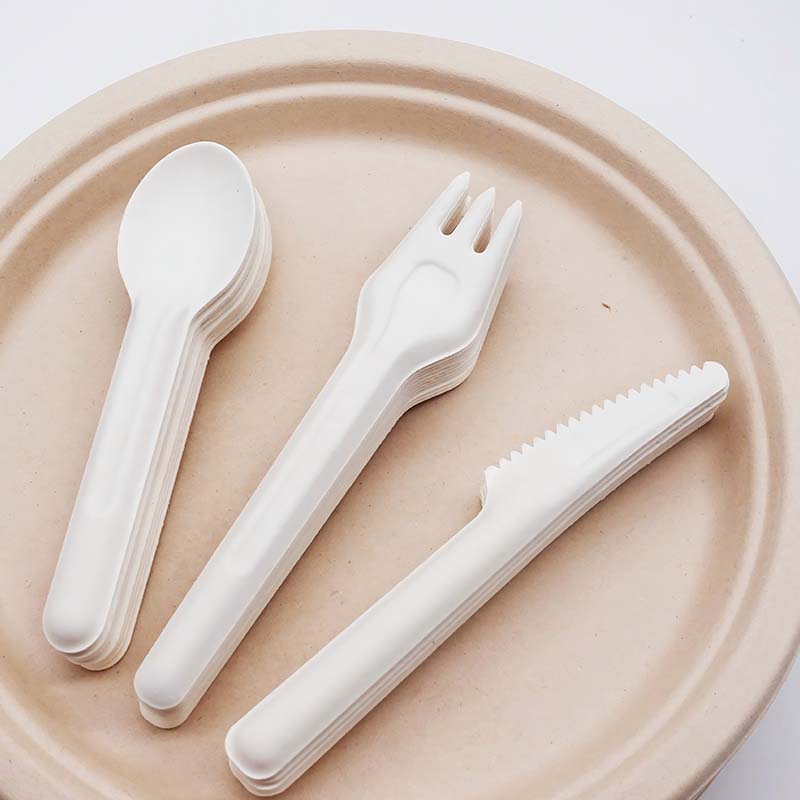
Bagasse tableware is the direct replacement for polystyrene and plastic containers. Made from waste sugarcane. Microwave safe, freezer safe, oil-resistant, PFAS-free, and compostable. This is the material that supermarket chains, QSR franchises, and delivery platforms are switching to at scale — right now, in 2026.
Best for: Takeaway, delivery, QSR, supermarkets, cloud kitchens, school cafeterias, hospitals, and any high-volume food service operation that currently uses polystyrene or plastic containers. Mid-range pricing. Highest volume demand.
Product range from China: Bowls, food boxes (21 products clamshells, compartment, square, oval, sushi trays), cups, cutlery, plates, trays (12 products — including supermarket 104-format), and straws.
Wood (Birch/Pine) — The Budget Tier
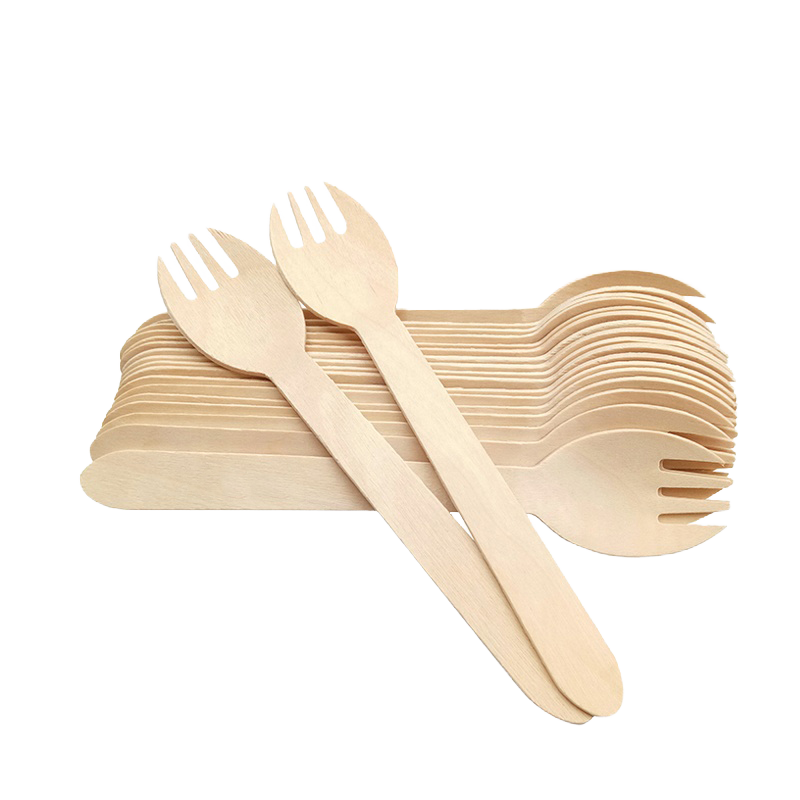
Wooden disposable tableware is the most affordable eco material. Wooden cutlery at one cent per fork. Wooden stirrers at one-tenth of a cent. Wooden ice cream sticks at one-thousandth of a dollar. For importers building a budget-tier eco-product line, wood is the material that matches plastic on price while being fully biodegradable.
Best for: QSR, school cafeterias, institutional catering, food trucks, ice cream manufacturing, vending, and any price-sensitive operation that needs the cheapest eco-compliant option. Lowest per-unit cost. Highest volume per order.
Product range from China: Cutlery, plates, cups, food boxes, boat trays, cone cups, coffee stirrers, and ice cream sticks.
Palm Leaf — The Ultra-Premium Niche
Palm leaf plates are pressed from naturally fallen Areca palm leaves. Every plate is one-of-a-kind. The most visually distinctive disposable tableware on the market. Seasonal supply. Highest per-unit cost.
Best for: Weddings, boutique events, eco-lifestyle retail, food photography, and occasions where the plate is a conversation piece, not just a container.
The Multi-Material Strategy
The most successful disposable tableware importers do not pick one material. They import all four and position them as tiers in their catalogue — bamboo for premium, bagasse for volume, wood for budget, palm leaf for ultra-premium. Different customers need different materials. One catalogue serves them all.
FriendlyBamboo manufactures across all four materials — plus reed straws, wheat straws, umbrella picks, and cocktail picks. 150+ eco-friendly disposable products from one factory. One order. One shipment. One supplier. See the complete range →
The 2026 Regulatory Landscape What You Must Know Before Importing
Disposable tableware is one of the most heavily regulated product categories in the world in 2026. Regulations vary by country, by state, and by material. Importing the wrong material into the wrong market can mean unsellable inventory, fines, or confiscated shipments.
Polystyrene Bans
Polystyrene (foam) food packaging is now banned in the EU, India, and over 250 US cities and counties. Multiple additional countries have announced phase-out timelines. If you are currently importing polystyrene disposable tableware, your market is shrinking with every new ban. The replacement is bagasse, bamboo, or wood — materials that are compliant everywhere.
Single-Use Plastic Restrictions
The EU Single-Use Plastics Directive has eliminated plastic cutlery, plates, stirrers, and straws from the European market. Similar legislation is advancing in Canada, the UK, Australia, India, and across Southeast Asia. Eco-friendly disposable tableware is not optional in these markets — it is the only legal option for the product categories covered by the bans.
PFAS Bans in Food Packaging
This is the regulation that matters most in 2026. PFAS (“forever chemicals”) have been used as grease-proofing agents in disposable paper plates, paper cups, and some moulded fibre products for decades. In 2026, regulators are eliminating them.
The EU restricts PFAS in food contact materials from August 2026. Maine bans PFAS in food packaging from May 2026. California, New York, Washington, Minnesota, Connecticut, Vermont, and Maryland have enacted or proposed similar restrictions.
What this means for importers: If you import paper plates or paper cups that rely on PFAS coatings for grease resistance, your products may become non-compliant mid-shipment. Bagasse tableware is inherently PFAS-free — grease resistance comes from fibre density, not chemical coating. Bamboo and wooden tableware contain no coatings of any kind. Importing these materials eliminates your PFAS compliance risk.
FriendlyBamboo products are independently verified PFAS-free across the entire range. View PFAS-free verification →
FDA Food Contact Compliance (US Market)
Any disposable tableware that contacts food must comply with FDA 21 CFR Part 177 in the US market. This applies to bamboo, bagasse, wooden, and palm leaf products equally. Your Chinese supplier must provide FDA test reports that demonstrate compliance. Products that arrive without FDA documentation may be detained by US Customs.
FriendlyBamboo FDA certification covers every product in our range. Lab test reports provided with every shipment.
EU Food Contact Regulation (EC) No 1935/2004
For EU-bound imports, disposable tableware must comply with EC Regulation 1935/2004 on materials intended for food contact. This requires a Declaration of Conformity and supporting migration testing data for certain materials. Your supplier should provide this documentation proactively.
Finding the Right Chinese Manufacturer
The Chinese disposable tableware manufacturing sector includes thousands of companies — genuine factories, trading companies that pretend to be factories, and hybrid companies that manufacture some products and source others. Here is how to find a real manufacturer.
Verify Factory Ownership
A genuine manufacturer owns production equipment — moulding presses for bagasse, die-cutting machines for wood, bamboo processing lines. Request factory photos and video showing equipment with the company name visible. Check the company’s Chinese business registration for a “manufacturing” classification. Trading companies are classified differently.
Verify Material-Specific Expertise
A factory that manufactures bamboo cutlery should be able to tell you the bamboo species (Moso), harvest age (5+ years), fibre density, moisture content after drying, sanding grit sequence, and FDA compliance data without looking anything up. A factory that makes bagasse products should know their sugarcane pulp source, pressing temperature and duration, wall thickness tolerances, and BPI certification status. If the supplier gives vague or delayed answers to material-specific questions, they are likely a trading company relaying your questions to an actual factory.
Verify Multi-Material Capability
If you plan to import bamboo, bagasse, and wooden products, verify that the supplier actually manufactures across all three materials — not just resells two of them from partner factories. A genuine multi-material manufacturer has separate production lines for each material type, all within the same facility or campus.
FriendlyBamboo operates production across bamboo, bagasse, wood, palm leaf, reed, and wheat. Our factory processes each material with dedicated equipment, dedicated quality control, and unified management. This is not common — most Chinese disposable tableware factories specialise in one material and trade the rest.
Verify Export Track Record
Ask how many countries the supplier ships to, how many containers per month, and which destination markets they have experience with. An experienced exporter knows the phytosanitary requirements for the EU, the FDA Prior Notice procedure for the US, the AQIS requirements for Australia, and the documentation needed for Middle Eastern markets. A factory that has only sold domestically will learn these requirements using your first order as their experiment.
FriendlyBamboo ships to 30+ countries across 6 continents. We have been managing export documentation for over 12 years. Request a quote with freight and documentation included →
The Import Process — Simplified
Phase 1: Discovery and Qualification (Week 1-2)
Contact the supplier. Request product catalogue, pricing, certifications, and factory verification materials. Compare 2-3 suppliers. Shortlist based on product range, pricing, certifications, and communication responsiveness.
Phase 2: Samples (Week 2-4)
Request samples from your shortlisted supplier(s). Test quality — smoothness, strength, dimensions, taste neutrality, microwave performance (bagasse), oil resistance, and branding quality (if private-label). Select your supplier based on sample quality. FriendlyBamboo ships samples within 7 days.
Phase 3: Order and Production (Week 4-8)
Confirm product specifications, quantities, branding, packaging, and shipping terms. Place order with deposit (standard: 30% deposit, 70% before shipment). Production takes 15-30 days depending on product complexity and order volume.
Phase 4: Shipping and Documentation (Week 8-12)
Supplier arranges export documentation — commercial invoice, packing list, certificate of origin, phytosanitary certificate, fumigation certificate. Goods ship by sea (20-35 days) or air (3-7 days). For DDP orders, the supplier handles everything including customs clearance and delivery.
Phase 5: Customs and Delivery (Week 10-14)
Your customs broker clears the shipment. Duties and taxes are paid. Goods are delivered to your warehouse. Inspect the shipment against the packing list and quality samples. Begin selling.
Total timeline from first contact to warehouse delivery: 10-14 weeks for the first order. Reorders are faster (6-8 weeks) because specifications, branding, and logistics are already established.
Also read – eco friendly food packaging for small business
Landed Cost Structure for Disposable Tableware
Your landed cost — the total cost of products in your warehouse — includes seven layers beyond the factory price.
| Cost Layer | Typical Percentage of Factory Price |
|---|---|
| Factory price (product cost) | Base — 100% |
| Custom branding / private label | +10-30% |
| Sea freight | +5-15% |
| Insurance | +0.3-0.5% |
| Documentation (CO, phyto, fumigation) | +1-3% |
| Customs duty | +3-7% (varies by country and HS code) |
| VAT / GST (often reclaimable) | +5-27% (country-dependent) |
| Destination handling + customs broker | +3-8% |
Rule of thumb: Your landed cost (excluding reclaimable VAT) is typically 1.3x to 1.6x the factory price. A product that costs $0.03 at the factory lands at $0.04 to $0.05 in your warehouse. Your selling margin must be calculated from this landed cost, not from the factory price.
For a detailed cost calculation with real numbers, see our complete import cost breakdown guide →.
The Competitive Advantage of Importing From One Multi-Material Manufacturer
Most importers source disposable tableware from 3-5 separate factories — one for bamboo, one for bagasse, one for wood, one for speciality items. Each factory means a separate order, separate production schedule, separate shipping, separate customs clearance, separate quality standard, and separate relationship to manage.
Importing from a single multi-material manufacturer eliminates all of this duplication.
Cost advantage: One container with bamboo cutlery, bagasse bowls, wooden stirrers, and cocktail picks costs less to ship than four separate shipments. Consolidated freight reduces per-unit shipping by 10-20%.
Quality advantage: One factory with one quality management system produces consistent quality across all materials. Your bamboo cutlery and your bagasse bowls meet the same ISO 9001 standard because they come from the same QMS.
Documentation advantage: One set of export documents for one shipment. One customs clearance. One broker fee. One inspection risk instead of four.
Relationship advantage: One account manager who knows your specifications, your branding, your delivery schedule, and your quality requirements across every product. You do not start from scratch with a new sales representative for every material.
FriendlyBamboo manufactures 150+ products across bamboo, bagasse, wood, palm leaf, reed, and wheat. One factory. One order. One shipment. One invoice. The simplest supply chain for the broadest disposable tableware catalogue.
Also read – sugarcane bagasse plates wholesale
Why Import Disposable Tableware From FriendlyBamboo
150+ products across 6 materials. The broadest eco-friendly disposable tableware range from a single Chinese manufacturer. Bamboo (80+ products), bagasse (50+ products), wooden (30+ products), palm leaf, reed, and wheat.
12+ years of manufacturing and export. 30+ countries. Established freight relationships. Every export document handled routinely.
Factory-direct. You deal with the manufacturer. No trading company markup. Maximum margin for your distribution business.
Complete certification suite. FSC, FDA, ISO 9001, ISO 14001, BPI, PFAS-free. Every certificate verifiable. Audit-ready. Provided with every shipment.
Private-label from Day 1. Laser engraving, printed wrappers, branded retail boxes, branded cartons. Branding mockups within 48 hours. Build your brand from our factory.
FOB, CIF, DDP. You choose your logistics involvement. DDP means we deliver to your door with all duties paid — you receive one price and one delivery.
24-hour quotes. Submit your product list and receive factory-direct pricing within 24 hours. Samples within 7 days. Production in 15-30 days.
For Further Readings:
eco friendly products for restaurant
eco friendly food packaging for small business
eco friendly products for hotels
eco friendly products for hospitals
eco friendly products for catering services
→ Start Importing Disposable Tableware Now
Frequently Asked Questions
How do I import disposable tableware from China? Define your product range and materials, find and verify a factory-direct manufacturer, request and test samples, negotiate pricing and terms, place your order, and arrange shipping (or choose DDP for zero-logistics importing). FriendlyBamboo supports the entire process — 150+ products, samples within 7 days, 24-hour quotes, and DDP to 30+ countries.
What disposable tableware materials are available from China? Bamboo (cutlery, chopsticks, skewers, straws, plates, picks), bagasse/sugarcane (bowls, food boxes, cups, plates, trays, straws), wood (cutlery, plates, cups, food boxes, boat trays, stirrers), and palm leaf (plates). Plus reed straws, wheat straws, and cocktail accessories. FriendlyBamboo manufactures all six materials.
What regulations affect disposable tableware imports in 2026? Polystyrene bans (EU, India, 250+ US cities), single-use plastic restrictions (EU, UK, Canada, Australia), PFAS bans in food packaging (EU from August 2026, multiple US states), FDA food contact compliance (US), and EU food contact regulation EC 1935/2004. Eco-friendly materials (bamboo, bagasse, wood, palm leaf) are compliant with all of these.
What certifications should imported disposable tableware have? FSC (sustainable sourcing), FDA 21 CFR 177 (food contact safety), ISO 9001 (quality), ISO 14001 (environmental). For bagasse: BPI (compostability). For all materials: PFAS-free verification. These are increasingly mandatory, not optional.
How much does it cost to import disposable tableware from China? Landed cost is typically 1.3x to 1.6x the factory price (excluding reclaimable VAT). A product at $0.03 factory price lands at $0.04-$0.05. The gap includes freight, duty, insurance, documentation, and handling. See our detailed cost calculator →.
Should I import from multiple factories or one multi-material factory? One multi-material factory saves 10-20% on freight (consolidated shipping), simplifies documentation (one export set instead of multiple), ensures consistent quality (one QMS), and reduces management overhead (one relationship). FriendlyBamboo manufactures bamboo, bagasse, wood, palm leaf, reed, and wheat from one facility.
What is the minimum order to import disposable tableware? Varies by product: bamboo cutlery 10,000-50,000 pieces, bagasse containers 10,000+, wooden products 10,000-50,000+, palm leaf plates 5,000+. First-time trial orders at reduced MOQs available from FriendlyBamboo.
How long does importing disposable tableware take? First order: 10-14 weeks total (2 weeks discovery + 2 weeks samples + 4 weeks production + 4-5 weeks shipping). Reorders: 6-8 weeks (production + shipping). Air freight reduces shipping to 3-7 days for urgent needs.
Can I sell imported disposable tableware under my own brand? Yes. FriendlyBamboo offers complete private-label — laser engraving, printed wrappers, branded packaging, white-label documentation. Branding mockups within 48 hours. Your customers see your brand, not ours.
Ready to import disposable tableware from China? Request your factory-direct quote from FriendlyBamboo — 150+ products, 6 materials, all certifications, FOB/CIF/DDP. 24-hour response.
Explore the full range: Bamboo | Bagasse | Wooden | Palm Leaf | Reed Straws | Wheat Straws
Related guides: Cost to Import Bamboo Products From China → | How to Import Eco-Friendly Products From China → | Where to Buy Bulk Bamboo Products at Factory Price →