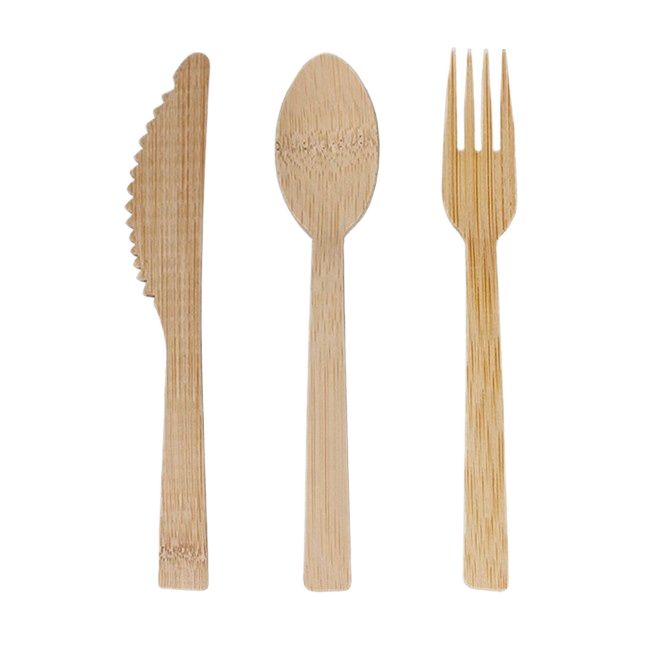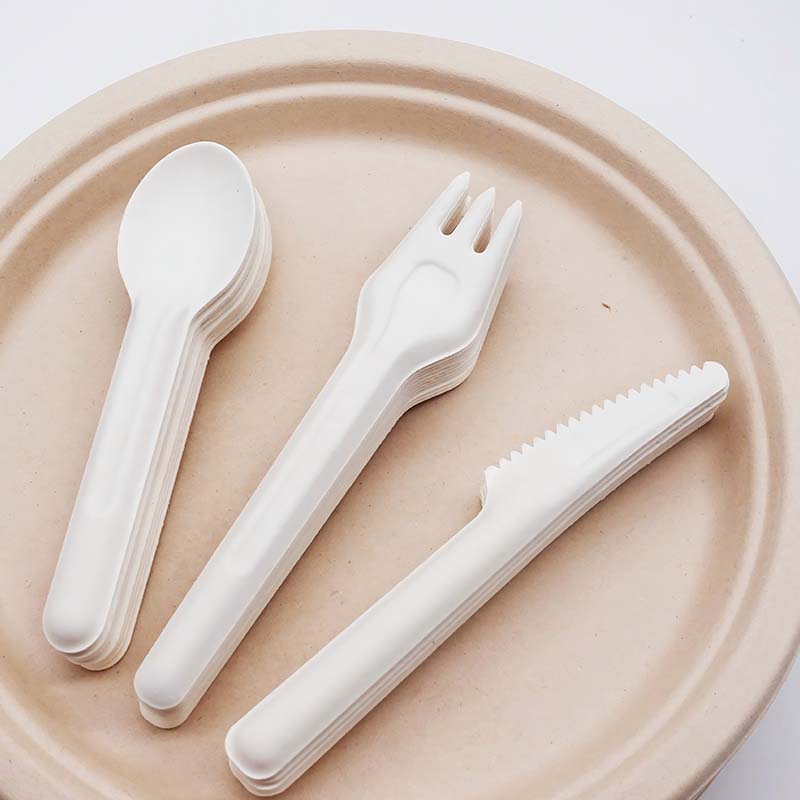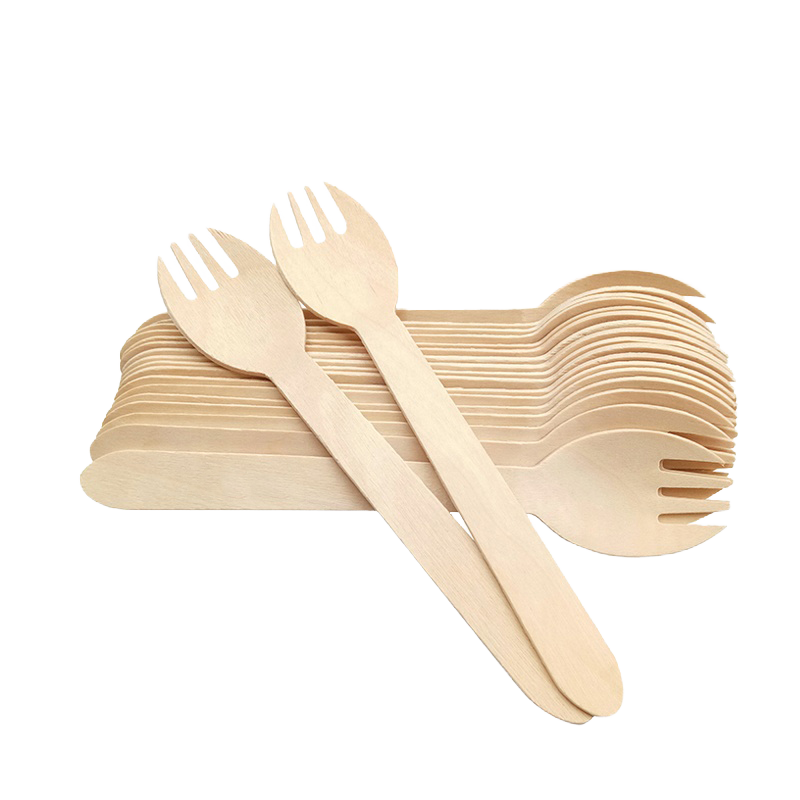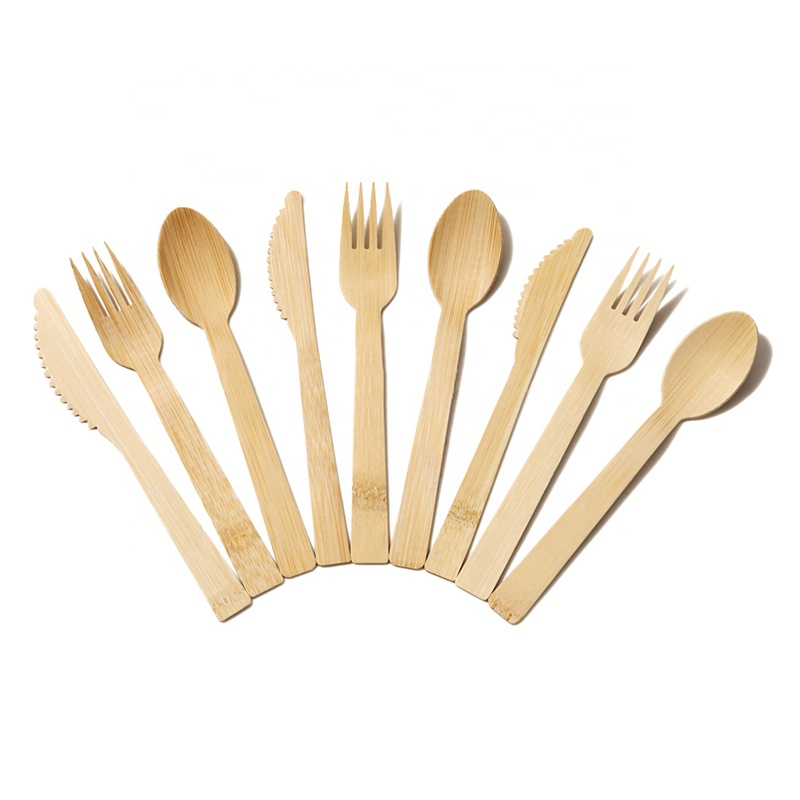
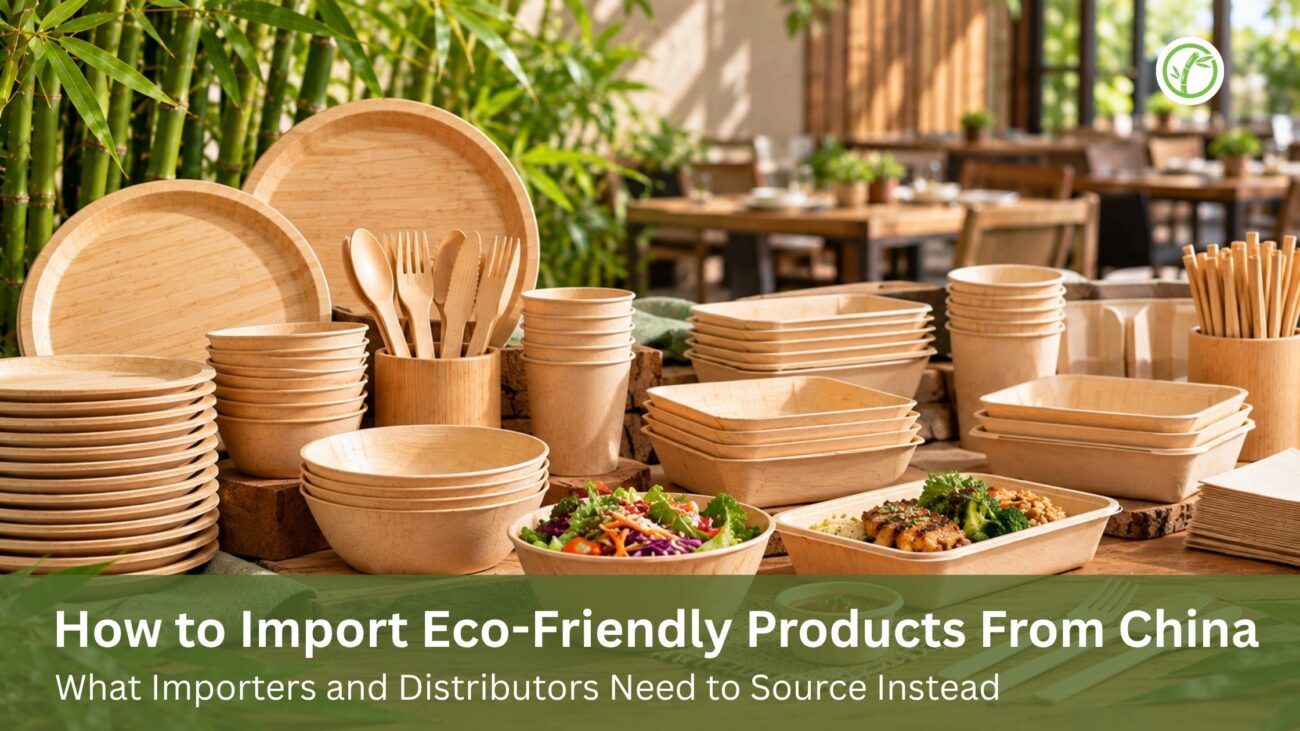
China manufactures the majority of the world’s eco-friendly disposable products — bamboo cutlery, bagasse containers, wooden tableware, palm leaf plates, reed straws, wheat straws, and compostable packaging. If you are building a distribution business, launching an eco-product brand, supplying restaurants and hotels, or stocking a retail catalogue with sustainable products, your supply chain almost certainly runs through China.
Importing eco-friendly products from China is not complicated. But it is specific. The products have certification requirements that regular consumer goods do not. The materials have phytosanitary regulations that plastic products never triggered. The sustainability claims your customers rely on must be verifiable, not just printed on a box.
This guide walks through the complete process — from choosing what to import to receiving your first shipment at your warehouse — with specific guidance for eco-friendly disposable products including bamboo, bagasse (sugarcane), wooden, palm leaf, reed, and wheat materials.
Step 1 — Decide What Eco-Friendly Products to Import
Before you contact a single supplier, define your product range. The eco-friendly disposable products market has six major material categories, each serving different customers and different price tiers.
Bamboo products — Cutlery, chopsticks, skewers, straws, plates, picks, toothpicks, stirrers, ice cream sticks. The premium eco material. Strongest, smoothest, taste-neutral. Best margins per unit. Serves hotels, premium restaurants, branded cafes, cocktail bars, and events.
Bagasse (sugarcane) products — Bowls, food boxes, cups, cutlery, plates, trays, straws. Made from waste sugarcane. The high-volume replacement for polystyrene and plastic containers. Microwave safe, PFAS-free, compostable. Serves QSR, delivery, takeaway, supermarkets, and institutional catering. Fastest-growing category.
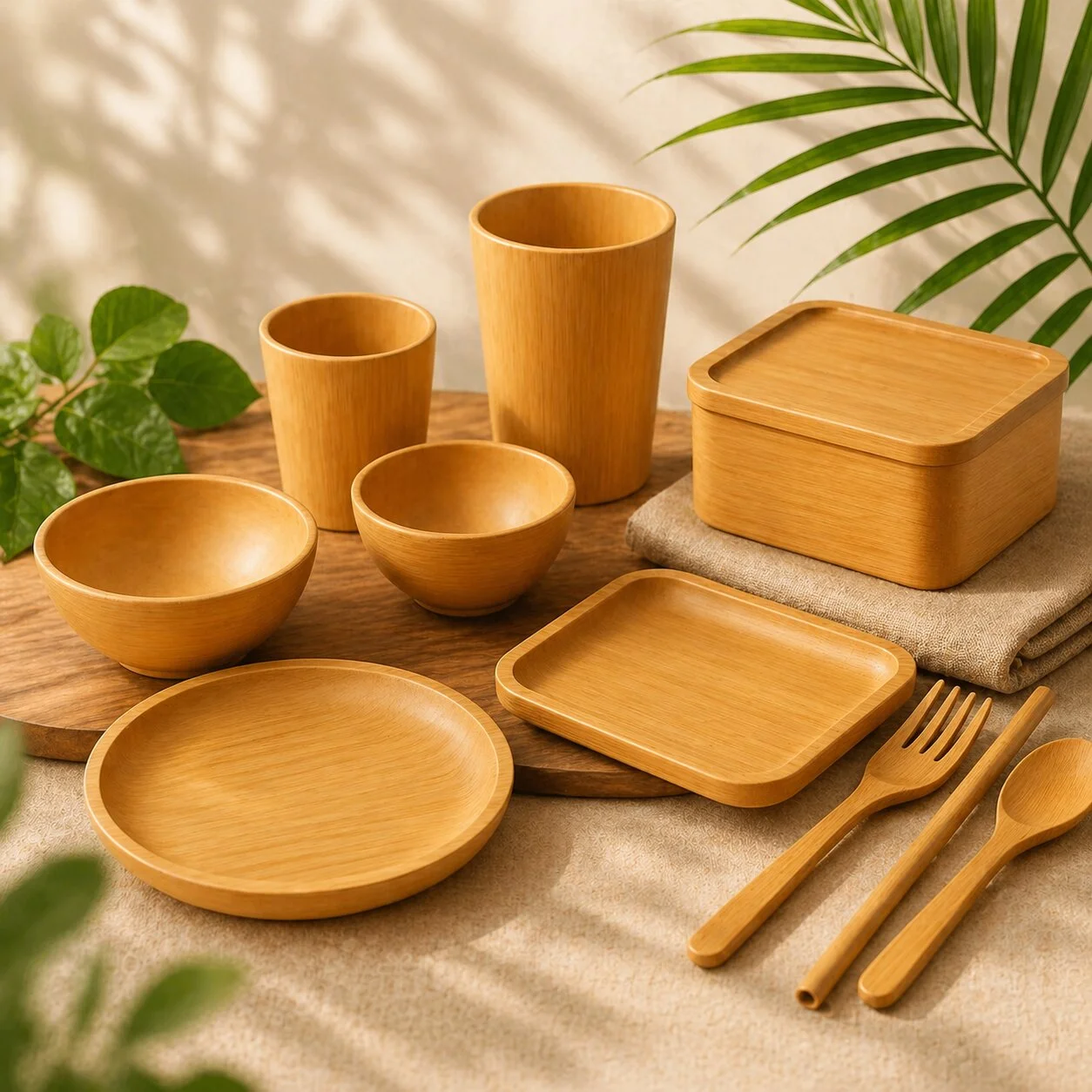
Wooden products — Cutlery, plates, cups, food boxes, boat trays, cone cups, stirrers, ice cream sticks. The most affordable eco material. Serves budget-first operations, schools, food trucks, and high-volume institutional buyers.
Palm leaf plates — Pressed from naturally fallen Areca palm leaves. Every plate unique. The premium-premium tier. Serves weddings, boutique events, and eco-lifestyle retail.
Reed straws and wheat straws — Natural plant-stem straws. The purest eco straws. Serve eco-purist cafes, cocktail bars, and natural-lifestyle retail.
Cocktail picks and umbrella picks — Decorative bamboo and paper bar accessories. Serve cocktail bars, hotels, cruise ships, and party supply.
The smart approach: Do not import one product from one material. Import a range across multiple materials and price tiers. This gives your customers choice and makes your catalogue harder to replace. See our complete range across all materials →
Step 2 — Find and Verify Your Supplier
This step separates successful importers from burned ones. China has thousands of eco-product suppliers. Many are factories. Many are trading companies pretending to be factories. The difference matters — factories give you 15-30% lower pricing and direct quality control. Trading companies add margin without adding value.
How to verify a real eco-product manufacturer:
Check certifications at the factory level. FSC, FDA, and ISO certificates are issued to specific factory entities. The certificate must name the company you are dealing with, not a different factory they source from. Request the certificate and verify the entity name matches.
Request a factory video tour. A 5-minute video of the production floor, raw material storage, machinery, and finished goods area. A factory that makes eco-friendly products will show you bamboo processing equipment, bagasse moulding presses, or wood die-cutting machines. A trading company will show you an office and product samples.
Ask about material sourcing. A real bamboo manufacturer knows their bamboo species (Moso), harvest age (5+ years), and forest certification (FSC). A real bagasse manufacturer knows their sugarcane source and pulp processing. A trading company gives vague answers because they source from different factories for different orders.
Verify export experience. Ask which countries they ship to, how many containers per month, and whether they handle phytosanitary certificates. Experienced exporters answer these questions immediately. Inexperienced ones stall.
FriendlyBamboo verification: We are a factory-direct manufacturer with 12+ years of export experience, shipping to 30+ countries. Our FSC, FDA, ISO 9001, and ISO 14001 certificates are factory-level, issued to our manufacturing entity. Factory tours available on request. View all certifications →
Step 3 — Understand the Certifications Your Products Need
Eco-friendly products imported for food service have specific certification requirements. Missing a single certificate can mean your shipment is rejected at customs, your products fail a retail buyer’s audit, or your business faces regulatory penalties.
Essential certifications for eco-friendly disposable products:
| Certification | What It Covers | Why It Matters | Who Requires It |
|---|---|---|---|
| FSC | Raw material sourced from responsibly managed forests | Proves sustainable sourcing — not just “eco” marketing | Hotel chains, corporate buyers, ESG-reporting companies, EU importers |
| FDA (21 CFR 177) | Product is safe for direct food and oral contact | Legal requirement for food-contact products in the US and widely accepted globally | Every food service operation, every retailer, every distributor |
| ISO 9001 | Manufacturing quality management system | Proves consistent quality across production batches | Institutional buyers, government procurement, supermarkets |
| ISO 14001 | Environmental management at factory level | Proves the factory itself operates sustainably | ESG audits, corporate sustainability reporting |
| BPI | Product is compostable in commercial facilities | Required for “compostable” marketing claims in the US | Composting-certified venues, municipal composting programmes |
| PFAS-Free | No forever chemicals in the product | Required as EU and US states ban PFAS in food packaging in 2026 | EU importers, US importers (state-specific), supermarket chains |
Do not accept “we are working on certification.” If the supplier does not already hold these certificates, your products are not certified — regardless of what they promise for future orders. Certificates are audited and issued before production, not after.
FriendlyBamboo certifications: FSC, FDA, ISO 9001, ISO 14001, BPI (bagasse products), and independent PFAS-free verification across the entire product range. Certificates provided with every order, verifiable and audit-ready.
Step 4 — Request Samples Before You Commit
Never place a bulk order without testing physical samples first. Photos lie. Descriptions are optimistic. Only a sample in your hand tells the truth about quality.
What to test in your samples:
Bamboo cutlery and utensils — Smoothness (run fingers along edges and tines), splinter check, strength (press fork tines, try to snap a spoon), taste test (stir hot water and taste for woody note).
Bagasse containers — Microwave test (heat food for 2 minutes), oil test (pour cooking oil and wait 30 minutes), hot liquid test (pour near-boiling water and check for leaking), structural test (load with heavy food and carry one-handed).
Wooden products — Surface smoothness, splinter check, dimensional consistency (measure 10 pieces — are they identical?), weight and feel.
Straws — Soak test (leave in water for 2 hours — any softening?), taste test (drink water through the straw — any flavour?), diameter check (fits your cup lids?).
Request samples from multiple suppliers and compare side by side. The differences in quality become obvious when you hold competing products together.
FriendlyBamboo samples: We ship samples within 7 days of request. All product categories available for sampling. Request your samples →
Step 5 — Negotiate Pricing and Terms
Once you have verified the supplier and approved the samples, negotiate your order terms.
Key negotiation points for eco-friendly product imports:
Unit price. Factory pricing decreases at higher volumes. Ask for price breaks at 2x and 5x your initial order quantity — this tells you the cost trajectory as your business scales. At FriendlyBamboo, we provide tiered pricing with every quote.
MOQ (Minimum Order Quantity). Every factory has MOQs based on efficient production run sizes. For eco products, typical MOQs are 5,000-50,000 pieces depending on the product. First-time trial orders may be available at reduced MOQs.
Payment terms. Standard is 30% deposit to start production, 70% balance before shipment (T/T wire transfer). For first orders, this is reasonable. For established relationships, negotiate net-30 or net-60 payment terms.
Incoterms. FOB (you arrange shipping from the supplier’s port), CIF (supplier arranges shipping to your port), or DDP (supplier delivers to your warehouse with all duties paid). Each Incoterm shifts cost and responsibility differently. DDP is easiest for first-time importers — you receive one total price with zero logistics on your end.
Custom branding. If you want private-label products, confirm branding costs, MOQs for branded items, and design approval timelines upfront. FriendlyBamboo provides branding mockups within 48 hours of receiving your design files.
Step 6 — Handle Documentation and Compliance
Eco-friendly products made from plant-based materials (bamboo, wood, reed, wheat, palm leaf) trigger specific import documentation requirements that plastic or metal products do not.
Documentation your supplier must provide:
Commercial Invoice and Packing List — Standard for all imports. Details product descriptions, quantities, values, and packaging specifications.
Certificate of Origin — Confirms the products were manufactured in China. Required for customs clearance and for applying the correct duty rate.
Phytosanitary Certificate — Required for plant-based materials. Issued by China’s export inspection authority. Certifies the products have been inspected and are free from pests and diseases. Without this, your bamboo or wooden products may be rejected at your country’s border.
Fumigation Certificate (ISPM 15) — Required when products are shipped in wooden pallets or crates. Certifies the wood packaging has been heat-treated or fumigated to prevent pest transmission. Also commonly required for the bamboo and wooden products themselves.
FDA Prior Notice (US imports) — If importing food-contact products to the US, the FDA requires prior notice of the shipment before it arrives. Your customs broker files this electronically.
REACH/EU Compliance Declaration (EU imports) — For products entering the EU, a declaration of compliance with REACH chemical regulations may be required by customs or by your downstream buyers.
FriendlyBamboo handles all export-side documentation — commercial invoices, packing lists, certificates of origin, phytosanitary certificates, and fumigation certificates are standard with every shipment. We have been managing export documentation to 30+ countries for over 12 years. No surprises. No missing paperwork. No customs delays.
Step 7 — Arrange Shipping
You have three choices: sea freight, air freight, or your supplier’s DDP service.
Sea freight — Best for recurring bulk orders. Lowest per-unit cost. 20-35 days transit time. Full container load (FCL) for large orders. Less than container load (LCL) for smaller shipments.
Air freight — Best for urgent orders, product launches, and small sample shipments. 3-7 days transit. 5-10x more expensive per unit than sea freight.
DDP (supplier handles everything) — Best for first-time importers and businesses that do not want to manage freight logistics. The supplier arranges freight, insurance, customs clearance, duty payment, and delivery to your warehouse. You receive one total price and one delivery.
Container capacity for eco-friendly products:
| Container | Typical Eco Product Capacity | Best For |
|---|---|---|
| 20ft | 10-15 CBM / 8-12 tonnes | Medium orders, single product category |
| 40ft | 25-30 CBM / 18-24 tonnes | Large orders, multi-product consolidated |
| 40ft HC | 30-35 CBM / 18-24 tonnes | Maximum volume, lightweight products (straws, toothpicks, stirrers) |
Consolidation tip: Importing bamboo cutlery, bagasse containers, wooden stirrers, and reed straws in the same container from FriendlyBamboo reduces your per-unit freight cost by 10-20% compared to shipping each product category separately from different suppliers.
Step 8 — Clear Customs in Your Country
When your shipment arrives at your destination port, it must clear customs before you can receive it.
What you need:
A customs broker. Unless you have import experience, hire a licensed customs broker in your country. They file customs declarations, calculate duties, arrange inspections if required, and release your goods. Cost: $100-$300 per shipment.
Correct HS code classification. Bamboo products typically fall under HS codes 4419 (tableware/kitchenware), 4421 (articles of wood), or 4602 (basketwork/bamboo articles). Bagasse products may fall under HS 3924 (tableware of plastics — despite being plant-based, some countries classify moulded fibre here) or 4823 (articles of paper pulp). Correct classification determines your duty rate. Misclassification can result in higher duties or penalties.
Duty payment. Customs duties are calculated on the CIF value (product cost + freight + insurance). Rates vary by country and product classification — see our import cost guide for detailed duty rates.
VAT/GST payment. Most countries charge import VAT or GST on top of customs duty. This is usually reclaimable for registered businesses.
Possible inspection. Customs authorities randomly select shipments for physical inspection. If your shipment is selected, expect 1-3 days delay and $200-$500 in examination fees. Having correct documentation reduces inspection likelihood.
Step 9 — Receive and Inspect Your Goods
When your shipment arrives at your warehouse, inspect it before distributing to customers.
Inspection checklist:
Quantity verification. Count cartons and cross-reference against the packing list. Open 5-10% of cartons randomly and count pieces. Discrepancies should be flagged immediately with your supplier.
Quality spot-check. Pull samples from random cartons across the shipment (front, middle, back of the container). Check for damage, defects, dimensional consistency, surface finish, and branding accuracy (if private-label).
Certification verification. Confirm that FSC, FDA, and other certificates provided match the products received. Certificates should reference the correct product descriptions and manufacturing dates.
Photography. Photograph the container on arrival, the cartons, the product samples, and any damage or defects. Documentation protects you in any dispute resolution.
Report issues within 48 hours. If you find quality issues, document them with photos and measurements and report to your supplier immediately. Reputable manufacturers like FriendlyBamboo resolve quality concerns promptly — replacement shipments, credits, or production adjustments for future orders.
Step 10 — Build a Recurring Import Schedule
The first order is the hardest. Every subsequent order is easier because the product specifications, quality standards, branding templates, and logistics chain are already established.
Building your reorder cycle:
Track sell-through rates. Monitor how quickly each product sells. Your reorder point should trigger 6-8 weeks before you run out — enough time for production (15-30 days) and shipping (20-35 days by sea).
Maintain safety stock. Keep 4-6 weeks of inventory buffer for your best-selling products. Eco-friendly products do not expire (dry bamboo, bagasse, and wood have 12+ month shelf life), so holding extra stock carries minimal risk.
Scale volume over time. As your sales grow, increase order volumes to unlock lower tier pricing. Moving from 10,000 to 50,000 pieces per product typically reduces factory price by 10-20%.
Diversify your product range. Start with your core products (the 3-5 items that sell fastest). Once your import process is running smoothly, add new categories from the same supplier. FriendlyBamboo’s 150+ products across 6 materials mean you can expand your catalogue without adding supplier complexity.
→ Start your first eco-product import with FriendlyBamboo
Common Mistakes First-Time Eco-Product Importers Make
Importing without samples. The single most expensive mistake. A $15,000 shipment of products you have never physically tested is a $15,000 gamble. Always sample first.
Ignoring phytosanitary requirements. Bamboo, wood, reed, wheat, and palm leaf are plant materials. Most countries require phytosanitary and fumigation certificates. If your supplier does not provide these, your shipment sits at customs until they do — incurring storage fees every day.
Calculating margin from factory price, not landed cost. Factory price is 50-65% of your landed cost. If you set your selling price based on factory price margin, your actual margin after freight, duty, and handling will be much lower than planned. Always calculate from landed cost.
Not verifying certifications. Printing “eco-friendly” on a box does not make a product eco-friendly. FSC, FDA, and BPI certifications are audited and verifiable. If your supplier cannot provide verifiable certificates, your “eco” products have no defensible sustainability claim — and your customers will eventually discover this.
Using multiple suppliers for related products. Buying bamboo cutlery from one factory, bagasse bowls from another, and wooden plates from a third means three shipping costs, three customs clearances, three quality standards, and three supplier relationships. Consolidating with a single multi-material manufacturer like FriendlyBamboo cuts logistics cost and complexity dramatically.
Overlooking PFAS compliance. The EU bans PFAS in food packaging from August 2026. If your imported eco products contain PFAS coatings (some paper and moulded fibre products do), they will be non-compliant. Bamboo and wooden products are inherently PFAS-free. Bagasse products from FriendlyBamboo are independently verified PFAS-free.
Why Import Eco-Friendly Products From FriendlyBamboo
150+ products across 6 materials. Bamboo, bagasse, wooden, palm leaf, reed, and wheat. Your entire eco-friendly disposable product range from one factory.
12+ years export experience to 30+ countries. We know the documentation your customs authority requires because we have shipped there before.
Factory-direct pricing. No trading company. No middleman. The margin gap between our price and your selling price is yours to keep.
Full certification suite. FSC, FDA, ISO 9001, ISO 14001, BPI, PFAS-free. Provided with every order. Audit-ready.
Private-label and custom branding. Your brand on products, wrappers, packaging, and documentation. Build your own eco brand from our factory.
FOB, CIF, and DDP shipping. You choose the level of logistics involvement. DDP means we deliver to your warehouse door — you do nothing except receive the goods.
24-hour quotes. Submit your product list → and receive factory-direct pricing with freight estimates within 24 hours.
→ Start Importing Eco-Friendly Products Now
Frequently Asked Questions
How do I start importing eco-friendly products from China? Define your product range, find and verify a factory-direct supplier, request samples, negotiate pricing and terms, place your order, and arrange shipping. The 10-step process in this guide covers everything. FriendlyBamboo supports first-time importers with samples within 7 days, 24-hour quotes, and DDP delivery for zero-logistics importing.
What eco-friendly products can I import from China? Bamboo products (cutlery, chopsticks, skewers, straws, plates, picks, toothpicks, stirrers), bagasse products (bowls, food boxes, cups, cutlery, plates, trays, straws), wooden products (cutlery, plates, cups, food boxes, boat trays, cone cups, stirrers), palm leaf plates, reed straws, wheat straws, umbrella picks, and cocktail picks. FriendlyBamboo manufactures 150+ products across all six materials.
What certifications do I need to import eco-friendly food products? FSC (sustainable sourcing), FDA (food contact safety), ISO 9001 (quality), ISO 14001 (environmental), BPI (compostability for bagasse), and PFAS-free verification. These are required by downstream customers and increasingly by customs authorities. Your supplier must provide these — do not import without them.
Do eco-friendly products from China need phytosanitary certificates? Yes. Bamboo, wooden, reed, wheat, and palm leaf products are plant-based materials. Most importing countries require phytosanitary certificates confirming the products are pest-free. Fumigation certificates may also be required. FriendlyBamboo arranges both as standard.
What is the easiest way to import eco-friendly products from China? DDP (Delivered Duty Paid). Your supplier handles production, shipping, insurance, customs clearance, duties, and delivery to your warehouse. You receive one total price and one delivery. Zero logistics on your end. FriendlyBamboo offers DDP to 30+ countries.
How long does it take to import eco-friendly products from China? Production: 15-30 days. Sea freight: 20-35 days. Air freight: 3-7 days. Customs clearance: 1-5 days. Total from order to warehouse: 6-10 weeks by sea, 3-5 weeks by air. Reorders are faster because specifications are already confirmed.
Can I import from one supplier across multiple eco materials? Yes. FriendlyBamboo manufactures bamboo, bagasse, wooden, palm leaf, reed, and wheat products. Order all materials in one consolidated shipment. One invoice, one customs clearance, one delivery. Consolidation reduces freight and administrative costs by 10-20%.
What are the biggest risks when importing eco-friendly products? Fake or missing certifications, unverified sustainability claims, inconsistent product quality, missing phytosanitary documentation causing customs delays, and calculating margin from factory price instead of landed cost. All of these are avoidable with proper supplier verification and landed-cost calculation.
Ready to import eco-friendly products from China? Request your factory-direct quote from FriendlyBamboo — 150+ products, 6 materials, FSC/FDA certified, FOB/CIF/DDP to 30+ countries. 24-hour response.
Explore the full range: Bamboo | Bagasse | Wooden | Palm Leaf | Reed Straws | Wheat Straws | All Certifications