Wholesale Bagasse Cutlery Products – Bulk Supply & OEM Factory
FriendlyBamboo supplies bamboo straws wholesale to cafés, bubble tea chains, bars, hotels and distributors in 30+ countries. Choose natural or yellow Moso bamboo straws in 6–12mm diameters and 200–240mm lengths, packed in bulk bags, retail boxes or paper sleeves, with laser-engraved or private-label branding. Prices from $0.05 per straw at 10,000+ units.
Showing(All)
All Bagasse Cutlery
Showing all 7 results
-
 ECO
ECOBagasse Disposable Fork – Sustainable Bulk Cutlery...
MOQ:10 CartonsMATERIAL:Bagasse -
ECO
Bagasse Disposable Fork – Sustainable White Bagasse...
MOQ:10 CartonsMATERIAL:Bagasse -
ECO
Bagasse Disposable Knife – Eco-Friendly Wholesale Cutlery Solut...
MOQ:10 CartonsMATERIAL:Bagasse -
ECO
Bagasse Disposable Knife – Food-Grade White Bagasse Knife...
MOQ:10 CartonsMATERIAL:Bagasse -
ECO
Bagasse Soup Spoon – White Bagasse Soup Spoon 120 mm...
MOQ:10 CartonsMATERIAL:Bagasse -
ECO
Bagasse Spoon – Compostable Disposable Cutlery...
MOQ:10 CartonsMATERIAL:Bagasse -
ECO
Bagasse Spoon – Compostable Disposable Cutlery...
MOQ:10 CartonsMATERIAL:Bagasse
Your Bagasse Cutlery Wholesale Supplier
Most people have heard of bamboo cutlery and wooden cutlery. Fewer have heard of bagasse cutlery and that gap is closing fast.
Bagasse cutlery wholesale is made from waste sugarcane, the same agricultural byproduct used to make bagasse plates, bowls, and containers. The fibrous residue left after sugar mills extract juice from sugarcane is cleaned, pulped, and moulded under heat and pressure into forks, spoons, and knives. No trees harvested. No petroleum. No plastic. No chemicals. A genuinely eco-friendly disposable cutlery option made entirely from agricultural waste.
Why does bagasse cutlery exist when bamboo and wooden cutlery already do? Because some operations want a single-material supply chain. If you already use bagasse plates, bagasse bowls, and bagasse containers, adding bagasse cutlery means every disposable product your customer touches is made from the same waste sugarcane material. One material story. One sustainability message. One supplier. Zero mixed-material confusion.
FriendlyBamboo supplies bagasse cutlery wholesale in bulk to restaurants, QSR chains, cloud kitchens, event caterers, and wholesale distributors across 30+ countries for over 12 years. Forks, spoons, and knives in natural (unbleached) and white finishes. FSC, FDA, ISO, and BPI certified.
Available Products
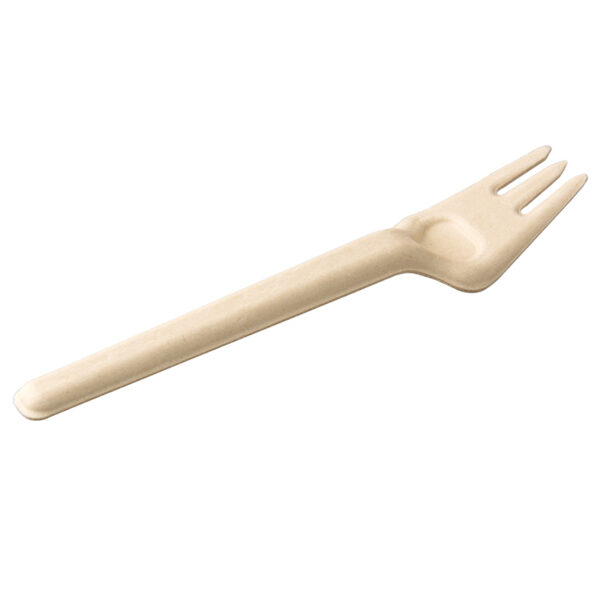
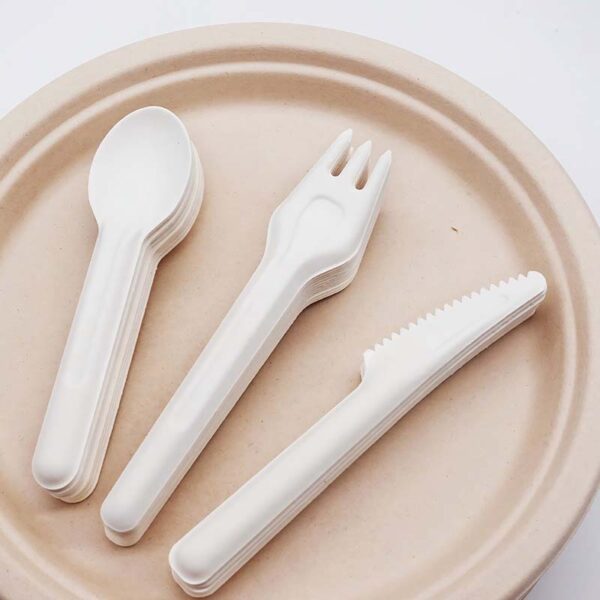
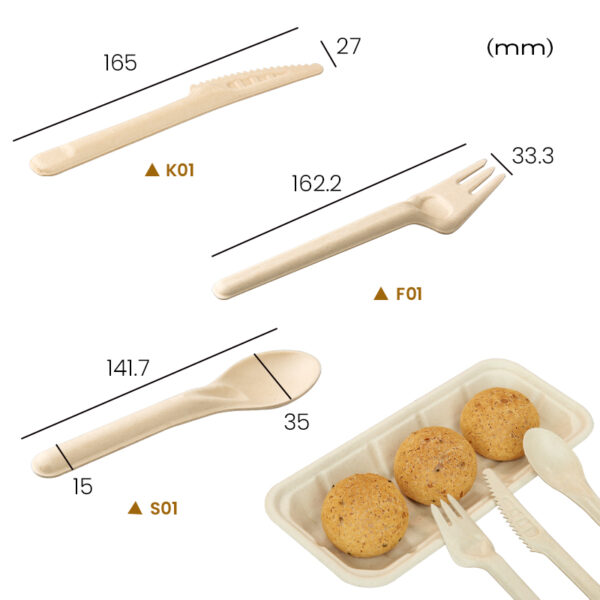
Bagasse Disposable Forks (Natural) — Two-pronged and four-pronged forks moulded from waste sugarcane fibre in a natural off-white / tan colour. The unbleached finish shows the organic character of the material; each fork has a subtle variation in tone that signals authenticity. Sturdy enough for salads, pasta, rice dishes, and soft proteins. Available in 162mm (6.4 inch) standard length. The natural colour pairs cleanly with bagasse plates and containers for a unified, eco-friendly disposable table setting.
Bagasse Disposable Forks (White) — Same construction as the natural fork, but in a bright white finish achieved through chlorine-free bleaching. The white colour gives a cleaner, more uniform appearance that matches traditional plastic cutlery aesthetics. Popular with operations transitioning from plastic, where staff and customers are accustomed to white cutlery. No optical compromise in the switch from plastic to bagasse.
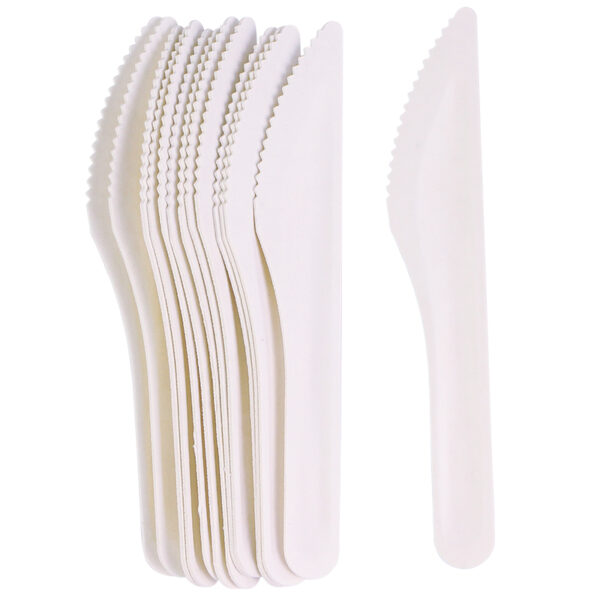
Bagasse Disposable Knives — Food-grade serrated-edge knives moulded from waste sugarcane fibre. Available in white and natural finishes. The serrated edge cuts through sandwiches, grilled vegetables, cakes, soft meats, and bread without excessive force. Standard length approximately 165mm (6.5 inches). Thicker handle section provides a comfortable grip. The knife blade is rigid enough for controlled cutting without flexing.
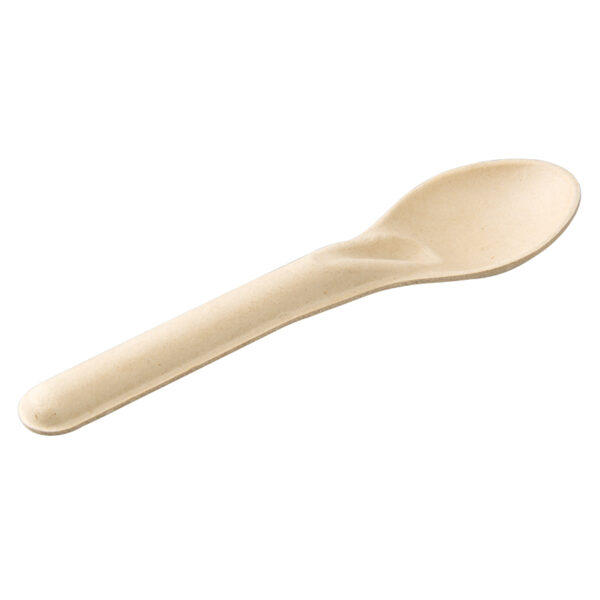
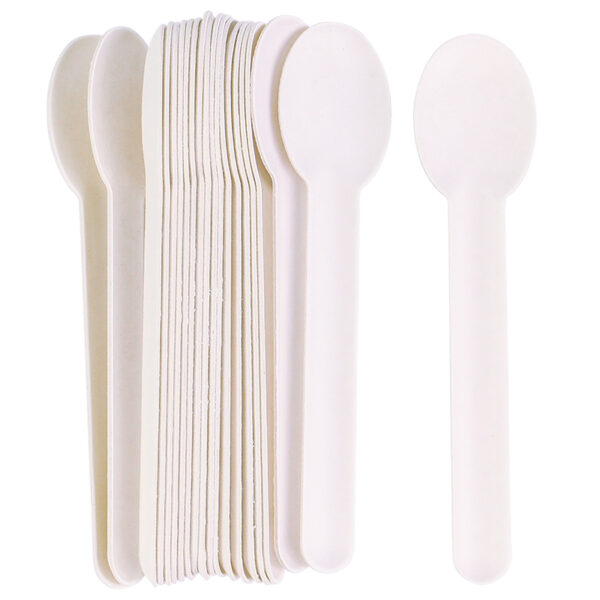
Bagasse Disposable Spoons (Natural) — Spoons in unbleached natural sugarcane colour. Deep bowl design holds liquid and semi-liquid food, soups, yoghurt, rice, porridge, desserts, and ice cream. Standard length approximately 155mm (6.1 inches). The bowl depth is calibrated for comfortable eating, deep enough to carry food to the mouth without dripping, shallow enough to fit comfortably between the lips.
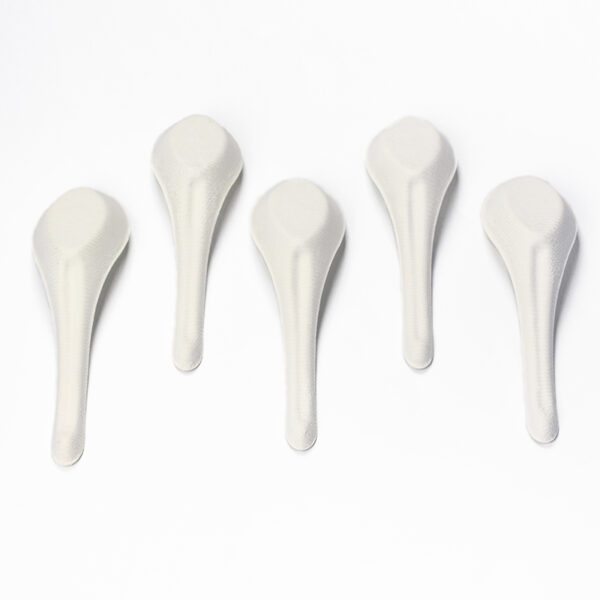
Bagasse Disposable Spoons (White) — Same spoon in bright white finish. Clean, clinical appearance suitable for healthcare catering, airline meals, and any setting where white cutlery is the operational standard.
Bagasse Cutlery Sets — Fork, knife, and spoon pre-packaged together. Available in natural and white. Wrapped in paper or left unwrapped in bulk bags. The pre-assembled set speeds up takeaway line operations; grab one set per order instead of picking three individual pieces. Available with a napkin included.
Sizes & Specifications of Bagasse Cutlery Wholesale
| Product | Length | Width | Weight | Finish Options |
|---|---|---|---|---|
| Fork | 162mm (6.4″) | 27mm | ~4g | Natural, White |
| Knife | 165mm (6.5″) | 15mm | ~5g | Natural, White |
| Spoon | 155mm (6.1″) | 33.3mm | ~4.5g | Natural, White |
| Cutlery Set | N/A | N/A | ~13.5g (3 pieces) | Natural, White |
Detailed dimensions visible on the product page — fork width 27mm, knife width 15mm, spoon bowl width 33.3mm, knife length 162.2mm, spoon length 141.7mm, handle + bowl. These specifications ensure proper eating functionality, not too small to be awkward, not too large to be wasteful with material.
Wholesale Pricing
| Product | Volume | Price Per Piece |
|---|---|---|
| Bagasse fork (natural or white) | 50,000+ pcs | $0.02 – $0.04 |
| Bagasse knife (natural or white) | 50,000+ pcs | $0.025 – $0.045 |
| Bagasse spoon (natural or white) | 50,000+ pcs | $0.02 – $0.04 |
| Cutlery set (3-piece, unwrapped) | 20,000+ sets | $0.06 – $0.10 |
| Cutlery set (3-piece, paper wrapped) | 20,000+ sets | $0.08 – $0.13 |
| Custom branded (any item) | 50,000+ pcs | $0.04 – $0.08 |
Bagasse cutlery pricing is competitive with both bamboo and wooden alternatives. The primary advantage is not price; it is material consistency. When your plates, bowls, containers, cups, AND cutlery are all made from waste sugarcane, your sustainability story is cleaner and simpler than any mixed-material alternative.
Natural vs White: Which Should You Order?
This is the most common question from first-time bagasse cutlery buyers.
| Factor | Natural (Unbleached) | White (Bleached) |
|---|---|---|
| Colour | Off-white/light tan with subtle variation | Bright, uniform white |
| Processing | Minimal — natural sugarcane colour retained | Chlorine-free bleaching step added |
| Eco perception | Strongest — looks “natural” and unprocessed | Still eco but looks more like conventional plastic |
| Matches with | Natural bagasse plates, bowls, containers | White bagasse products, or mixed-material settings |
| Customer reaction | “This looks genuinely eco-friendly” | “This looks like what I’m used to, but it’s compostable” |
| Cost | Slightly lower — fewer processing steps | Slightly higher — bleaching step added |
Our recommendation: If you already use natural (unbleached) bagasse plates and containers, match with natural cutlery for a unified look. If you are transitioning from plastic and your staff or customers expect white cutlery, start with white bagasse; it makes the switch invisible to the end user. Both finishes are equally food-safe, equally compostable, and equally PFAS-free.
How Bagasse Cutlery Wholesale Is Made
Bagasse cutlery is a harder engineering problem than bagasse plates or trays. Pulp moulding is naturally suited to flat or shallow shapes — a plate rim, a tray wall. Getting the same sugarcane fibre to hold a thin, rigid fork tine or a knife edge without cracking takes a different level of process control, which is exactly where quality separates across suppliers of bagasse cutlery wholesale.
Step 1 — Fibre extraction. Sugarcane stalks are crushed at the sugar mill to extract juice. The leftover fibrous pulp bagasse is the raw material, a by-product of sugar production rather than a dedicated crop grown for tableware.
Step 2 — High-density pulping. Bagasse fibre is cleaned and pulped into a slurry at a higher fibre density than is used for plates or trays. Cutlery needs a denser, more tightly bound pulp mix to hold a thin tine shape without the brittleness a lower-density mix would produce.
Step 3 — Precision moulding. The dense pulp slurry is pressed into fork, knife, and spoon-shaped moulds under significantly higher pressure than flat-plate moulding requires. This is the step where most of the process control lives — uneven pressure produces tines that snap under normal cutting or piercing force.
Step 4 — Heat-pressing and drying. Moulded pieces are pressed under heat to remove moisture and bond fibres into a rigid final shape in a single step, with drying time calibrated specifically for cutlery’s thinner cross-section compared to plates.
Step 5 — Trimming and edge finishing. Fork tines are separated and finished, knife edges are shaped with enough definition to cut through food without being a handling hazard, and spoon bowls are checked for depth and smoothness.
Step 6 — Quality sorting and packing. Finished pieces are sorted for structural integrity, then packed into bulk cartons or pre-set combinations for export.
Bagasse cutlery wholesale demands tighter process control than flatter bagasse products; sourcing bagasse cutlery wholesale from a manufacturer with dedicated cutlery moulding capacity — not a plate factory adding cutlery as an afterthought — is the single biggest factor in avoiding the snapped-tine complaints that plague lower-quality suppliers.
Performance: How Does Bagasse Cutlery Compare?
The honest question: Is bagasse cutlery as strong as bamboo or wooden cutlery?
The honest answer: not quite. But it is strong enough for the vast majority of food service applications.
Bagasse cutlery is moulded from pulp, not carved from solid material. This means it does not match the density and rigidity of solid bamboo or birchwood cutlery. You would not use a bagasse fork to pierce a thick steak. But for pasta, rice, salads, soft proteins, vegetables, soups, desserts, and most takeaway food, bagasse cutlery performs well.
Where bagasse cutlery wins is in material consistency. If your entire disposable product range is bagasse plates, bowls, containers, cups, lids, and cutlery, your sustainability message is airtight. One material. One composting stream. One story. That consistency has value for brands, hotel chains, and corporate clients who want a simple, defensible eco-narrative.
| Factor | Bagasse Cutlery | Bamboo Cutlery | Wooden Cutlery | Plastic Cutlery |
|---|---|---|---|---|
| Material source | Waste sugarcane | Moso bamboo | Birchwood | Petroleum |
| Strength | Good — handles most food | Excellent — very rigid | Good — rigid but can snap | Good — flexible |
| Best for | Standard meals, soft food, single-material systems | All food, including tough meats | Budget eco applications | Being banned |
| Taste | Neutral | Neutral | Slight woody note possible | Can leach chemicals |
| Compostable | Yes — 60-90 days | Yes — 90-180 days | Yes — 6-12 months | No — centuries |
| PFAS-free | Yes | Yes | Yes | N/A |
| Cost (bulk) | $0.02-$0.04/pc | $0.02-$0.05/pc | $0.01-$0.03/pc | $0.01-$0.03/pc |
| Material match | Matches bagasse plates, bowls, containers | Matches bamboo tableware | Matches wooden tableware | Matches nothing eco |
The strategy many operations use: Bamboo cutlery for premium dining and events where strength matters most. Bagasse cutlery for standard takeaway and delivery, where material consistency with bagasse containers matters most. Both available from FriendlyBamboo
Quality Standards
Cutlery is the highest-risk bagasse product to get wrong, because it has to survive real mechanical force — cutting, piercing, scooping — that a plate or tray never experiences. Quality control reflects that.
Pulp density verification. Incoming pulp mix is checked for fibre density before moulding — under-dense pulp is the leading cause of brittle, snap-prone bagasse cutlery, and it’s not visible in a finished piece until it’s put under load.
Moulding pressure monitoring. Because cutlery moulding runs at higher pressure than flat products, pressure is tracked per batch to catch inconsistency before it reaches finished goods.
Flex and snap testing under real-use force. Finished forks, knives, and spoons are tested against real cutting and piercing resistance, not just visual inspection — this is the test that actually predicts field performance, and it’s the one corner-cutting suppliers are most likely to skip.
Surface and edge finish. Every batch is checked for smooth, splinter-free edges — cutlery is a direct mouth- and hand-contact product, and finish standards are stricter than for non-contact bagasse products like trays.
Dimensional consistency. Tine spacing, knife length, and spoon bowl depth are checked against tolerance so bulk orders arrive uniform, piece to piece.
Must read – Bagasse Tableware Manufacturers in China
Certification backs each checkpoint:
| Certification | What It Verifies |
|---|---|
| FDA (21 CFR 177) | Safe for direct food and mouth contact |
| ISO 9001 | Manufacturing consistency across production runs |
| ISO 14001 | Environmental management in production |
| PFAS-Free | No fluorinated coatings or chemical treatments |
Full certificate copies are available for procurement qualification and customs documentation on every wholesale order — worth requesting specifically for cutlery, given how much quality varies with moulding process control across suppliers.
Packaging Options
Bulk Bag — Individual forks, spoons, or knives packed loose in OPP bags inside master cartons. Lowest per-unit cost. Standard for back-of-house dispensing at prep stations.
Pre-Wrapped Sets — Fork, knife, spoon, and napkin wrapped in paper. Ready to drop into takeaway bags. The wrapper is your branding surface. Most popular format for takeaway and delivery operations.
Unwrapped Sets — Fork, knife, and spoon bundled together without individual wrapping. Middle ground between bulk bags and pre-wrapped sets. Your team assembles into bags at the point of service.
Retail-Ready Box — Cutlery packed in branded boxes for supermarket shelves and e-commerce. Barcoded and labelled. Popular for eco-product retail and private-label distribution.
Custom Branded Packaging — Your brand on wrappers, boxes, or cartons. Private-label programmes available.
Custom Branding
Printed Wrappers — Your logo and messaging on the paper wrapper around cutlery sets. Full-colour printing. The wrapper is the first thing a takeaway customer touches. Most cost-effective branding method for bagasse cutlery.
Branded Packaging — Your logo on boxes, cartons, and retail packaging. Barcodes and product info included.
Private Label — Complete white-label programme. Your brand on cutlery, wrappers, and packaging. We manufacture eco-friendly disposable products under your name. Ideal for distributors supplying restaurants with a complete bagasse product line.
→ Request Custom Branding Quote
Certifications of Bagasse Cutlery Wholesale
| Certification | What It Verifies |
|---|---|
| FSC | Raw material from certified sustainable supply chains |
| FDA (21 CFR 177) | Safe for direct food contact — lab tested |
| ISO 9001 | Consistent manufacturing quality |
| ISO 14001 | Environmental management |
| BPI | Compostable in commercial composting facilities |
| PFAS-Free | No forever chemicals — no coatings, no treatments |
Sustainability
Bagasse cutlery carries the same core sustainability advantage as every other bagasse product — a raw material that’s waste before it’s a product — with the added case that it’s displacing one of the highest-volume single-use plastic items in foodservice.
A genuine by-product, not a dedicated crop. Sugarcane is grown for sugar; bagasse is what’s left after juice extraction. Millions of tonnes are produced globally regardless of demand for tableware, so using it for cutlery adds no new land, water, or crop-cycle demand.
Displaces plastic at a high-frequency touchpoint. Cutlery is handed out with nearly every takeaway order — replacing plastic forks and knives specifically (rather than lower-frequency items) is a high-leverage material swap for any foodservice operation’s overall plastic footprint.
No added coating or PFAS. Bagasse cutlery in our range carries no plastic component and no PFAS-based treatment — pulp moulded and pressed, nothing added.
Fast, accessible biodegradation. Bagasse cutlery composts in 60 to 90 days in commercial facilities and breaks down in soil over a similar timeframe, with no synthetic residue.
Scales without seasonal supply limits. Bagasse supply tracks the global sugar industry’s harvest — large and geographically distributed, supporting consistent year-round manufacturing at genuinely high volume, unlike seasonal materials such as palm leaf.
For operations tracking Scope 3 emissions or sustainable procurement commitments, replacing plastic cutlery with bagasse cutlery wholesale is one of the highest-impact single material swaps available, and the by-product sourcing story supports that claim directly in ESG reporting.
Industries We Supply
Restaurants & QSR Chains — Bagasse forks and spoons for takeaway and dine-out. Paired with bagasse containers for a fully compostable single-material takeaway package.
Cloud Kitchens & Delivery Brands — Cutlery sets matched with bagasse containers. One material for every disposable product in the delivery bag. Simplifies sustainability messaging and waste stream.
Hotels & Resorts — Natural or white cutlery for room service, buffets, and poolside dining. Consistent with bagasse plates and bowls already in use across hospitality properties.
Event Caterers — Bulk cutlery for large-scale events. Compostable disposal post-event. No plastic sorting required when the entire table setting is made of bagasse.
Airline & Railway Catering — Lightweight disposable cutlery for in-flight and in-transit meal kits. FDA certified for food contact at altitude and in transit conditions.
Wholesale Distributors — Private-label bagasse cutlery as part of a complete eco-product distribution programme. Growing category as restaurants adopt full-bagasse product systems.
Country Regulations
Plastic cutlery is one of the most consistently and specifically named items in single-use plastics legislation worldwide, which makes bagasse cutlery wholesale a direct compliance answer in most markets rather than just a sustainability upgrade.
European Union. The EU Single-Use Plastics Directive explicitly bans plastic cutlery across all member states. Uncoated bagasse cutlery, containing no plastic, is fully compliant with no exemption process required.
United States. Plastic cutlery restrictions are active across California, New York, and hundreds of other jurisdictions, often as “upon request only” rules, with a growing number of PFAS-specific bans targeting coated compostable products (e.g., California’s AB 1200). Uncoated bagasse cutlery clears FDA 21 CFR Part 177 and these newer PFAS-specific rules alike.
United Kingdom. The UK’s single-use plastics ban names cutlery directly; bagasse cutlery meets the exemption criteria without modification.
Canada. The federal Single-Use Plastics Prohibition Regulations name cutlery specifically as a banned item nationwide; bagasse alternatives are unaffected.
Australia, GCC states, and other markets with active single-use plastics restrictions consistently list cutlery among the first enforced categories, and uncoated bagasse cutlery clears these by default.
The practical upshot: because plastic cutlery bans are among the most widespread and specifically enforced single-use plastics regulations globally, and PFAS-specific rules are increasingly catching coated compostable alternatives, uncoated bagasse cutlery wholesale resolves compliance risk cleanly across nearly every export market at once. Full certificates for customs filing across our 30+ export markets are available on the certifications page, and destination-specific requirements can be confirmed as part of your bulk quote.
How to Order
Step 1 — Choose a fork, a spoon, a knife, or a set. Select a natural or white finish.
Step 2 — Submit the bulk quote form with quantities, branding needs, and delivery destination.
Step 3 — We send your tailored proposal within 24 hours.
Frequently Asked Questions
What is the minimum order for wholesale bagasse cutlery? Individual forks, spoons, and knives start at 50,000 pieces per order. Pre-wrapped cutlery sets start at 20,000 sets. Custom-branded items may require higher MOQs. Trial quantities available for first-time buyers.
How much does bagasse cutlery cost in bulk? Forks and spoons cost $0.02 to $0.04 per piece at 50,000+ units. Knives cost $0.025 to $0.045. Three-piece sets cost $0.06 to $0.10 unwrapped and $0.08 to $0.13 paper-wrapped. Custom-branded cutlery costs $0.04 to $0.08 per piece. Competitive with bamboo and wooden alternatives.
What is bagasse cutlery made from? Bagasse cutlery is made from waste sugarcane — the fibrous residue left after sugarcane stalks are crushed for juice. This agricultural waste is cleaned, pulped, and moulded under heat and pressure into forks, spoons, and knives. No trees harvested. No petroleum used. No plastic. A genuinely eco-friendly disposable product from agricultural waste.
Is bagasse cutlery as strong as bamboo cutlery? Bagasse cutlery is moulded from pulp, while bamboo cutlery is carved from solid material. Bamboo is denser and stronger better for tough meats and heavy food. Bagasse is strong enough for pasta, rice, salads, soft proteins, soups, and most standard takeaway food. Choose bamboo for maximum strength. Choose bagasse for single-material consistency with bagasse plates and containers.
What is the difference between natural and white bagasse cutlery? Natural (unbleached) cutlery has an off-white/tan colour showing the organic sugarcane character. White cutlery is processed with chlorine-free bleaching for a bright, uniform appearance. Both are equally food-safe and compostable. Natural looks more authentically eco-friendly. White matches traditional plastic cutlery aesthetics for easier customer transition.
Is bagasse cutlery PFAS-free? Yes. Independently verified PFAS-free. No coatings or chemical treatments applied. Bagasse cutlery does not require grease-proofing coatings because it is a utensil, not a container. Important for businesses seeking fully PFAS-free disposable product systems.
Is bagasse cutlery compostable? Yes. Compostable in 60 to 90 days in commercial composting facilities. Made from waste sugarcane with no plastic or synthetic materials. BPI certified. When paired with bagasse plates, bowls, and containers, the entire table setting composts together one material, one waste stream.
Can I get a cutlery set with a napkin? Yes. Pre-wrapped sets include fork, knife, spoon, and napkin in a paper wrapper. The wrapper is printable for custom branding. Ready to drop into takeaway bags. Available in natural and white finishes.
Why choose bagasse cutlery over bamboo or wooden? The primary reason is material consistency. If you use bagasse plates, bowls, and containers, adding bagasse cutlery means every disposable product is the same waste sugarcane material. One composting stream. One sustainability story. One supplier. This simplifies both your waste management and your eco-messaging. If maximum cutlery strength is the priority, choose bamboo cutlery.
Do you ship internationally? Yes. We deliver to 30+ countries across North America, Europe, the Middle East, Asia-Pacific, and Australia. Sea freight (20-35 days) and air freight (3-7 days) are available. Lightweight product. We handle all export documentation. FOB and CIF pricing available.
You May Also Need
Cocktail Picks → Bamboo Fruit Forks → Bamboo Fruit Sticks → Bamboo Toothpicks → Bamboo Pole → Bamboo Cutlery → Bamboo Chopsticks → Bamboo Straws → Bamboo Plates → Bamboo Toothpicks →
Guides & Resources
The Complete Guide to Bamboo Cutlery → Why Bamboo Is Outpacing Plastic → Bamboo vs Plastic Cutlery → Bamboo Spoons vs Wooden Spoons → How Bamboo Cutlery Is Made → Disposable Wooden Forks → Are Bamboo Utensils Safe for Food → Custom Branded Bamboo Cutlery →