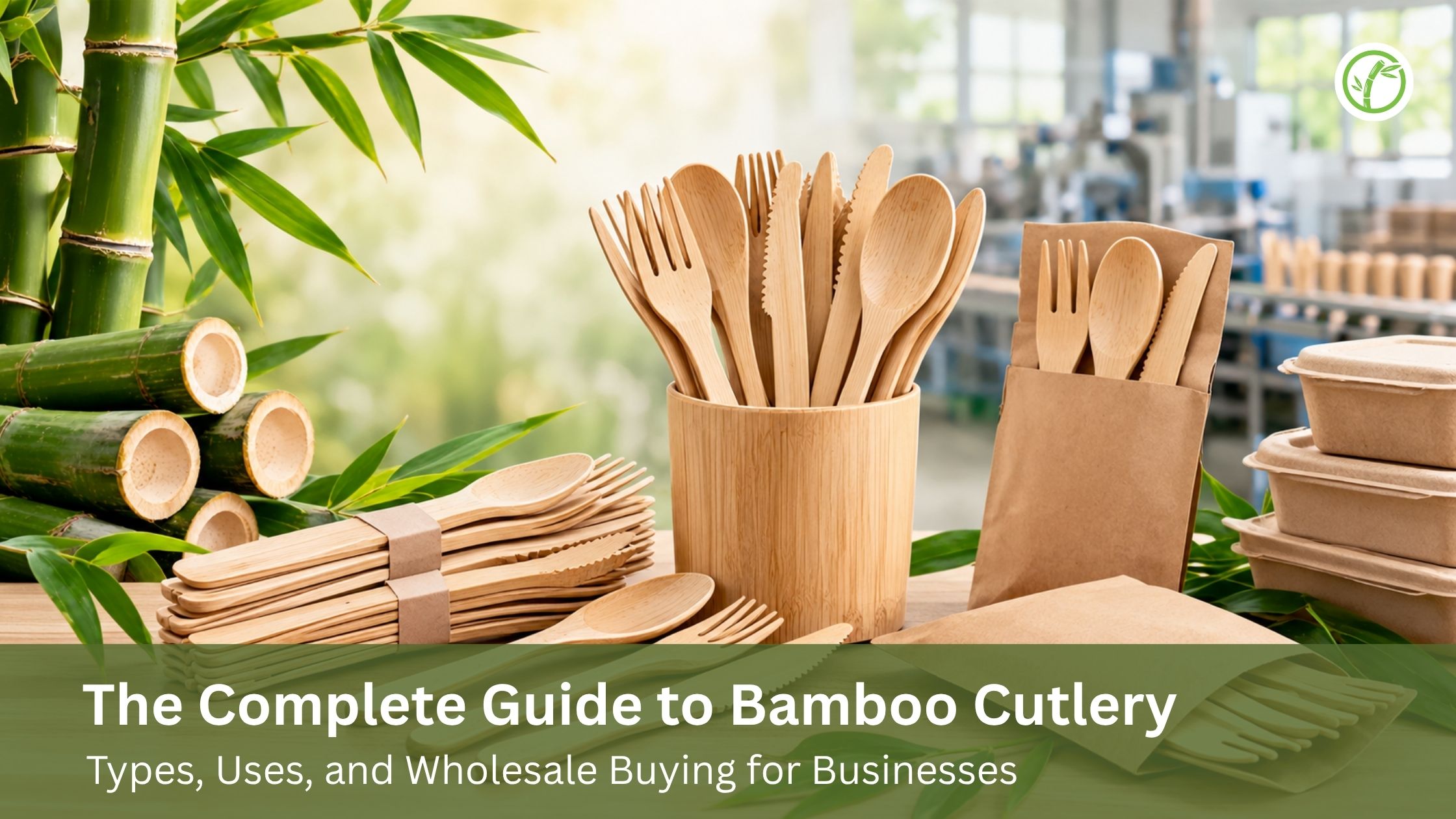
If your restaurant chain serves 10,000 takeaway meals a week, that is 10,000 plastic forks heading straight to a landfill every seven days. Multiply that across a year. The number is uncomfortable.
Now consider this: a bamboo fork does the same job, holds up against hot curry and grilled steak, and decomposes in under six months. The per-unit cost difference? Often less than a cent.
That is why procurement managers across the restaurant, hospitality, and catering industries are making the switch. Not because of guilt. Because of math, regulations, and what their customers now expect.
This guide covers everything you need to know about bamboo cutlery if you are buying in bulk for your business. The types available, how they are made, which certifications actually matter, how to evaluate a supplier, and what custom branding options exist. Whether you manage purchasing for a single restaurant or a national distribution network, this page will give you the clarity you need to make the right sourcing decision.
What Is Bamboo Cutlery and Why Are Businesses Switching?
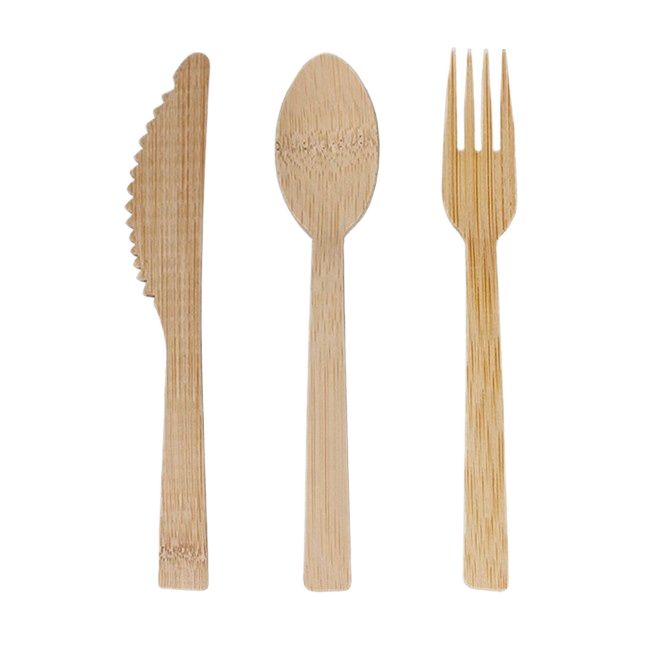
Bamboo cutlery refers to forks, spoons, knives, and combination sets made entirely from natural bamboo, specifically Moso bamboo (Phyllostachys edulis) in most cases. Unlike plastic cutlery, which is petroleum-based and takes centuries to break down, bamboo cutlery is plant-based, biodegradable, and compostable.
But the switch is not driven by environmentalism alone. Three practical forces are pushing businesses toward bamboo cutlery at scale.
Regulatory pressure is real and growing. The European Union has enforced a full ban on single-use plastic cutlery, plates, and straws since 2021. India extended its single-use plastics ban to food packaging in 2022, with enforcement tightening every year. In the United States, over 250 cities and counties have passed legislation restricting plastic food packaging. Australia, Canada, the UAE, and multiple Southeast Asian nations are following the same path. If your supply chain still relies on plastic cutlery, you are on borrowed time in most major markets.
Consumer expectations have shifted. According to multiple industry surveys, over half of consumers consider sustainable packaging important when ordering takeout. Many are willing to pay a small premium for it. When a guest picks up a sturdy bamboo fork instead of a flimsy plastic one, it signals that your brand takes quality and responsibility seriously.
The cost gap has nearly closed. Ten years ago, bamboo cutlery cost significantly more than plastic. That is no longer the case. At wholesale volumes of 50,000 units or more, the per-unit price of bamboo cutlery is competitive with mid-range plastic alternatives. Factor in the brand perception boost and potential regulatory fines you avoid, and bamboo becomes the more economical choice in most scenarios.
Types of Bamboo Cutlery Available for Wholesale
Not all bamboo cutlery is the same. When you are sourcing for a business, understanding the product range helps you match the right items to your specific use case.
Bamboo Forks
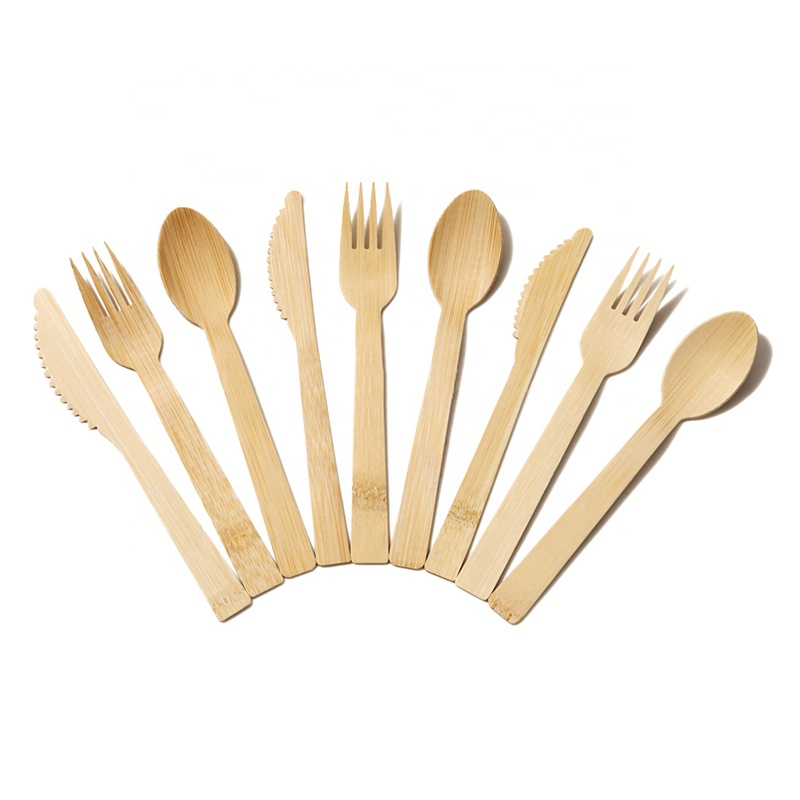
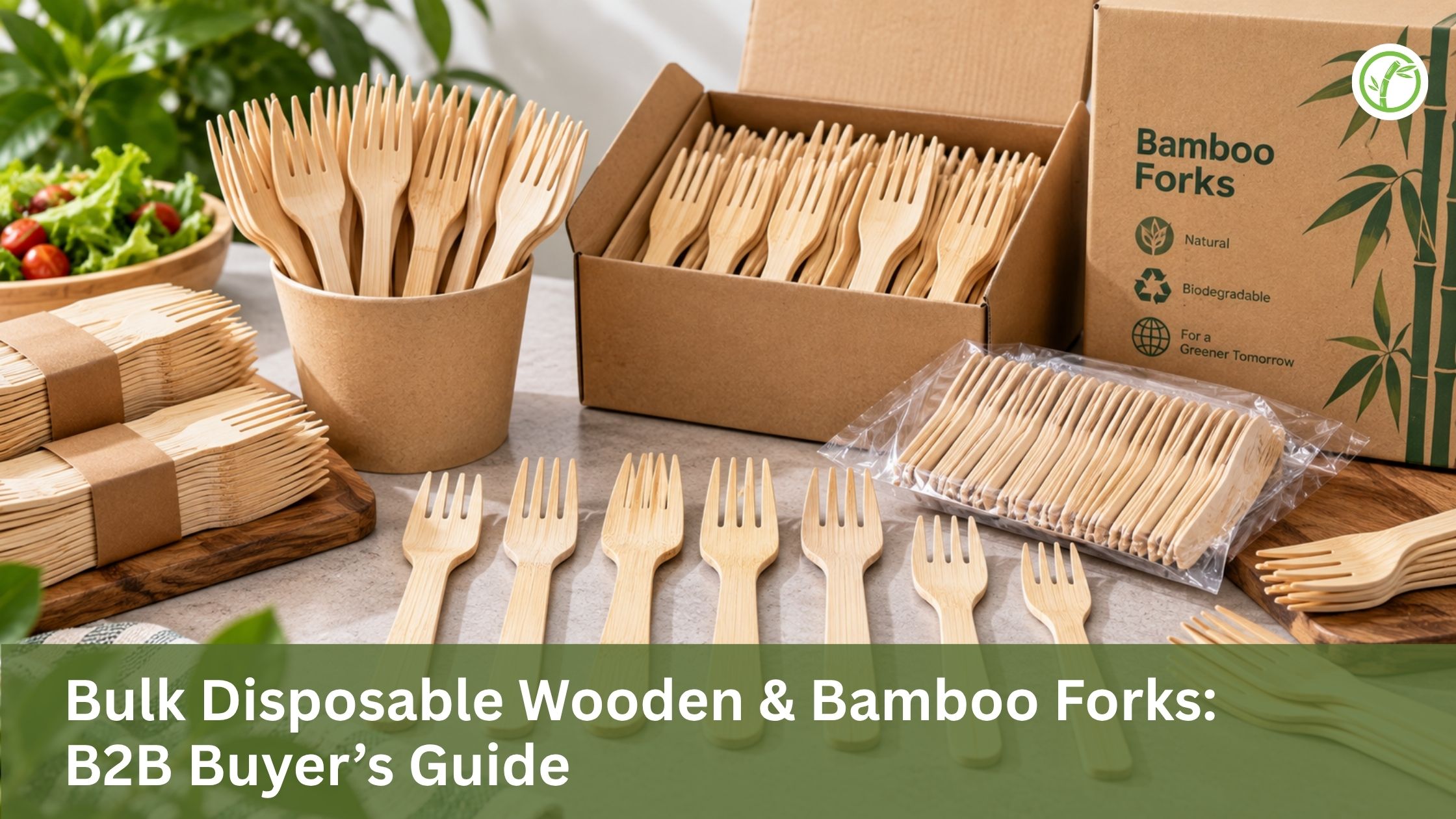
Bamboo forks are the most commonly ordered item in the category. They are available in standard sizes of 140mm (5.5 inches) for appetizers and desserts, and 170mm (6.7 inches) for main courses. A good bamboo fork should have tines that are sharp enough to pierce food without excessive force, while being thick enough to avoid snapping. The hot-press forming process used in quality manufacturing creates forks that can handle dense foods like grilled meats and thick pastas without bending or breaking.
Bamboo Spoons
Available in the same standard sizes, bamboo spoons are widely used in takeaway, ice cream service, tasting events, and catering. The bowl depth matters — a well-made bamboo spoon has a bowl deep enough to hold liquids without dripping, unlike some flat wooden alternatives. Tasting spoons in smaller sizes (100mm or 110mm) are popular for dessert stations and food sampling at events.
Bamboo Knives
Bamboo knives feature a serrated or smooth edge capable of cutting through soft to medium foods like sandwiches, grilled vegetables, cakes, and tender meats. They are not designed for cutting through bone or hard materials, but for standard food service applications, they perform reliably. The 170mm size is standard for most wholesale orders.
Bamboo Cutlery Sets
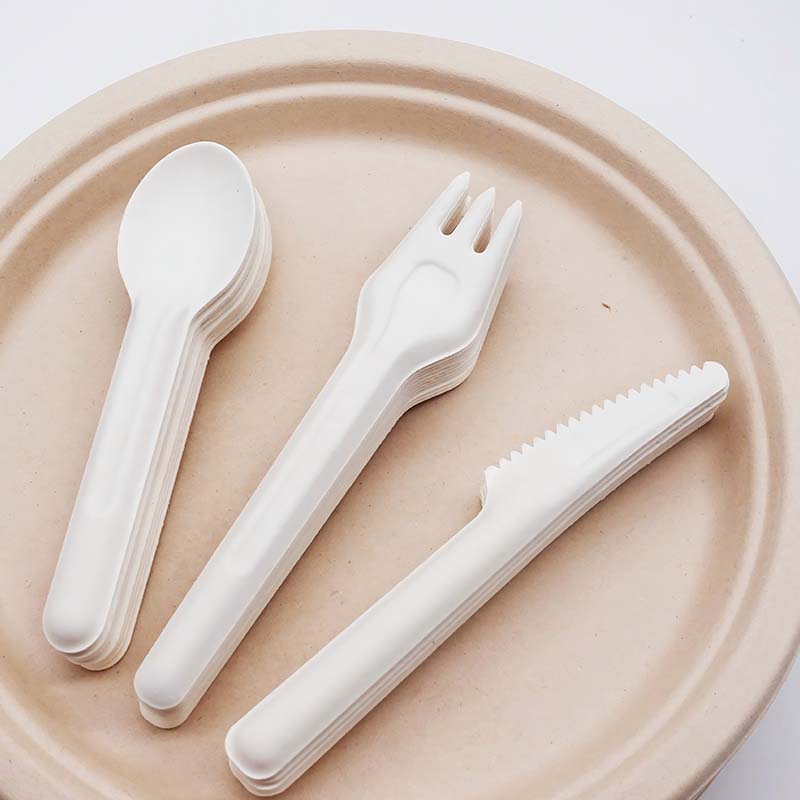
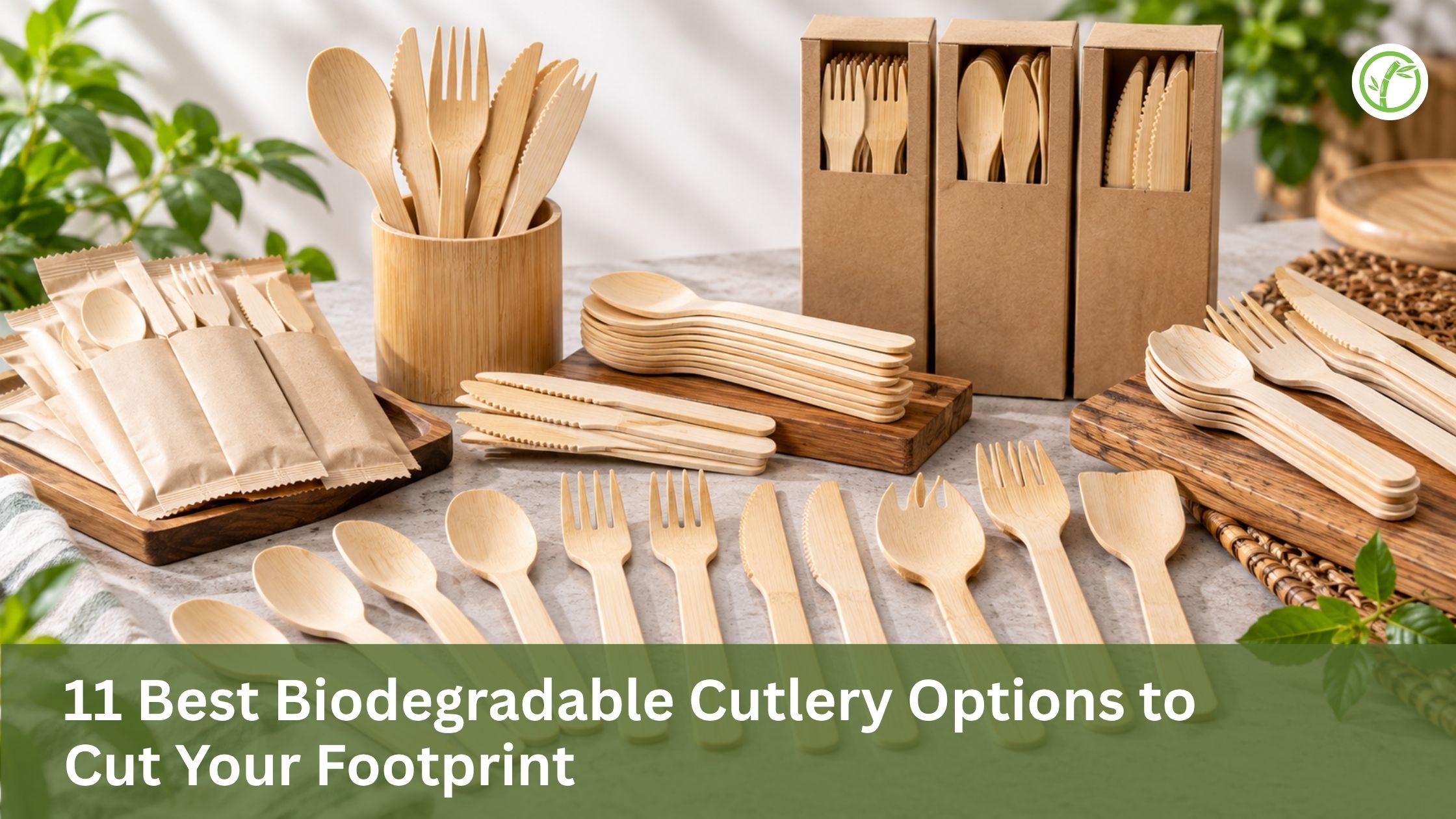
For takeaway and delivery, many businesses prefer pre-packaged cutlery kits. A typical bamboo cutlery set includes a fork, knife, and spoon, often with a napkin included. These sets come individually wrapped in paper or kraft packaging, which keeps them hygienic and convenient for customers. Sets are available in both 140mm and 170mm configurations. Custom branding on the wrapper makes these a powerful marketing touchpoint for restaurant and delivery brands.
Bamboo Sporks
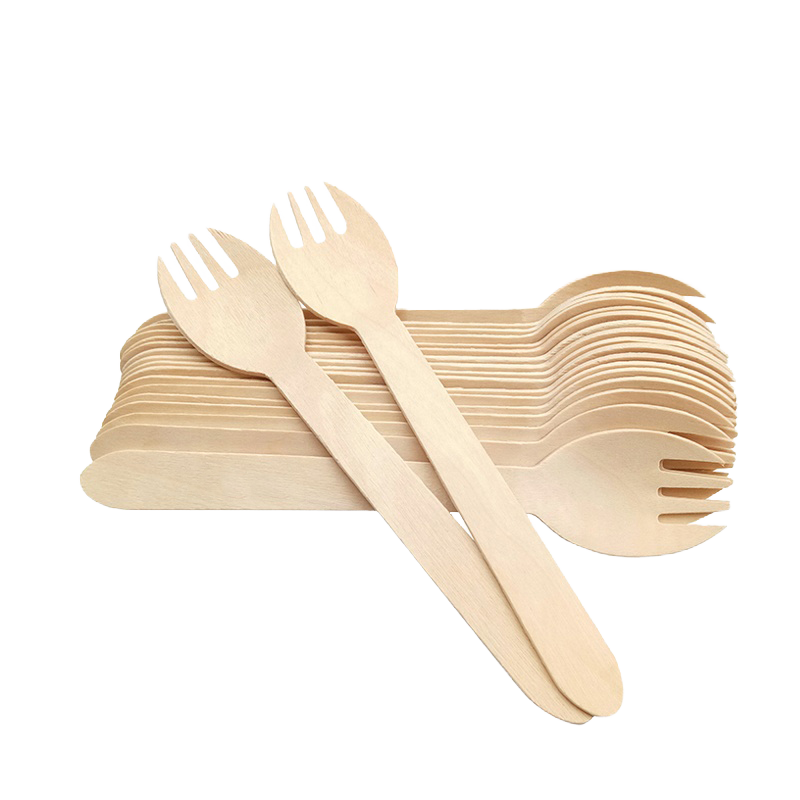
A space-saving option that combines a spoon and fork in a single utensil. Bamboo sporks are especially popular for quick-service restaurants, food trucks, and outdoor events where carrying multiple utensils is impractical.
How Bamboo Cutlery Is Made: The Manufacturing Process
Understanding how bamboo cutlery is manufactured helps you evaluate quality when selecting a supplier.
The process starts with raw Moso bamboo, typically harvested at five years of maturity. At this age, the bamboo has reached maximum density and hardness, which directly affects the strength of the finished cutlery. Young bamboo produces weak, porous products that splinter easily — one of the key quality differences between reliable and unreliable suppliers.
After harvesting, the bamboo is split into slabs and then planed into thin strips. These strips are steamed at high temperatures to remove sugars and starches that can attract insects and cause discoloration. This step also acts as a natural sterilization process.
The steamed strips are then dried under controlled conditions to bring the moisture content down to between 6 and 10 percent. Getting this right is critical. Too much moisture, and the cutlery warps or develops mould during storage and shipping. Too little, and it becomes brittle.
Next, the dried bamboo strips are cut into blanks using CNC or laser cutting machines. These blanks are hot-pressed into the specific shapes of forks, spoons, and knives. The hot-press process is what gives bamboo cutlery its smooth finish and structural strength. It is done without adhesives or chemical additives — the heat and pressure alone bond the bamboo fibers.
Finally, each piece goes through sanding and finishing to ensure a splinter-free surface. Quality control at this stage involves both automated inspection and manual checks. The stocking test is a common industry standard: if a piece of cutlery can be run across a fine nylon stocking without snagging, it passes.
The entire process is chemical-free. No bleaches, no coatings, no synthetic additives. This is what makes bamboo cutlery genuinely food-safe and compostable, and it is why certifications like FDA and FSC matter — they verify that the process has been followed correctly.
Also read – Bamboo Chopsticks Manufacturers in China
Bamboo Cutlery vs Plastic Cutlery: A Business Comparison
If you are evaluating whether to make the switch, here is how bamboo and plastic stack up across the factors that matter most to a procurement team.
Decomposition time. Bamboo cutlery composts in three to six months under the right conditions. Plastic cutlery takes 400 to 1,000 years to decompose in a landfill, and even then, it breaks into microplastics rather than returning to the soil.
Strength and usability. Quality bamboo cutlery is remarkably sturdy. Moso bamboo has a density comparable to many hardwoods. A well-made bamboo fork can pierce grilled chicken and steak without bending. Cheap plastic forks often snap under the same pressure. For spoons, bamboo performs better with hot foods because it does not warp or release chemicals when exposed to heat, unlike some plastic alternatives.
Food safety. Bamboo is naturally non-toxic and does not leach chemicals into food. Some plastic cutlery, particularly those made from polystyrene, can release harmful compounds when in contact with hot or acidic foods. Bamboo cutlery manufactured under FDA and LFGB standards is verified safe for direct food contact.
Brand perception. This is where the gap is widest. Plastic cutlery tells your customer you chose the cheapest option. Bamboo cutlery tells them you care about quality, the environment, and their dining experience. For hospitality brands, event companies, and restaurants with a takeaway focus, this perception shift directly affects customer loyalty and willingness to pay.
Cost at scale. At wholesale volumes above 50,000 units, bamboo cutlery typically costs between $0.02 and $0.05 per unit, depending on size, type, and customization. This is slightly higher than the cheapest plastic cutlery, but the difference is minimal. When you account for the brand value boost and regulatory compliance, the total cost of ownership favors bamboo.
Certifications. Bamboo cutlery from reputable suppliers comes with FSC (sustainable sourcing), FDA (food safety), ISO 9001 (quality management), and often additional certifications like LFGB (European food contact) and BPI (compostability). Plastic cutlery rarely carries meaningful sustainability certifications.
Bamboo Cutlery vs Wooden Cutlery: Which Is Better for Bulk?
This is one of the most common questions from businesses evaluating eco-friendly alternatives. Both bamboo and wood (typically birch) cutlery are biodegradable and compostable, but they have distinct differences that affect your buying decision.
Bamboo is denser and more flexible than birchwood, which means bamboo cutlery is less likely to snap under pressure. If you serve foods that require some force to eat — grilled meats, dense salads, thick pastas — bamboo holds up better.
Birchwood cutlery is generally cheaper per unit, which makes it attractive for very high-volume applications where cost is the primary concern, like fast-food chains and cafeteria settings. However, wooden cutlery can sometimes leave a slight woody taste, which some diners notice. Bamboo is taste-neutral when properly processed.
From an aesthetic standpoint, bamboo has a smoother, more refined finish that works well in premium settings — upscale catering, boutique hotels, high-end restaurants. Wooden cutlery has a more rustic appearance that suits casual dining and outdoor events.
Both materials are compostable, but bamboo decomposes slightly faster due to its fibrous structure.
The bottom line: if your priority is strength and premium appearance, bamboo is the better choice. If absolute lowest cost is the goal and your application is casual food service, wood is a viable alternative. Many businesses stock both and use them for different settings.
Certifications That Matter When Buying Bamboo Cutlery
Not all certifications are equal, and not all claims on a supplier’s website are independently verified. Here are the certifications that actually matter for bamboo cutlery and what each one tells you.
FSC (Forest Stewardship Council) verifies that the bamboo was sourced from responsibly managed forests. This is the gold standard for sustainable sourcing and is increasingly required by large retailers and hotel chains for their ESG reporting.
FDA (U.S. Food and Drug Administration) compliance means the cutlery has been tested and approved for direct food contact under 21 CFR Part 177. This is non-negotiable if you are selling into the U.S. market.
LFGB is the European equivalent of FDA compliance, specifically for the German market but widely recognized across the EU. It covers food contact safety including migration testing.
ISO 9001 certifies that the manufacturer has a quality management system in place. While it does not test the product itself, it tells you the factory follows consistent processes — which reduces the risk of batch-to-batch quality variation.
ISO 14001 certifies environmental management practices at the factory level. Combined with FSC, this gives you confidence that the entire supply chain is managed responsibly.
BPI (Biodegradable Products Institute) certification verifies that the product will compost in a commercial composting facility within the required timeframe. This is especially important if your customers or local regulations require compostable claims.
When evaluating a supplier, ask for copies of these certificates and verify them independently. A trustworthy manufacturer will provide documentation without hesitation.
Custom Branding Options for Bamboo Cutlery
One of the most compelling advantages of bamboo cutlery for businesses is the ability to turn every utensil into a brand touchpoint. Here are the customization options available at wholesale volumes.
Laser engraving burns your logo directly onto the bamboo surface. The result is a subtle, permanent mark that looks premium and does not affect food safety. Laser engraving works best on flat surfaces — knife handles, spoon handles, and fork handles are all suitable. This option is popular with hotels, premium catering companies, and corporate event organizers.
Printed logos use food-safe ink to apply your brand identity to the wrapper or sleeve of a cutlery set. This is the most cost-effective branding option and works well for high-volume takeaway operations where the wrapper is the first thing a customer sees.
Custom packaging goes beyond the individual wrapper. You can design branded boxes, sleeves, and retail-ready packaging that aligns with your brand guidelines. This is particularly valuable for distributors and retailers who sell eco-friendly cutlery under their own brand.
Private label is the most comprehensive option. Your brand name, logo, and packaging replace all supplier branding. The product appears entirely as your own. This is ideal for wholesale distributors, eco-product retailers, and Amazon sellers who want to build an independent brand around sustainable disposables.
Minimum order quantities for custom branding vary by supplier, but at FriendlyBamboo, we offer branding options at accessible MOQs designed for growing businesses, not just enterprise buyers.
How to Choose the Right Bamboo Cutlery Supplier
The wrong supplier costs you more than money. It costs you delayed shipments, inconsistent quality, customer complaints, and potentially regulatory issues. Here is a practical checklist for evaluating bamboo cutlery suppliers.
Ask for physical samples before committing to volume. Photos do not reveal splinter quality, finish consistency, or actual thickness. Run the stocking test on fork tines and spoon edges. Check that the bamboo colour is consistent across samples. Look for any signs of mould or discolouration, which indicate poor moisture control during manufacturing.
Verify certifications independently. Do not accept a supplier’s claim at face value. FSC certificates include a license number that can be verified on the FSC database. FDA compliance should be backed by lab test reports from accredited facilities. If a supplier hesitates to share documentation, that is a red flag.
Evaluate their production capacity and lead times. Ask how many units they produce per month. Ask what happens if your order needs to scale up by 50 percent. A supplier with limited capacity may not be able to grow with your business, leading to supply disruptions at the worst possible time.
Check their export experience. If you are importing, your supplier needs to understand HS codes, phytosanitary requirements, customs documentation, and container loading. A domestically focused manufacturer with no export experience can create expensive delays at the port.
Understand their quality control process. What percentage of each batch is inspected? Is inspection automated, manual, or both? What is their defect tolerance? What happens if a batch fails QC? The answers to these questions tell you more about a supplier than their marketing materials ever will.
Look for consistent communication. How quickly do they respond to enquiries? Do they proactively update you on order status? In a B2B relationship that may span years and hundreds of thousands of units, communication quality matters enormously.
Industries That Use Bamboo Cutlery in Bulk
Bamboo cutlery is not a niche product anymore. It is standard issue across multiple industries.
Restaurants and QSR chains are the largest buyers. From single-location cafes to national fast-casual chains, bamboo cutlery is the go-to replacement for plastic takeaway utensils. The combination of strength, food safety, and brand perception makes it ideal for any restaurant with a delivery or takeout component.
Hotels and resorts use bamboo cutlery for in-room dining, poolside service, breakfast buffets, and banquet events. The premium aesthetic of bamboo fits the hospitality environment better than plastic ever could. Many hotel procurement teams now require FSC-certified products to meet their sustainability reporting standards.
Event and catering companies order bamboo cutlery for everything from corporate conferences to wedding receptions. The ability to brand the cutlery with event-specific logos adds a personalised touch that disposable plastic cannot match. Bulk event orders often range from 5,000 to 100,000 pieces depending on the scale.
Wholesale distributors and retailers buy bamboo cutlery to resell under their own brand or as part of a broader eco-product line. Private labelling and white-label options make it possible to build a profitable distribution business around sustainable disposables without manufacturing a single piece.
Airlines and railway catering services are increasingly switching to bamboo as part of broader sustainability programs. The lightweight nature of bamboo cutlery makes it especially suitable for in-flight service where every gram of weight matters.
Cloud kitchens and food delivery brands are among the fastest-growing segments. These businesses have no dine-in presence — their packaging and cutlery are the entire physical brand experience. Bamboo cutlery with branded wrapping turns a delivery order into a marketing moment.
What Affects the Price of Wholesale Bamboo Cutlery?
Pricing in the bamboo cutlery market is not one-size-fits-all. Several factors influence what you will pay per unit, and understanding them gives you negotiating power and helps you budget accurately.
Order volume is the biggest lever. Most suppliers operate on tiered pricing, where the cost per unit drops as quantity increases. A 10,000-unit order will cost meaningfully more per piece than a 100,000-unit order. If your consumption is predictable, negotiating annual volume commitments can unlock better rates even if individual shipments are smaller.
Cutlery type and size affect pricing. Knives are typically the most expensive per unit because the serration process adds a manufacturing step. Spoons fall in the middle. Forks are usually the least expensive. Larger sizes (170mm) cost more than smaller ones (140mm) because they use more raw material. Cutlery sets — fork, knife, spoon, and napkin packaged together — carry a premium because of the assembly and packaging labour involved.
Customization and branding add cost but also add value. Laser engraving is more expensive than printed wrappers, but it creates a premium look. Custom packaging design involves a one-time setup fee. Private label programs that include branded cartons and retail-ready packaging are the most expensive customization option, but they also generate the highest margins for distributors and retailers.
Raw material quality plays a role. Cutlery made from mature Moso bamboo (five years or older) costs more to produce but delivers a superior product — stronger, smoother, longer shelf life. Cheaper suppliers sometimes use younger bamboo to cut costs, which results in weaker products that splinter and discolour.
Shipping and logistics should not be overlooked. Bamboo cutlery is lightweight relative to its volume, which affects container utilisation. Your supplier should be able to optimise carton sizes and container loading to maximise the number of units per shipment and minimise your per-unit shipping cost. CIF (Cost, Insurance, and Freight) versus FOB (Free on Board) pricing terms will also affect your landed cost.
As a general benchmark, standard bamboo cutlery at wholesale volumes of 50,000+ units typically falls in the range of $0.02 to $0.05 per unit for unbranded items, and $0.04 to $0.08 for branded sets with custom packaging. These figures vary by market, order size, and customization level — always request a tailored quote for accurate pricing.
Also read – eco friendly food packaging for small business
The Environmental Impact: Real Numbers
Businesses making the switch to bamboo cutlery often need concrete data for internal proposals, ESG reporting, and customer-facing communications. Here are the numbers that matter.
Bamboo is the fastest-growing plant on earth. Some species grow up to 91 centimetres (36 inches) in a single day. Moso bamboo, the species used for cutlery, reaches harvest maturity in three to five years. Compare that to hardwood trees used for wooden cutlery, which take 20 to 50 years to mature. This growth rate means bamboo forests regenerate quickly after harvesting, making bamboo one of the most renewable raw materials available for manufacturing.
A single bamboo plant absorbs approximately 12 tonnes of carbon dioxide per hectare per year — significantly more than most tree species. Bamboo also releases 35 percent more oxygen than an equivalent stand of trees. This means the raw material for your cutlery is actively fighting climate change while it grows.
When it comes to end-of-life impact, the difference is stark. A single plastic fork that weighs 3 grams will persist in the environment for 400 to 1,000 years. A bamboo fork of the same size weighs about 4 grams and decomposes in 90 to 180 days under composting conditions. Over the life of a restaurant that serves 500 takeaway orders per day, switching from plastic to bamboo cutlery diverts approximately 547 kilograms of non-biodegradable plastic waste from landfills every year. That is over half a tonne of plastic waste eliminated annually from a single location.
For multi-location businesses, the numbers scale dramatically. A 50-location restaurant chain making the switch eliminates roughly 27 tonnes of plastic waste per year. That is the kind of number that belongs in an annual sustainability report — and the kind of number that resonates with customers, investors, and regulators alike.
Bamboo cutlery production also requires significantly less energy than plastic manufacturing. Producing one tonne of plastic cutlery requires roughly 7,500 kilowatt-hours of energy and relies on petroleum extraction. Producing one tonne of bamboo cutlery requires a fraction of that energy because the primary processes — cutting, steaming, pressing — are mechanical rather than petrochemical.
How long does bamboo cutlery last?
Reusable Bamboo Cutlery: Lasts 2 to 5 years (or several hundred uses) with proper care. To maximize longevity, hand-wash with mild soap and dry immediately. Never submerge in water for long periods or put them in a dishwasher, as heat and moisture warp and crack the wood.
Single-Use/Disposable Bamboo Cutlery: Intended for 1 to 2 uses. While sturdy enough to survive a quick re-wash, they are thin, untreated, and degrade rapidly after exposure to hot liquids or food.
For Further Readings:
eco friendly products for restaurant
eco friendly food packaging for small business
eco friendly products for hotels
eco friendly products for hospitals
eco friendly products for catering services
Storage, Shelf Life, and Handling Best Practices
Once your bamboo cutlery arrives, proper storage ensures it stays in perfect condition until it reaches your customers.
Bamboo cutlery should be stored in a cool, dry environment with relative humidity below 65 percent. Excessive moisture is the primary enemy — it can cause warping, mould growth, and discolouration. If your warehouse or storage area is in a humid climate, consider climate-controlled storage or ensure good ventilation.
Properly manufactured bamboo cutlery with moisture content controlled to 6 to 10 percent has a shelf life of 12 to 18 months when stored correctly. Individually wrapped sets last longer because the packaging provides an additional moisture barrier.
When handling inventory, follow first-in, first-out (FIFO) rotation. While bamboo cutlery does not expire in the traditional sense, older stock may show slight colour changes if stored for extended periods, which does not affect safety or usability but may affect visual consistency.
For food trucks, outdoor events, and pop-up operations, keep bamboo cutlery in sealed containers until needed. Exposure to rain or direct sunlight during an event can compromise quality if the cutlery is left unprotected for extended periods.
Can you take bamboo cutlery on a plane
Yes, you can bring bamboo cutlery on a plane, but security guidelines depend on how you pack them and the specific utensil: Carry-On Baggage: Spoons and Forks: Fully permitted through airport security checkpoint screening (TSA and international equivalents). Bamboo Knives: Generally allowed only if the blade is completely dull, rounded, or smooth (like a butter knife) without sharp serrations. Standard serrated or pointed wooden/bamboo butter-style knives pass routinely, but the final decision always rests with the individual security officer.
Why Businesses Partner With FriendlyBamboo
For over 12 years, FriendlyBamboo has supplied bamboo, bagasse, and wooden eco-products to businesses across the globe. Here is what sets us apart for bamboo cutlery sourcing.
We carry FSC, FDA, and ISO certifications — your compliance requirements are covered from day one. Every batch is quality-controlled with standardised processes to ensure consistency whether you order 10,000 or 500,000 pieces.
Our custom branding services include laser engraving, printed wrappers, bespoke packaging, and full private-label programs. Your bamboo cutlery becomes your brand, not ours.
We supply globally with logistics infrastructure designed for B2B scale. Whether you are in the United States, Europe, the Middle East, Asia, or Australia, we deliver on time and manage the export documentation for you.
And because we supply all three eco-material categories — bamboo, bagasse, and wooden products — you can consolidate your entire sustainable disposables supply chain with a single partner. One supplier. One relationship. One invoice. Simpler procurement, fewer headaches.
Ready to make the switch? Request your bulk quote today at friendlybamboo.com/bulk-order or contact our sales team directly. We will prepare a tailored proposal with pricing, MOQ details, delivery timelines, and custom branding options specific to your business needs.
Frequently Asked Questions About Bamboo Cutlery
Is bamboo cutlery safe for hot food? Yes. Bamboo is naturally heat-resistant and can handle temperatures from -18°C to over 200°C. Unlike some plastics, it does not warp, melt, or release chemicals when exposed to hot food. It is safe for soups, curries, grilled dishes, and other hot items.
How long does bamboo cutlery take to decompose? Under composting conditions, bamboo cutlery decomposes in three to six months. In a commercial composting facility, it can break down in as little as 90 days. Even in a landfill, it decomposes significantly faster than plastic, which takes hundreds of years.
Can bamboo cutlery be reused? Disposable bamboo cutlery is designed for single use. However, because it is chemical-free and sturdy, many people rinse and reuse it a few times before composting. Reusable bamboo cutlery sets, designed for multiple uses with proper care, are a separate product category.
What is the minimum order quantity for wholesale bamboo cutlery? MOQs vary by supplier and customization level. At FriendlyBamboo, we offer flexible MOQs designed for both growing businesses and large-scale operations. Custom branding orders typically start at higher volumes than standard bulk orders.
Does bamboo cutlery leave a taste? Properly processed bamboo cutlery is taste-neutral. If there is a noticeable woody or off taste, it usually indicates poor manufacturing — either insufficient steaming, inadequate drying, or the use of young bamboo that has not reached full maturity.
Is bamboo cutlery FDA approved? Bamboo cutlery from certified manufacturers undergoes FDA-compliant testing to ensure it meets food contact safety standards under 21 CFR Part 177. Always ask your supplier for the specific test reports to confirm compliance.
What sizes are available? Standard sizes are 140mm (5.5 inches) for appetizers, desserts, and tasting, and 170mm (6.7 inches) for full-size main course use. Tasting spoons are available in 100mm and 110mm sizes. Custom sizes can be produced at higher MOQs.