Wholesale Bagasse Straw Products – Bulk Supply & OEM Factory
From packaging and tableware to private label products, our catalog is designed to meet the needs of restaurants, hotels, event organizers, and distributors worldwide.
Showing(All)
All Bagasse Straw
Showing all 4 results
-
 ECO
ECOBagasse Straw – Natural Biodegradable Bagasse Straw...
MOQ:10 CartonsMATERIAL:Bagasse -
ECO
Bagasse Straw – Wholesale Natural Bagasse Straws 210 mm...
MOQ:10 CartonsMATERIAL:Bagasse -
ECO
Bulk Natural Bagasse Straw 230 mm – 6/8/12 mm...
MOQ:10 CartonsMATERIAL:Bagasse -
ECO
Individually Wrapped Natural Bagasse Straw – Eco Friendly Straw...
MOQ:10 CartonsMATERIAL:Bagasse
Your Wholesale Bagasse Straw Supplier
The plastic straw is dead. Paper straws replaced it — and then customers hated the paper straw. It goes soggy in 10 minutes. It collapses in smoothies. It leaves a papery taste in every drink. It disintegrates before the customer finishes a large iced coffee. The paper straw solved a regulatory problem but created a customer experience problem.
Bagasse straws solve both.
Made from waste sugarcane — the same fibrous agricultural byproduct used for bagasse plates, bowls, and containers — bagasse straws offer something no other eco straw does: the structural durability of plastic with the compostability of paper. They do not go soggy. They do not collapse under suction. They do not leave a taste. They hold firm in hot coffee, iced tea, smoothies, and cocktails for as long as the customer needs. And when the drink is done, the straw composts in 60 to 90 days.
FriendlyBamboo supplies bagasse straws in bulk to cafes, QSR chains, juice bars, hotels, airlines, and wholesale distributors across 30+ countries for over 12 years. Multiple diameters, two lengths, individually wrapped and bulk — eco-friendly disposable straws made from waste sugarcane with FSC, FDA, ISO, and BPI certification.
Available Products
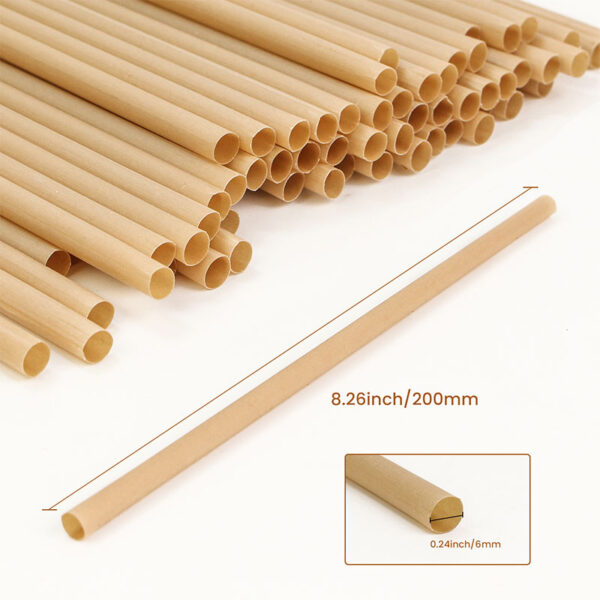
Natural Biodegradable Bagasse Straw (200mm) — Standard-length straw at 200mm (8.26 inches) in natural sugarcane colour. The all-purpose straw for standard drink sizes — iced coffee, cold juice, soft drinks, water, iced tea, and cocktails. Available in 6mm diameter for standard beverages and 8mm for slightly thicker drinks. The natural tan colour signals eco-friendly authenticity to every customer who picks one up. Smooth exterior, clean interior bore, consistent diameter.
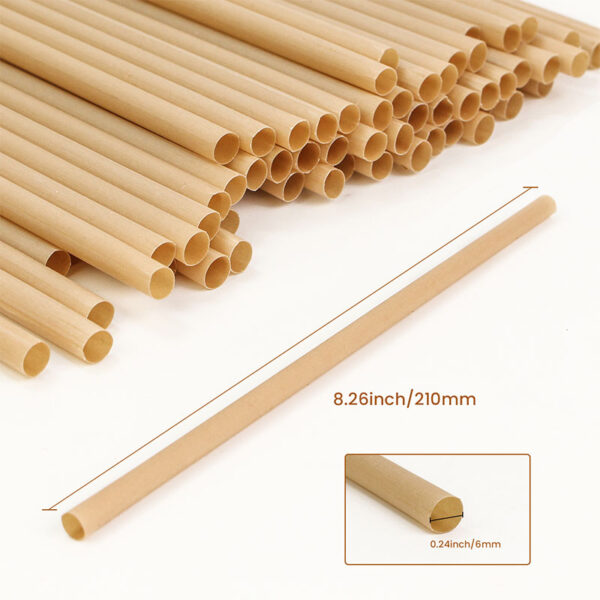
Natural Bagasse Straw (210mm) — Slightly longer at 210mm (8.26 inches) for taller cups and larger beverages. Available in 6mm and 8mm diameters. The extra 10mm provides additional height above the cup rim for comfortable drinking with lids. Popular with QSR chains and takeaway cafes that use taller 16oz and 20oz cups where the standard 200mm straw sits too low.
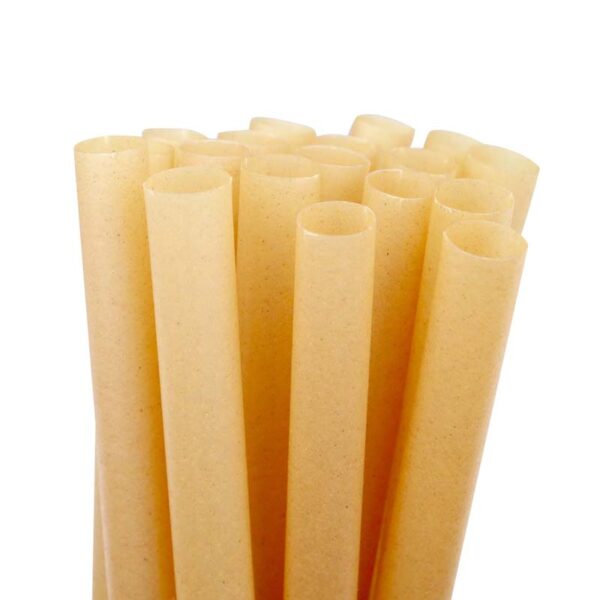
Bulk Natural Bagasse Straw (230mm) — The longest straw in the range at 230mm (9 inches). Available in 6mm, 8mm, and 12mm diameters. The 230mm length fits the largest cup sizes — 20oz, 24oz, and even 32oz cups used by smoothie bars, bubble tea shops, and American-style QSR. The 12mm wide diameter option is specifically designed for thick drinks — bubble tea with tapioca pearls, thick smoothies, milkshakes, and acai blends where a narrow straw would block or require excessive suction.
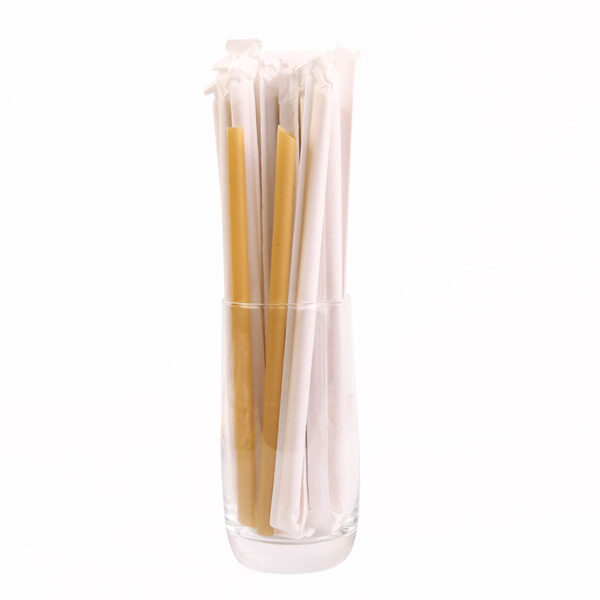
Individually Wrapped Natural Bagasse Straw — Any of the above straws sealed in a paper sleeve for hygiene. Each straw is wrapped individually so the customer receives a sealed, untouched straw. Required for hotels, airlines, room service, hospitals, and any setting where individually packaged amenities are the operational standard. The wrapper keeps the straw clean during storage and handling. Available in plain wrapper or custom-printed wrapper with your brand.
Sizes & Specifications
| Diameter | Length Options | Best For |
|---|---|---|
| 6mm (standard) | 200mm, 210mm, 230mm | Water, juice, soft drinks, iced coffee, iced tea, cocktails |
| 8mm (medium) | 200mm, 210mm, 230mm | Thicker juices, smoothies, frappes, frozen drinks |
| 12mm (wide) | 230mm | Bubble tea (boba), thick smoothies, milkshakes, acai bowls |
| Length | Fits Cup Size | Best For |
|---|---|---|
| 200mm (8″) | 8-12oz standard cups | Standard café drinks, cocktails, small iced drinks |
| 210mm (8.3″) | 12-16oz cups | Takeaway coffee, medium iced drinks, tall cocktails |
| 230mm (9″) | 16-32oz large cups | Large smoothies, bubble tea, QSR large drinks, milkshakes |
Which combination do you need? For standard café and bar service — 6mm x 200mm. For takeaway with taller cups — 6mm or 8mm x 210mm. For smoothies and thick drinks — 8mm x 230mm. For bubble tea with tapioca pearls — 12mm x 230mm (the only diameter that allows boba pearls to pass through). Most operations stock 2 combinations: a standard (6mm x 200mm) and a wide (8mm or 12mm x 230mm).
Wholesale Pricing
| Product | Volume | Price Per Straw |
|---|---|---|
| 6mm x 200mm (bulk) | 50,000+ pcs | $0.01 – $0.02 |
| 6mm x 210mm (bulk) | 50,000+ pcs | $0.01 – $0.02 |
| 8mm x 200-230mm (bulk) | 50,000+ pcs | $0.012 – $0.025 |
| 12mm x 230mm (bulk) | 50,000+ pcs | $0.015 – $0.03 |
| Individually wrapped (any size) | 50,000+ pcs | $0.02 – $0.04 |
| Custom branded wrapper | 50,000+ pcs | $0.025 – $0.05 |
Bagasse straws cost roughly the same as paper straws at wholesale — often within half a cent per straw. But they last hours in liquid instead of minutes. The small additional cost over paper (if any) is offset by zero customer complaints, zero straw replacements mid-drink, and zero negative reviews mentioning soggy straws.
Compare the real cost: a paper straw that goes soggy means the customer asks for a second one. Two paper straws per drink = double the cost. One bagasse straw lasts the entire drink. Your per-drink straw cost is actually lower with bagasse when you factor in replacements.
How Bagasse Straws Wholesale Are Made
Bagasse straws are made differently from every other product in the bagasse range. Plates, trays, and cutlery are compression-moulded from wet pulp under heat and pressure — a process suited to rigid, shallow shapes. A straw is a thin, hollow tube, which needs an entirely different manufacturing approach: paper-forming, not moulding.
Step 1 — Fibre extraction. Sugarcane stalks are crushed at the sugar mill to extract juice. The leftover fibrous pulp — bagasse — is the raw material, a by-product of sugar production rather than a dedicated crop.
Step 2 — Pulping into bagasse paper. Bagasse fibre is cleaned and pulped into a slurry, then formed into continuous sheets of bagasse-based paper — the same fundamental papermaking process used for wood-pulp paper, but using cane fibre as the base material instead of timber.
Step 3 — Drying and reeling. Bagasse paper sheets are dried and wound into large rolls, calibrated to a thickness and strength suited to straw production — thick enough to hold structural rigidity in liquid, thin enough to spiral-wind cleanly.
Step 4 — Spiral winding. Strips of bagasse paper are spiral-wound around a mandrel (a thin rod that sets the straw’s internal diameter) in overlapping layers, then bonded with food-safe adhesive along the seam. This layered winding is what gives a bagasse straw its rigidity — a single flat sheet couldn’t hold its shape in liquid on its own.
Step 5 — Cutting to length. The continuous wound tube is cut to standard straw lengths — cocktail, standard, or jumbo/boba diameter, depending on the product line.
Step 6 — Drying, sterilising, and packing. Cut straws are fully dried, sterilised, and packed — bulk bags, dispensing boxes, or individually wrapped, depending on the order.
Because straw manufacturing runs on paper-forming and winding equipment rather than the compression moulds used for bagasse plates or bagasse cutlery, sourcing bagasse straws wholesale from a manufacturer with dedicated straw-winding capacity — not a plate factory adding straws as an afterthought — is the clearest signal of a supplier that actually understands this specific product.
Why Bagasse Straws Beat Paper Straws
This is the question every café owner, bar manager, and procurement head needs answered. Here is the comparison that matters.
| Factor | Bagasse Straw | Paper Straw |
|---|---|---|
| Time in liquid before softening | 2+ hours — no softening | 10-20 minutes — starts going soggy |
| Thick drinks (smoothies, boba) | Handles easily at 8-12mm | Collapses under suction |
| Taste transfer | None — completely neutral | Papery taste, especially in cold drinks |
| Customer complaints | Near zero | The #1 eco-product complaint in food service |
| Straw replacement mid-drink | Never needed | Frequently needed — doubles cost |
| Material | Waste sugarcane fibre | Tree-sourced paper, often with adhesive |
| Compostable | Yes — 60-90 days | Yes — if no plastic lining (some have one) |
| PFAS risk | None | Some paper straws contain PFAS in adhesive |
| Cost per straw (bulk) | $0.01-$0.03 | $0.01-$0.03 |
| Effective cost per drink | Lower — one straw per drink | Higher — often 2 straws per drink |
Paper straws and bagasse straws cost nearly the same at wholesale. But the effective cost per drink is lower with bagasse because you never replace a soggy straw mid-service. And the customer experience is incomparably better. No sogginess. No papery taste. No collapsing. No complaints.
If you have already switched from plastic to paper and your customers or staff complain about soggy straws, bagasse is the upgrade that fixes the problem without going back to plastic.
Quality Standards
A straw fails in one of two ways: it goes soft and collapses before the drink is finished, or the seam delaminates and leaks. Quality control is built entirely around preventing those two failure modes.
Paper density and fibre consistency. Incoming bagasse paper is checked for consistent thickness and fibre bonding before winding — inconsistent paper produces straws that soften unevenly in liquid.
Seam bond testing. Because a straw’s structural integrity depends entirely on the adhesive bond along its spiral seam, bond strength is tested on sample pieces from every production run — seam failure is the single most common defect in low-quality bagasse and paper straws.
Wet-strength testing. Finished straws are tested by full liquid immersion for a defined duration (well beyond typical drink-finishing time) to confirm they hold rigidity without collapsing or delaminating.
Diameter and length consistency. Internal diameter is checked against tolerance — too narrow and the straw restricts flow or clogs with boba or ice; too wide and it doesn’t fit standard cup lids.
Surface and edge finish. Cut ends are checked for smoothness, since a rough-cut straw edge is a direct mouth-contact issue.
Certification backs each checkpoint:
| Certification | What It Verifies |
|---|---|
| FDA (21 CFR 177) | Safe for direct food and beverage contact, including seam adhesive |
| ISO 9001 | Manufacturing consistency across production runs |
| ISO 14001 | Environmental management in production |
| PFAS-Free | No fluorinated coatings or chemical treatments |
Full certificate copies are available for procurement qualification and customs documentation on every wholesale order — worth requesting specifically for straws, given how much real-world performance depends on seam quality that isn’t visible in a static product sample.
How Bagasse Straws Are Made
Bagasse straws are manufactured differently from bamboo straws. While bamboo straws are cut from natural bamboo culms (each one unique), bagasse straws are extruded from waste sugarcane pulp — similar to how pasta is made.
The waste sugarcane fibre is cleaned, pulped with water, and fed into an extrusion machine that pushes the pulp through a circular die to form the straw shape. The extruded straw is dried, cut to length, and finished. The result is a uniform straw with consistent diameter, wall thickness, and length across every piece in every batch.
This extrusion process gives bagasse straws an advantage over bamboo straws in one specific area: consistency. Every bagasse straw is the same diameter. Every one fits the same lid hole. Every one delivers the same drinking experience. For high-volume operations where consistency matters — QSR chains, airline catering, vending — bagasse straws offer industrial-grade uniformity that natural bamboo cannot.
Sustainability
Bagasse straws carry the same core sustainability advantage as the rest of the bagasse range — a raw material that’s waste before it’s a product — applied to one of the most heavily regulated single-use plastic items in the world.
A genuine by-product, not a dedicated crop. Sugarcane is grown for sugar; bagasse is what’s left after juice extraction. Millions of tonnes are produced globally regardless of demand for straws, so using it adds no new land or water demand.
Displaces one of the most-banned plastic items globally. Plastic straws are among the earliest and most widely targeted single-use plastic items in legislation worldwide — replacing them specifically closes one of the most visible gaps in a foodservice operation’s plastic footprint.
No added coating or PFAS. Bagasse straws in our range use only food-safe paper adhesive at the seam — no plastic lining, no PFAS-based water-resistance treatment.
Compostable, unlike PLA “bioplastic” straws. Bagasse straws compost in 60 to 90 days in commercial facilities and break down in soil over a similar timeframe, without the industrial-composting-only limitation that affects PLA straws often marketed as an equivalent alternative.
Scales without seasonal supply limits. Bagasse supply tracks the global sugar industry’s harvest — large and geographically distributed, supporting consistent year-round manufacturing at high volume.
For operations tracking Scope 3 emissions or sustainable procurement commitments, replacing plastic straws with bagasse straws wholesale is a high-visibility, high-impact material swap, and the by-product sourcing story supports that claim directly in ESG reporting.
Performance Features
Structural Integrity in Liquid — The defining feature. Bagasse straws maintain full rigidity for 2+ hours in any liquid — hot, cold, acidic, carbonated. They do not soften, swell, collapse, or disintegrate. The sugarcane fibre structure resists moisture absorption far better than paper.
Taste-Neutral — No sugarcane taste, no papery flavour, no chemical aftertaste. Completely neutral in water, coffee, juice, cocktails, and every other beverage. This matters for specialty coffee shops, juice bars, and cocktail bars where any off-flavour is unacceptable.
Suction-Resistant — The straw wall does not collapse under suction, even with thick smoothies, milkshakes, and bubble tea. Paper straws routinely collapse when customers try to suck thick liquids through them. Bagasse holds firm.
Consistent Diameter — Extruded manufacturing produces uniform 6mm, 8mm, or 12mm diameter across every straw. Fits standard straw holes in cup lids without wobbling or falling through. Critical for QSR and takeaway operations where lid-straw fit matters.
PFAS-Free — No forever chemicals. No adhesive containing PFAS. No coatings. The straw is pure waste sugarcane fibre and water. Some paper straws use PFAS-containing adhesives in the seam — bagasse straws have no seam and no adhesive.
Compostable (60-90 Days) — Composts in commercial facilities within 60 to 90 days. BPI certified. Made from waste sugarcane with no plastic or synthetic materials.
Packaging Options
Bulk Bag — Straws packed in OPP bags inside master cartons. Standard for café and restaurant back-of-house dispensing. Pack counts: 100, 250, 500, or 1,000 per bag. Lowest per-unit cost.
Individually Wrapped — Each straw sealed in a paper sleeve. Required for hotels, airlines, hospitals, and room service. Adds hygiene assurance. Available with plain or custom-branded wrappers.
Dispenser Box — Straws in a countertop box for self-serve. Customer pulls one straw at a time. Popular for café counters and QSR drink stations.
Retail-Ready Packaging — Branded box packaging for supermarket, eco-product retail, and e-commerce. Pack counts of 50-200 for consumer sale.
Custom Branded Packaging — Your brand on bags, wrappers, boxes, or cartons. Private-label programmes available.
Custom Branding
Branded Wrappers (Individually Wrapped) — Your logo and messaging on the paper sleeve around each straw. Full-colour printing. The wrapper is visible when the customer unwraps the straw — a branding moment at the point of consumption. Popular with hotel chains, airlines, and branded café operations.
Branded Dispenser Box — Your logo on the countertop box. Visible to every customer who reaches for a straw.
Branded Outer Packaging — Your brand on cartons and retail boxes. For distribution and retail sale.
Private Label — Complete white-label. Your brand on straws, wrappers, boxes, and documentation. We manufacture eco-friendly disposable products under your name.
→ Request Custom Branding Quote
Bagasse Straws vs Paper Straws vs Bamboo Straws vs Plastic Straws
| Factor | Bagasse | Paper | Bamboo | Plastic |
|---|---|---|---|---|
| Soggy? | No — 2+ hours firm | Yes — 10-20 min | No — hours | No |
| Taste | Neutral | Papery | Neutral | Chemical possible |
| Thick drinks | Yes (8-12mm) | Collapses | Yes (10-12mm) | Yes |
| Consistency | Uniform — extruded | Uniform — extruded | Natural variation ±1mm | Uniform |
| Reusable | No — single use | No — single use | Yes — 50+ uses | Technically yes |
| Compostable | Yes — 60-90 days | Yes (if no lining) | Yes — 90-180 days | No — centuries |
| PFAS risk | None | Some (adhesive seam) | None | N/A |
| Cost (bulk) | $0.01-$0.03/pc | $0.01-$0.03/pc | $0.05-$0.15/pc | $0.005-$0.01/pc |
| Best for | High-volume single-use, QSR, takeaway | Budget single-use (if sogginess tolerated) | Premium dine-in, reusable, retail | Being banned |
Bagasse vs paper: Same price, dramatically better performance. No sogginess, no taste, no collapse. The upgrade from paper that your customers want.
Bagasse vs bamboo: Bamboo is premium and reusable — best for dine-in. Bagasse is uniform and disposable — best for takeaway and high-volume single-use. Many operations use both: bamboo for dine-in, bagasse for takeaway. We supply both — explore bamboo straws.
Bagasse vs plastic: Plastic is banned. Bagasse is compliant everywhere and performs similarly. The switch is not optional; it is regulatory.
Certifications
| Certification | What It Verifies |
|---|---|
| FSC | Raw material from certified sustainable supply chains |
| FDA (21 CFR 177) | Safe for beverage contact — hot and cold drinks |
| ISO 9001 | Consistent manufacturing quality |
| ISO 14001 | Environmental management |
| BPI | Compostable in commercial composting facilities |
| PFAS-Free | No forever chemicals — no adhesive, no coating, no seam |
Industries We Supply
Cafes & Coffee Shops — The core market. 6mm x 200mm as the all-purpose standard. Individually wrapped for grab-and-go counters. Bulk for back-of-house. The straw that ends soggy-straw complaints.
QSR & Fast-Food Chains — High-volume uniform straws for national consistency. 210mm and 230mm for taller cup formats. Consistent diameter fits standard lid holes across all locations.
Bubble Tea & Smoothie Shops — 12mm x 230mm wide straws that handle tapioca pearls and thick blends. The product that paper straws cannot do. Fastest-growing segment for bagasse straws.
Juice Bars — 8mm straws for thick cold-pressed juices and smoothies. Taste-neutral so delicate juice flavours are not affected.
Hotels & Airlines — Individually wrapped straws for room service, in-flight meal trays, and lobby beverage service. Branded wrappers for hotel chain identity.
Wholesale Distributors — Private-label bagasse straw programmes. Growing rapidly as café and restaurant operators upgrade from paper straws. The easiest upsell in eco-product distribution: “same price as paper, doesn’t go soggy.”
Country Regulations
Plastic straws are one of the earliest and most consistently named items in single-use plastics legislation worldwide, which makes bagasse straws wholesale a direct compliance answer in nearly every regulated market.
European Union. The EU Single-Use Plastics Directive explicitly bans plastic straws across all member states — one of the first product categories named in the regulation. Bagasse straws, containing no plastic, are fully compliant.
United States. Plastic straw bans or “upon request only” restrictions are active across California, New York, and hundreds of other jurisdictions, with growing PFAS-specific rules targeting coated compostable straws (e.g. California’s AB 1200). Uncoated bagasse straws clear FDA 21 CFR Part 177 and these PFAS-specific rules alike.
United Kingdom. The UK’s single-use plastics ban names straws directly; bagasse straws meet the exemption criteria without modification.
Canada. The federal Single-Use Plastics Prohibition Regulations name straws specifically as a banned item nationwide.
India. India’s national single-use plastics ban lists plastic straws among prohibited items, driving strong regional demand for compliant alternatives.
Australia, GCC states, and other markets with active single-use plastics restrictions consistently list straws among the very first enforced categories, and bagasse straws clear these by default.
The practical upshot: plastic straws are arguably the single most globally banned disposable plastic item, and PFAS-specific rules are increasingly catching coated or PLA-based “compostable” alternatives too. Uncoated bagasse straws wholesale resolves compliance risk cleanly across nearly every export market at once. Full certificates for customs filing across our 30+ export markets are available on the certifications page, and destination-specific requirements can be confirmed as part of your bulk quote.
How to Order
Step 1 — Choose your diameter, length, and packaging format.
Step 2 — Submit the bulk quote form with quantities, branding needs, and delivery destination.
Step 3 — We send your tailored proposal within 24 hours.
Frequently Asked Questions
What is the minimum order for wholesale bagasse straws? Standard bulk orders start at 50,000 straws. Individually wrapped straws start at 50,000 pieces. Custom-branded wrappers may require higher MOQs due to printing setup. Trial quantities available for first-time buyers testing a new diameter or length.
How much do bagasse straws cost in bulk? 6mm standard straws cost $0.01 to $0.02 per straw at 50,000+ units. 8mm costs $0.012 to $0.025. 12mm wide straws cost $0.015 to $0.03. Individually wrapped add $0.01 to $0.02 per straw. Custom branded wrappers cost $0.025 to $0.05. Pricing is comparable to paper straws — often within half a cent.
Do bagasse straws go soggy like paper straws? No. This is the primary advantage. Bagasse straws maintain full structural integrity for 2+ hours in any liquid — hot coffee, iced tea, smoothies, cocktails, and bubble tea. Paper straws begin softening within 10 to 20 minutes. If you have been receiving customer complaints about soggy paper straws, bagasse is the direct fix.
What is the difference between bagasse straws and bamboo straws? Bagasse straws are extruded from waste sugarcane pulp — uniform, consistent, single-use, and compostable. Bamboo straws are cut from natural bamboo — each one slightly unique, reusable with washing, and premium-priced. Bagasse is best for high-volume takeaway and single-use. Bamboo is best for premium dine-in and reusable service. We supply both.
Can bagasse straws handle bubble tea with tapioca pearls? Yes. The 12mm diameter x 230mm length straw is specifically designed for bubble tea. The wide bore allows tapioca pearls to pass through easily. Paper straws collapse under the suction required for thick boba drinks. Bagasse holds firm. This is the product category where bagasse straws have no viable paper alternative.
Are bagasse straws PFAS-free? Yes. Independently verified. Bagasse straws are made from waste sugarcane fibre and water, with no adhesive, no seam, and no coating. Some paper straws use PFAS-containing adhesives in the longitudinal seam that holds the straw shape together. Bagasse straws are extruded as a single piece, with no seam, no adhesive, and no PFAS risk.
Do bagasse straws leave a taste in drinks? No. Completely taste-neutral. No sugarcane flavour, no papery taste, no chemical aftertaste. Critical for specialty coffee, fresh juice, and cocktails, where any off-flavour is immediately noticeable. This is one of the most common complaints about paper straws, and a complaint that does not exist with bagasse.
How are bagasse straws different from paper straws in construction? Paper straws are made by rolling a strip of paper into a tube shape and gluing the seam with adhesive. The adhesive seam is the weak point — it is where paper straws start to unravel and go soggy. Bagasse straws are extruded as a single seamless tube from waste sugarcane pulp. No seam. No adhesive. No weak point. This is why they last hours instead of minutes.
Are bagasse straws compostable? Yes. Compostable in 60 to 90 days in commercial facilities. Made from waste sugarcane with no plastic, adhesive, or chemicals. BPI certified. Can be composted with food waste in a single stream.
Can I get my brand on bagasse straws? Yes. Branded paper wrappers for individually wrapped straws. Branded dispenser boxes for self-serve counters. Branded outer cartons for distribution. Full private-label programmes. The wrapper is the highest-visibility branding surface for individually wrapped straws.
Do you ship internationally? Yes. We deliver to 30+ countries. Sea freight (20-35 days) and air freight (3-7 days) are available. Bagasse straws are lightweight and pack efficiently. We handle all export documentation. FOB and CIF pricing available.
You May Also Need
Cocktail Picks → Bamboo Fruit Forks → Bamboo Fruit Sticks → Bamboo Toothpicks → Bamboo Pole → Bamboo Cutlery → Bamboo Chopsticks → Bamboo Straws → Bamboo Plates → Bamboo Toothpicks →
Guides & Resources
The Complete Guide to Bamboo Cutlery → Why Bamboo Is Outpacing Plastic → Bamboo vs Plastic Cutlery → Bamboo Spoons vs Wooden Spoons → How Bamboo Cutlery Is Made → Disposable Wooden Forks → Are Bamboo Utensils Safe for Food → Custom Branded Bamboo Cutlery →