Wholesale Bamboo Tableware Products – Bulk Supply & OEM Factory
From packaging and tableware to private label products, our catalog is designed to meet the needs of restaurants, hotels, event organizers, and distributors worldwide.
Showing(All)
All Bamboo Tableware
Showing all 4 results
-
 ECO
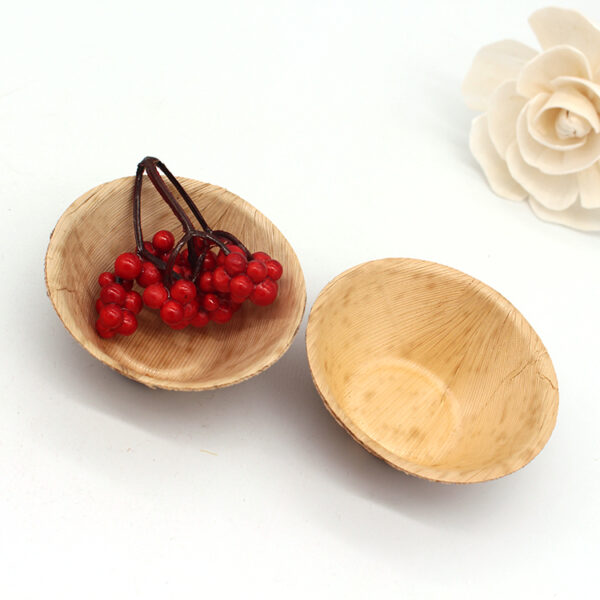
ECODisposable Bamboo Round Skin Bowl – Premium Bamboo Skin Bowl...
MOQ:10 CartonsMATERIAL:Bamboo -
ECO
Disposable Bamboo Square Plate – Premium Bamboo Plate...
MOQ:10 CartonsMATERIAL:Bamboo -
ECO
Eco Bamboo Round Plate – Premium Bamboo Round Plate...
MOQ:10 CartonsMATERIAL:Bamboo -
ECO
Eco Friendly Bamboo Skin Boat – Premium Bamboo Skin Boat...
MOQ:10 CartonsMATERIAL:Bamboo
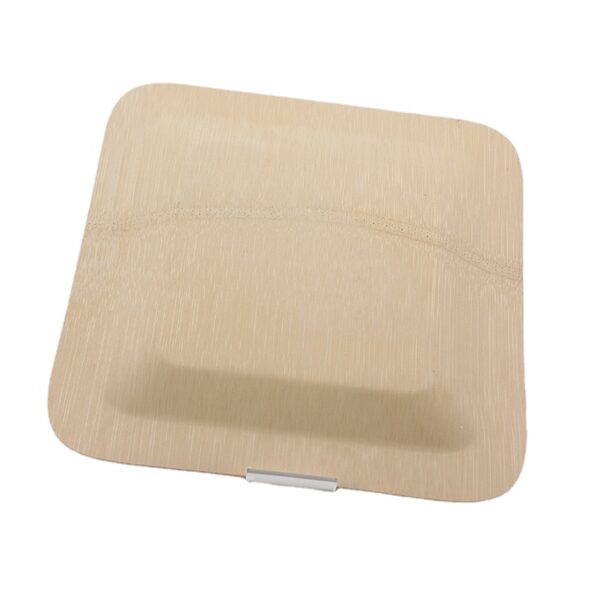
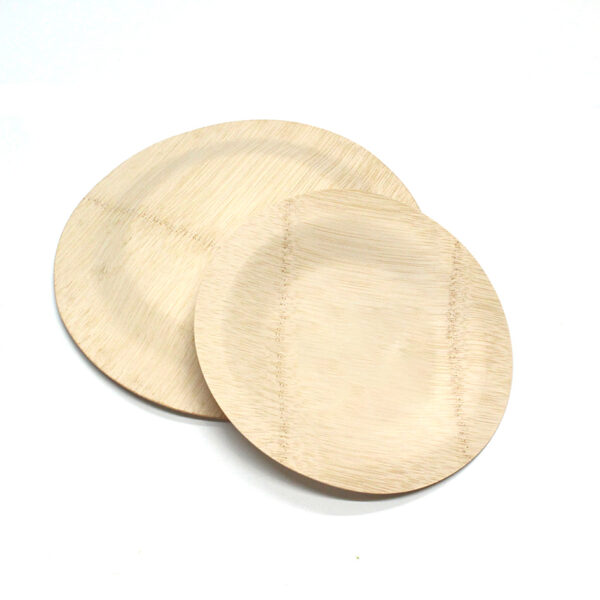
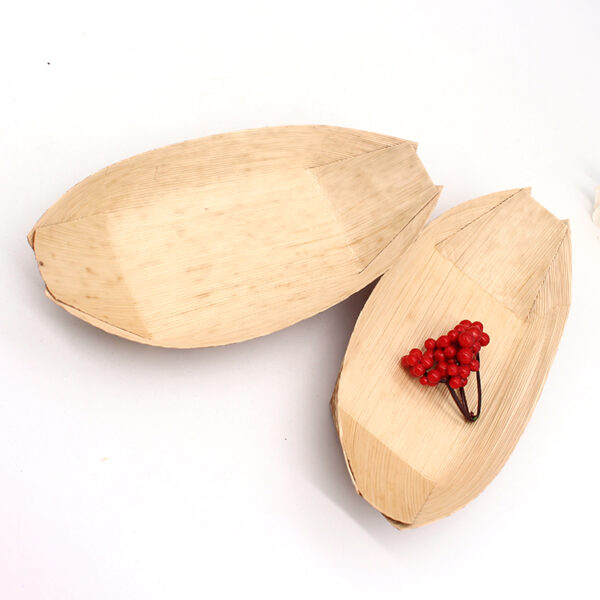
Wholesale Bamboo Tableware Supplier
A table setting is a statement. The plates are the canvas. The cutlery is the tool. And the tableware is the frame, the visible layer that communicates whether this meal was prepared with care or assembled in a hurry.
A plastic fork says this is a takeaway afterthought. A bamboo fork says this is a business that considers its guests. A bamboo plate says this is an operator who thought about the planet. A bamboo serving board says this is food worth presenting. Every piece of tableware tells a story before the first bite.
Bamboo tableware is the most visible, most versatile, and most underestimated sustainability statement in any foodservice operation. For a fraction of the cost of ceramic or metal, you present food with the warmth, texture, and intention of natural material. That is the best return on investment in the entire table setup budget.
FriendlyBamboo supplies wholesale bamboo tableware in bulk to restaurants, hotels, resorts, event caterers, corporate dining, catering hire companies, and wholesale distributors across 30+ countries for over 12 years. Bamboo plates, bamboo bowls, bamboo cutlery sets, bamboo serving boards, bamboo trays, bamboo cups, bamboo condiment sets, and bamboo placemats — all from sustainably sourced bamboo. Biodegradable, eco-friendly, and designed to make every meal look like it was worth eating.
How Bamboo Tableware Is Made
The process is as deliberate as the material.
Step 1 — Harvesting. Moso bamboo is harvested at 4–5 years maturity — the point at which the culm is structurally dense and dimensionally stable. The plant is not killed. New shoots regenerate from the same root system. Bamboo reaches harvest maturity in 4–5 years compared to 20–50 years for hardwood trees.
Step 2 — Processing. Harvested bamboo culms are split, stripped, and processed into flat boards or moulded forms depending on the product. No toxic adhesives or formaldehyde are used in the bonding process.
Step 3 — Shaping. Boards and forms are cut, pressed, or turned into finished tableware shapes — plates, bowls, boards, trays, cups. Edges and surfaces are sanded to a smooth, splinter-free finish.
Step 4 — Finishing. All tableware is treated with food-safe oils and lacquers. FDA-compliant for direct food contact. Natural finish and lacquered versions available depending on product.
Step 5 — Quality Inspection. Each piece is inspected for surface smoothness, structural integrity, and dimensional consistency. Natural grain variation between pieces is a characteristic of bamboo, not a defect.
The result: tableware made from one of the most renewable materials on earth, processed without toxic inputs, finished to a food-safe standard, and designed to last through years of commercial use.
Available Types of Bamboo Tableware
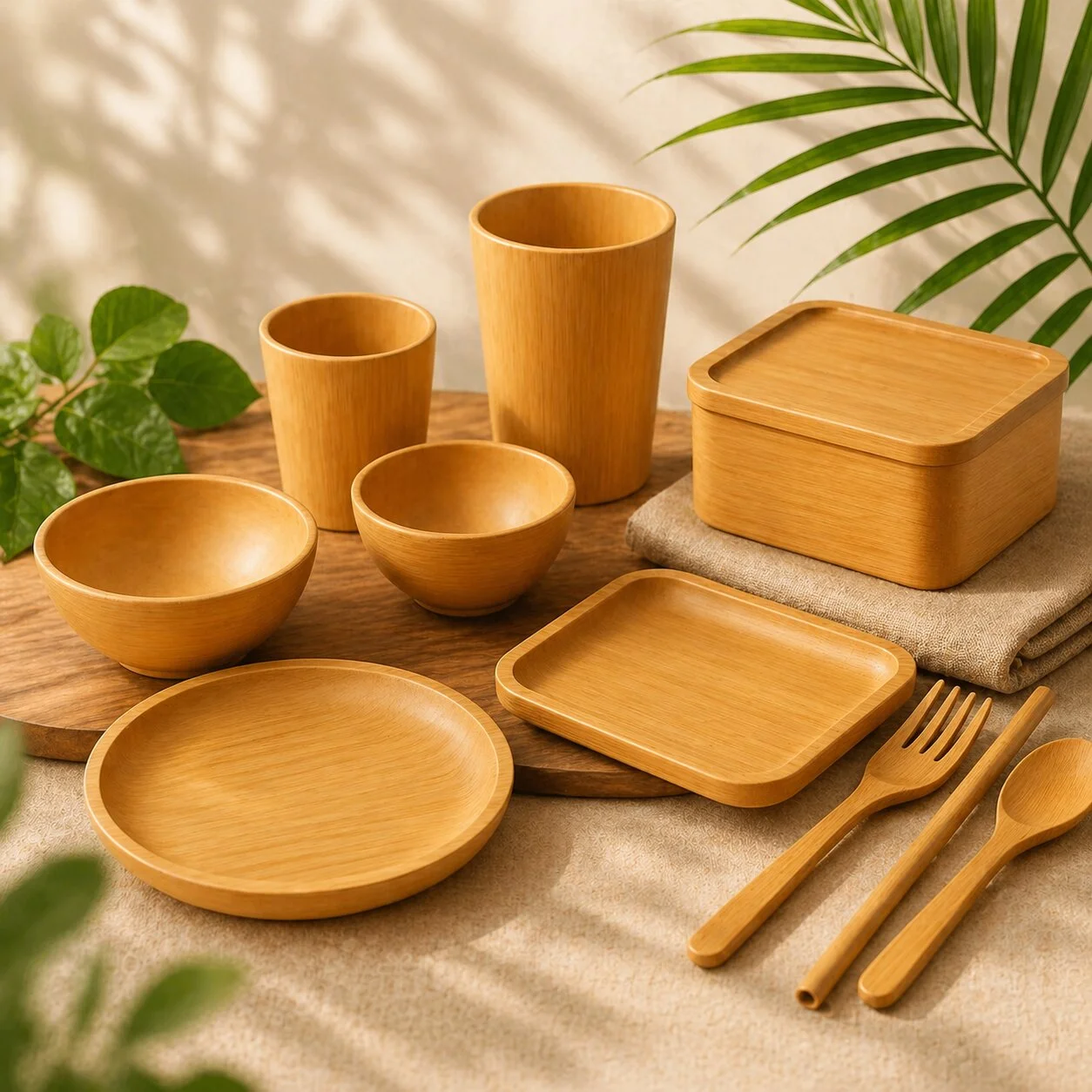
Bamboo Plates — Round, square, and rectangular bamboo plates in multiple sizes. Available in natural bamboo finish and lacquered versions. Lightweight yet sturdy. Suitable for hot and cold food. The most popular bamboo tableware item for food trucks, outdoor dining, pop-up restaurants, event catering, and eco-conscious sit-down restaurants. A bamboo plate carries food with warmth that ceramic and plastic cannot replicate.
Bamboo Bowls — Deep and shallow bamboo bowls for soups, salads, rice dishes, noodles, and desserts. Available in round and square profiles. Natural bamboo interior with optional lacquered exterior. Stackable for efficient storage and transport. Popular for Asian cuisine, health food restaurants, catering buffets, and outdoor food festivals.
Bamboo Cutlery Sets — Forks, knives, spoons, and chopsticks in natural bamboo. Available as individual pieces or bundled sets. Lightweight, smooth-finished, and splinter-free. Suitable for both casual dining and formal table settings. Individually wrapped options available for catering and takeaway. The replacement for plastic cutlery that actually feels premium in the hand.
Bamboo Serving Boards — Rectangular and paddle-shaped bamboo boards for charcuterie, cheese, bread, sushi, and tapas presentation. Available in multiple sizes from individual portions to large sharing boards. The natural bamboo grain makes every board a unique serving surface. A bamboo serving board transforms a plated dish into a presented experience.
Bamboo Trays — Flat bamboo trays for food and drink service. Rectangular designs with optional raised edges or handles. Used by hotels for in-room dining, by bars for cocktail service, and by caterers for canapés and drinks passing. Available in natural bamboo and stained finishes.
Bamboo Cups and Mugs — Reusable bamboo fibre cups and mugs for hot and cold beverages. Lightweight, insulating, and spill-resistant with lids available. Used by corporate canteens, eco-event organizers, outdoor venues, and coffee concepts. A bamboo cup signals environmental commitment at the point of order.
Bamboo Condiment Sets — Bamboo salt and pepper holders, sauce dishes, dipping bowls, and condiment trays. Matching sets for a cohesive table presentation. Used by restaurants wanting a unified bamboo tableware aesthetic from the centre of the table to the service ware.
Bamboo Placemats — Flat woven and solid bamboo placemats in multiple sizes. Protect tables from heat and spills while adding a natural material layer to the table setting. Popular in hotel dining rooms, wellness retreats, and Asian-themed restaurants.
Bamboo Chopsticks — Disposable and reusable bamboo chopsticks. Disposable individually sleeved pairs for takeaway and fast-casual Asian dining. Reusable polished pairs for sit-down restaurant service. Available with custom sleeve printing for brand presentation.
Sizes Available of Bamboo Tableware
| Product | Available Sizes | Best For |
|---|---|---|
| Bamboo Plates | 15cm / 20cm / 25cm / 30cm | Canapés, starters, mains, sharing |
| Bamboo Bowls | 10cm / 14cm / 18cm / 22cm | Dips, soups, rice, salads |
| Bamboo Serving Boards | 20cm / 30cm / 40cm / 50cm+ | Individual, sharing, large platters |
| Bamboo Trays | 25cm / 35cm / 45cm / 60cm | Drinks, canapés, in-room dining |
| Bamboo Cups | 150ml / 250ml / 350ml | Espresso, standard, large beverages |
| Bamboo Placemats | 30x40cm / 35x45cm / 40x60cm | Individual dining, place settings |
Which size? Small plates and bowls for starters and desserts. Standard (25cm plate, 18cm bowl) for most main course applications — the most popular. Large boards and trays for sharing concepts and buffet service. Most restaurant operations stock a standard plate (25cm) and a standard bowl (18cm) as their core bamboo tableware pieces.
Wholesale Pricing of Bamboo Tableware
| Product | Volume | Price Per Piece |
|---|---|---|
| Bamboo Plates | 5,000+ pcs | $0.35 – $1.20 |
| Bamboo Bowls | 5,000+ pcs | $0.30 – $1.00 |
| Bamboo Cutlery Sets (fork/knife/spoon) | 10,000+ sets | $0.08 – $0.25 |
| Bamboo Serving Boards | 2,000+ pcs | $1.20 – $4.50 |
| Bamboo Trays | 2,000+ pcs | $1.50 – $6.00 |
| Bamboo Cups / Mugs | 5,000+ pcs | $0.80 – $2.50 |
| Bamboo Condiment Sets | 2,000+ sets | $0.60 – $2.00 |
| Bamboo Placemats | 5,000+ pcs | $0.25 – $0.90 |
| Bamboo Chopsticks (disposable) | 50,000+ pairs | $0.03 – $0.08 |
| Custom-Branded Tableware (any item) | 2,000+ pcs | $0.10 – $2.00 surcharge |
A bamboo plate presented to a guest costs a fraction of a ceramic plate and signals the same care and intention. A bamboo serving board carrying a cheese selection costs less than the smallest piece of slate and photographs better in natural light. The material works harder than its price suggests.
What Makes Bamboo Tableware Unique
Every piece carries natural grain. No two bamboo pieces have identical grain patterns. The growth rings, node marks, and fibre direction create natural variation across plates, boards, and trays. Minor variation between pieces is a characteristic of the material — not a manufacturing inconsistency.
It is made from the world’s fastest-growing plant. Moso bamboo grows up to 90cm per day and reaches harvest maturity in 4–5 years. No deforestation. No replanting required. The same root system regenerates continuously after harvest. FSC certified sourcing.
Zero toxic inputs in the entire process. Food-safe oils and lacquers only. No formaldehyde. No toxic adhesives. No PFAS coatings. FDA-compliant for direct food contact. LFGB-certified for European food safety.
It is structurally superior to alternatives at the price point. Bamboo is harder than most hardwoods. Bamboo tableware does not shatter like ceramic, does not absorb odours like untreated wood, and does not communicate disposability like plastic. At its price point, no other material delivers equivalent structural performance and presentation quality.
It handles heat, repeated use, and commercial environments. Heat resistant under normal food service conditions. Rated for 1–3 years of commercial use with correct care. 30–40% lighter than ceramic equivalents — reducing server fatigue, transport weight, and shipping costs.
Bamboo Tableware vs Ceramic vs Plastic
| Factor | Bamboo Tableware | Ceramic | Plastic |
|---|---|---|---|
| Food presentation | Warm, natural, premium | Clean, traditional | Cheap, disposable |
| Photography rate | High — natural tones and texture | Moderate | Very low |
| Weight | Light | Heavy | Very light |
| Breakage risk | Low — does not shatter | High | None |
| Eco-friendly | Yes — biodegradable | Partially | No |
| Cost | Low–mid | Mid–high | Very low |
| Brand signal | “This venue cares about food and the planet.” | “This venue follows convention.” | “This venue chose the cheapest option.” |
| Custom branding | Yes — engraving, printing | Limited | Yes, but undermines eco message |
The difference between a bamboo serving board and a plastic tray is not just price and material. It is the entire message the venue sends about what it values, how it presents food, and whether it thought about the guest’s experience or simply covered the function.
Performance Features of Bamboo Tableware
Sustainably Sourced Bamboo — All tableware is produced from Moso bamboo, the fastest-growing bamboo species. Harvested at 4–5 years without killing the plant. FSC certified sourcing.
Food-Safe Finish — All bamboo tableware is treated with food-safe oils and lacquers. FDA-compliant for direct food contact. No formaldehyde or toxic adhesives.
Heat Resistant — Bamboo tableware withstands normal food service temperatures. Suitable for hot food presentation. Not for microwave or oven use.
Splinter-Free Surface — All edges and surfaces sanded and finished to a smooth, splinter-free standard. Safe for direct food contact and hand handling.
Stackable Design — Plates, bowls, and trays are designed to stack uniformly for storage and transport efficiency.
Natural Grain Variation — Each bamboo piece carries a unique grain pattern. Minor variation between pieces is a characteristic of natural bamboo, not a defect.
Durable and Long-Lasting — Reusable bamboo tableware rated for repeated commercial use with correct care. Significantly longer service life than disposable alternatives.
Lightweight — Bamboo tableware is 30–40% lighter than equivalent ceramic. Reduces server fatigue, transport weight, and shipping costs for catering operations.
Packaging Options for Bamboo Tableware
Bulk Carton — Tableware packed in protective kraft paper layers inside export cartons. Standard for restaurant and catering buyers.
Retail-Ready Pack — Individual bamboo pieces or sets in branded consumer packaging. For party supply, homeware, and gifting retail.
Gift Set Packaging — Curated bamboo tableware sets in presentation boxes. For corporate gifting, hospitality welcome packs, and premium retail.
Custom Branded Packaging — Your brand on inner packaging, outer cartons, and individual wrapping. Private-label programmes available for distributors.
Custom Branding
Laser Engraving — Your logo or brand mark burned permanently into bamboo plates, boards, trays, and cups. Every piece of tableware carries your identity. Permanent, elegant, and cost-effective at volume.
Custom Sleeve Printing — Your branding on chopstick sleeves and cutlery wrappers. Full-colour printing. Used by restaurants, hotels, and catering companies for branded place settings.
Custom Colour Staining — Bamboo tableware available in dark walnut, grey, and black stained finishes alongside natural bamboo. Custom stain colours available at volume for brand-matched aesthetics.
Custom Shapes and Sizes — Non-standard plate dimensions, board shapes, and tray proportions. MOQ for custom tooling is typically 5,000+ pieces. Contact us for feasibility on specific size or shape requirements.
Private Label — Your brand on all tableware and packaging. For hospitality equipment distributors, catering hire companies, and foodservice wholesalers.
→ Request Custom Branding Quote
Certifications
| Certification | What It Verifies |
|---|---|
| FSC | Bamboo sourced from responsibly managed forests |
| FDA (21 CFR 177) | Safe for direct food and beverage contact |
| ISO 9001 | Consistent manufacturing quality |
| ISO 14001 | Environmental management systems |
| LFGB | European food safety standard compliance |
| PFAS-Free | No chemical coatings on the bamboo body |
Industries We Supply
Restaurants and Cafes — The core market. Bamboo plates for mains, boards for sharing menus, bowls for Asian concepts, and cutlery sets for eco-conscious table settings. The full bamboo tableware wardrobe for foodservice.
Hotels and Resorts — Branded bamboo trays for in-room dining. Bamboo boards for restaurant service. Bamboo cups for poolside and room amenities. Laser-engraved pieces for premium branded table presence.
Event Caterers and Wedding Planners — Bamboo tableware is lighter than ceramic, more presentable than plastic, and practical for outdoor events, marquee dinners, and destination weddings. The material elevates event presentation without the risk of breakage.
Corporate Dining and Canteens — Bamboo cutlery for sustainable daily operations. Bamboo trays for cafeteria service. Bamboo cups for beverage stations. A visible, daily sustainability commitment.
Food Trucks and Street Food — Bamboo plates and bowls for serving. Bamboo cutlery for packaging. Lightweight, sturdy, and on-brand for food operators with a quality-conscious positioning.
Wellness Retreats and Yoga Centres — The natural material alignment between bamboo tableware and wellness environments. Bamboo plates, bowls, and cups for retreat dining programmes.
Catering Hire Companies — Bamboo tableware as a premium hire category alongside ceramic and glassware. Lighter to transport, lower breakage cost, growing demand from eco-conscious event clients.
Wholesale Distributors — Private-label bamboo tableware programmes for foodservice equipment and hospitality supply distribution.
How to Order
Step 1 — Select your tableware products, sizes, finishes, and quantities.
Step 2 — Submit the bulk quote form with packaging preference and delivery destination.
Step 3 — We send your tailored proposal within 24 hours.
Frequently Asked Questions
What is the minimum order for wholesale bamboo tableware? Standard orders start at 2,000–10,000 pieces depending on the product type. Plates and bowls typically 5,000 pieces minimum. Serving boards and trays from 2,000 pieces. Cutlery sets from 10,000 sets. Custom-branded and custom-shaped items may require higher MOQs due to tooling or engraving setup. Trial quantities available for operators testing bamboo tableware for the first time.
How much does wholesale bamboo tableware cost? Bamboo plates $0.35 to $1.20. Bamboo bowls $0.30 to $1.00. Cutlery sets $0.08 to $0.25. Serving boards $1.20 to $4.50. Trays $1.50 to $6.00. Bamboo cups $0.80 to $2.50. Chopsticks $0.03 to $0.08 per pair. Custom branding adds $0.10 to $2.00 per piece depending on method and design complexity.
What is bamboo tableware made from? Moso bamboo — the most commercially viable and sustainably managed bamboo species. Harvested at 4–5 years maturity. Processed without formaldehyde or toxic adhesives. Finished with food-safe oils and lacquers. Fully biodegradable and compostable at end of life.
Is bamboo tableware safe for food contact? Yes. All FriendlyBamboo tableware meets FDA 21 CFR 177 food contact standards and LFGB European food safety requirements. Food-safe oils and lacquers. No formaldehyde, no toxic adhesives, no PFAS coatings.
Can bamboo tableware be used for hot food? Yes for hot food presentation. Bamboo tableware is heat resistant under normal food service conditions. It is not suitable for microwave or oven use. It should not be submerged in water for extended periods or put in a dishwasher — hand washing or wipe-down is recommended for reusable pieces.
Can I get my restaurant logo on bamboo tableware? Yes. Laser engraving on plates, boards, trays, and cups produces a permanent, elegant brand mark. Custom sleeve printing on chopsticks and cutlery wrappers. Custom stain colours for brand-matched aesthetics. Full private-label programmes for distributors.
Is bamboo tableware eco-friendly? Yes. Bamboo is the fastest-growing plant on earth — Moso bamboo grows up to 90cm per day and reaches harvest maturity in 4–5 years compared to 20–50 years for hardwood trees. Bamboo tableware is biodegradable and compostable. Significantly lower environmental impact than ceramic (kiln energy) and plastic (fossil fuel-derived, non-biodegradable).
How durable is reusable bamboo tableware? With correct care — hand washing, occasional food-safe oil treatment, dry storage — commercial bamboo tableware lasts 1–3 years in regular foodservice use. Harder and more durable than wood. Less brittle than ceramic. Not rated for dishwasher use.
Does bamboo tableware stain or absorb odours? Lacquered bamboo tableware resists staining and odour absorption in normal food service use. Natural finish bamboo is more porous and benefits from regular food-safe oil treatment. Strongly coloured sauces and acidic foods should be rinsed promptly from natural finish pieces.
Can I rotate bamboo tableware styles seasonally? Yes. Many operators use large sharing boards for winter menus and individual bowls for summer concepts. Placemats for formal indoor dining, trays for outdoor terrace service. We supply seasonal and concept-matched tableware programmes for operators running menu-driven table setting changes.
What is the difference between bamboo tableware and palm leaf plates? Bamboo tableware is smooth, consistent, and reusable — suited to permanent restaurant and hotel table settings. Palm leaf plates are dramatic, unique, and disposable — suited to premium events and occasions where the plate is part of the visual experience. Bamboo is year-round scalable supply. Palm leaf is seasonal. Both are eco-friendly, biodegradable, and available from FriendlyBamboo. See palm leaf plates →
Do you ship internationally? Yes. 30+ countries. Sea freight (20–35 days) and air freight (3–7 days). Bamboo tableware is lighter than ceramic equivalents, reducing freight costs significantly. We handle all export documentation. FOB and CIF pricing available.
You May Also Need
Bamboo Straws → Bagasse Straws → Eco-Friendly Straws (All Types) → Bamboo Cutlery → Bamboo Coffee Stirrers → Bagasse Cups →
Guides and Resources
Bamboo Straw Manufacturers in China → What Is Bagasse? Complete Guide →