Something shifted in the global materials market, and most people missed it.
While the sustainability conversation was busy debating paper straws and reusable bags, bamboo quietly became one of the fastest-growing industrial materials on the planet. Not as a niche eco-product. Not as a feel-good alternative. As a genuine, scaled replacement for plastic across food service, packaging, construction, textiles, and consumer goods.
The global bamboo market was valued at approximately $79 billion in 2025. Industry forecasts project it will reach $115 billion by 2030 — a compound annual growth rate of nearly 8 percent. In the same period, the single-use plastics market is being systematically dismantled by legislation in over 100 countries.
This is not a trend. It is a structural realignment of the global supply chain. And if your business touches food service, packaging, hospitality, or retail, understanding why bamboo is winning will shape your procurement decisions for the next decade.
The Regulatory Tsunami That Changed Everything
Bamboo’s rise did not happen in a vacuum. It was accelerated by what may be the most coordinated regulatory shift in the history of materials policy: the worldwide crackdown on single-use plastics.
The European Union led with its Single-Use Plastics Directive, banning plastic cutlery, plates, straws, and polystyrene food containers across all 27 member states starting in 2021. But the EU did not stop there. The Packaging and Packaging Waste Regulation, with provisions taking effect from August 2026, goes further — banning PFAS in food contact packaging, restricting single-use packaging in hotels, restaurants, and bars, and mandating recycled content thresholds for all plastic packaging by 2030.
India implemented one of the broadest bans in 2022, covering plastic cutlery, plates, cups, straws, trays, wrapping film, and stirrers. Enforcement has tightened every year since, with manufacturers and food service operators facing fines for non-compliance.
In the United States, plastic regulation is state-driven but accelerating. Over 250 cities and counties have passed restrictions on polystyrene, plastic bags, or plastic cutlery. California, New York, Washington, Colorado, and Maine have state-level legislation. Delaware became the 11th state to ban polystyrene food containers.
China — the world’s largest producer and consumer of single-use plastics — launched the “Bamboo as a Substitute for Plastic” (BASP) initiative in November 2022, a joint programme between the Chinese government and the International Bamboo and Rattan Organization. The programme explicitly promotes bamboo products as a nature-based replacement for plastics across food service, packaging, and consumer goods.
Canada, Australia, the UAE, Thailand, Indonesia, Vietnam, and South Korea have all implemented or announced plastic restriction timelines. Indonesia aims to comprehensively ban single-use plastics by the end of 2026. Thailand’s roadmap targets full phase-out of plastic food packaging.
The pattern is unmistakable. Every major economy is either restricting, taxing, or outright banning single-use plastics. And in every market where plastic leaves, bamboo enters.
Why Bamboo — and Not Something Else?
There are other plastic alternatives. Paper. PLA bioplastics. Bagasse (sugarcane fibre). Areca palm leaf. Wheat straw. Each has its place. But bamboo has emerged as the dominant replacement material for several reasons that are structural, not sentimental.
It grows faster than anything else
Bamboo is the fastest-growing plant on earth. Moso bamboo — the species most commonly used for commercial products — can grow up to 91 centimetres in a single day. It reaches harvest maturity in three to five years. Compare that to the hardwood trees used for wooden cutlery and paper products, which take 20 to 50 years to mature.
This growth rate means bamboo supply can scale with demand in a way that no other natural material can. When a market suddenly needs 10 million more forks next quarter because plastic was just banned, bamboo supply chains can respond. Wood supply chains cannot.
It regenerates without replanting
When a bamboo culm is harvested, the root system stays alive and sends up new shoots within weeks. A well-managed bamboo forest produces a continuous harvest without replanting, deforestation, or soil depletion. This is fundamentally different from tree-based materials, where harvesting means killing the tree and starting a 20-year regrowth cycle.
It absorbs more carbon than trees
A bamboo forest absorbs approximately 12 tonnes of carbon dioxide per hectare per year — significantly more than most tree species. Bamboo also releases 35 percent more oxygen than an equivalent stand of trees. For businesses building ESG narratives and carbon offset strategies, bamboo-based supply chains offer a measurable, defensible environmental story.
It requires no agricultural inputs
Bamboo grows without pesticides, herbicides, fertilisers, or irrigation. It thrives on marginal land that is often unsuitable for food crops. This means bamboo cultivation does not compete with food production, does not introduce chemicals into the ecosystem, and does not strain water resources. The environmental profile is clean from root to product.
It performs at industrial scale
This is the factor that separates bamboo from other alternatives. PLA bioplastics require industrial composting facilities that do not exist in most regions. Paper products require tree harvesting and chemical pulping. Areca palm leaf products depend on a limited and seasonal raw material supply.
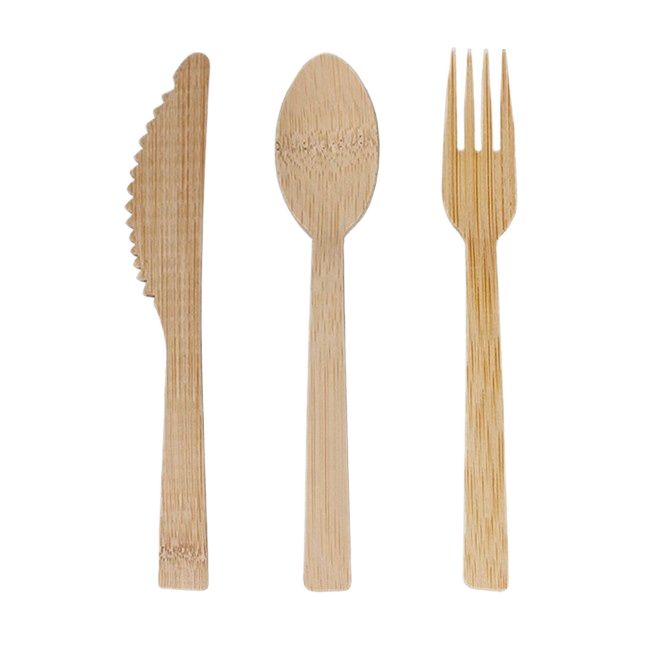
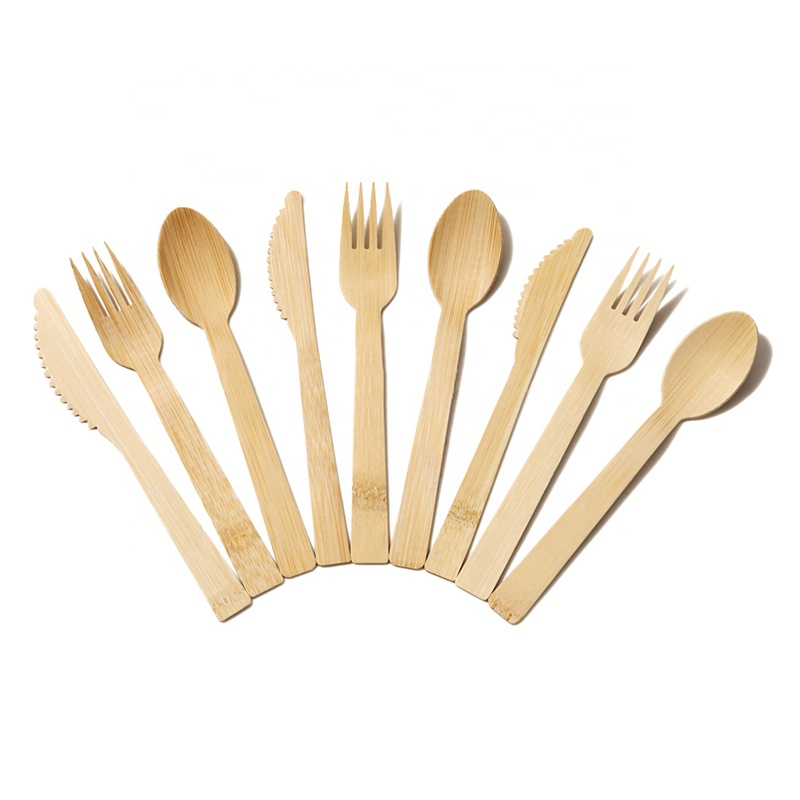
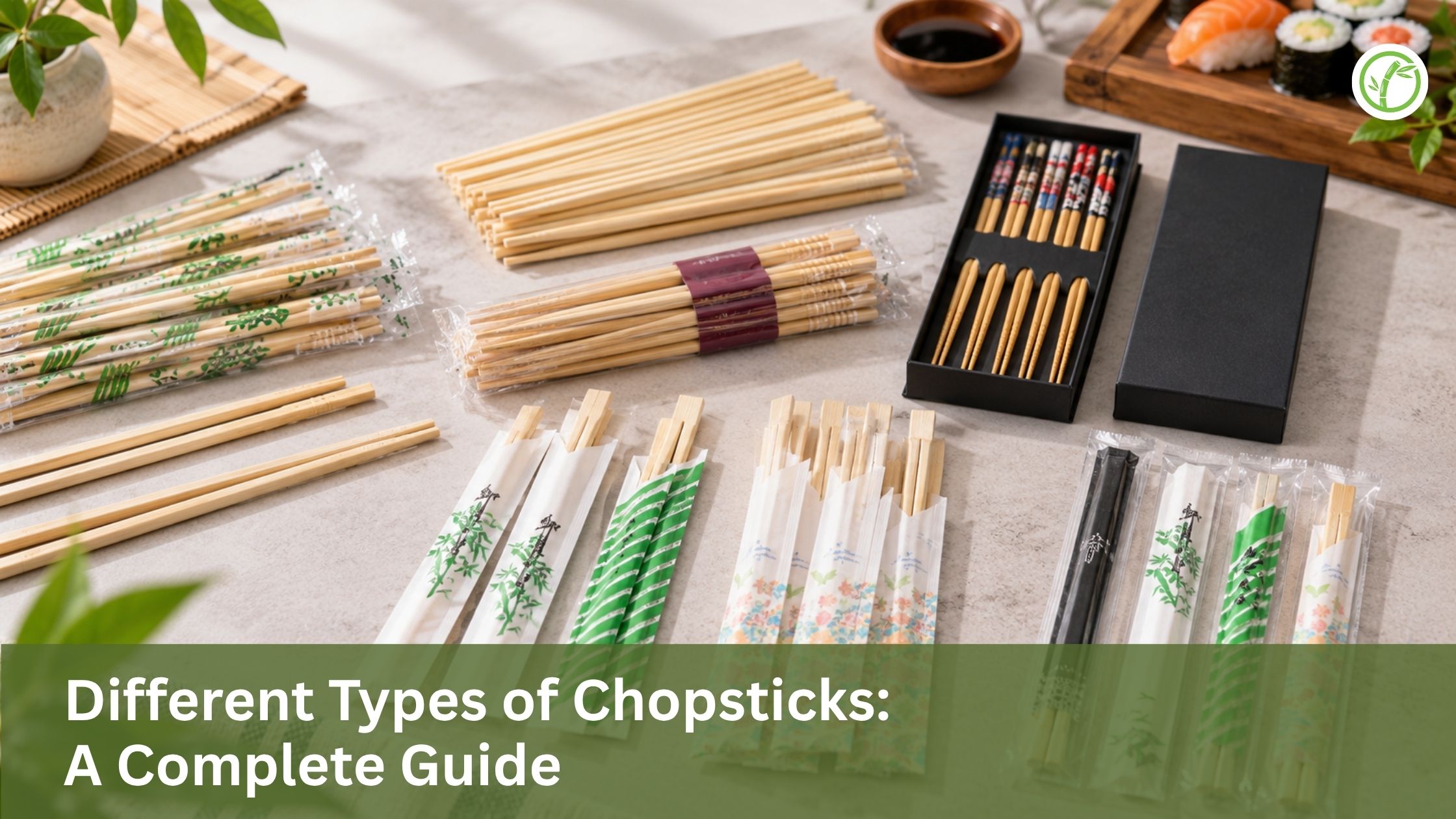
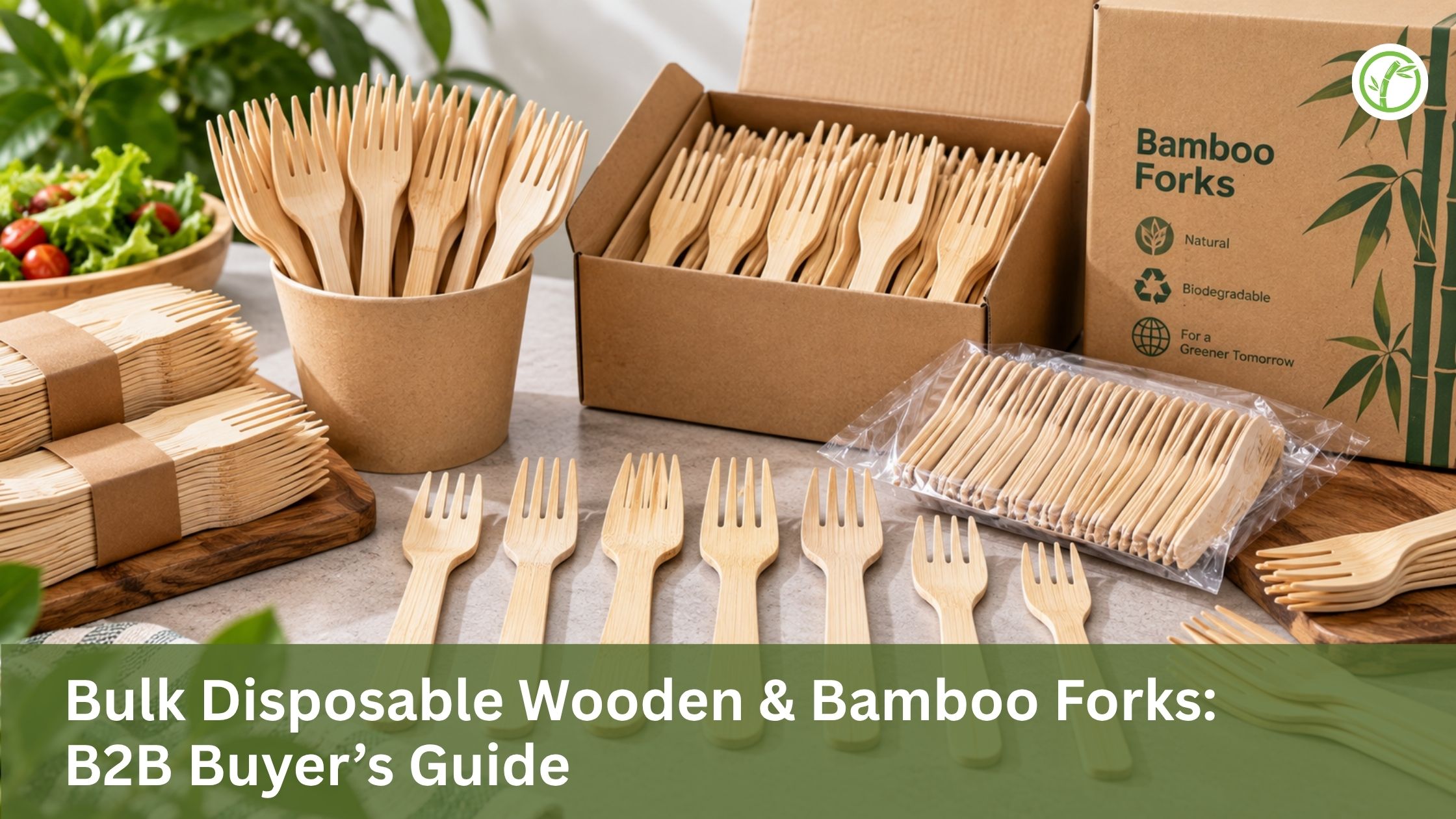
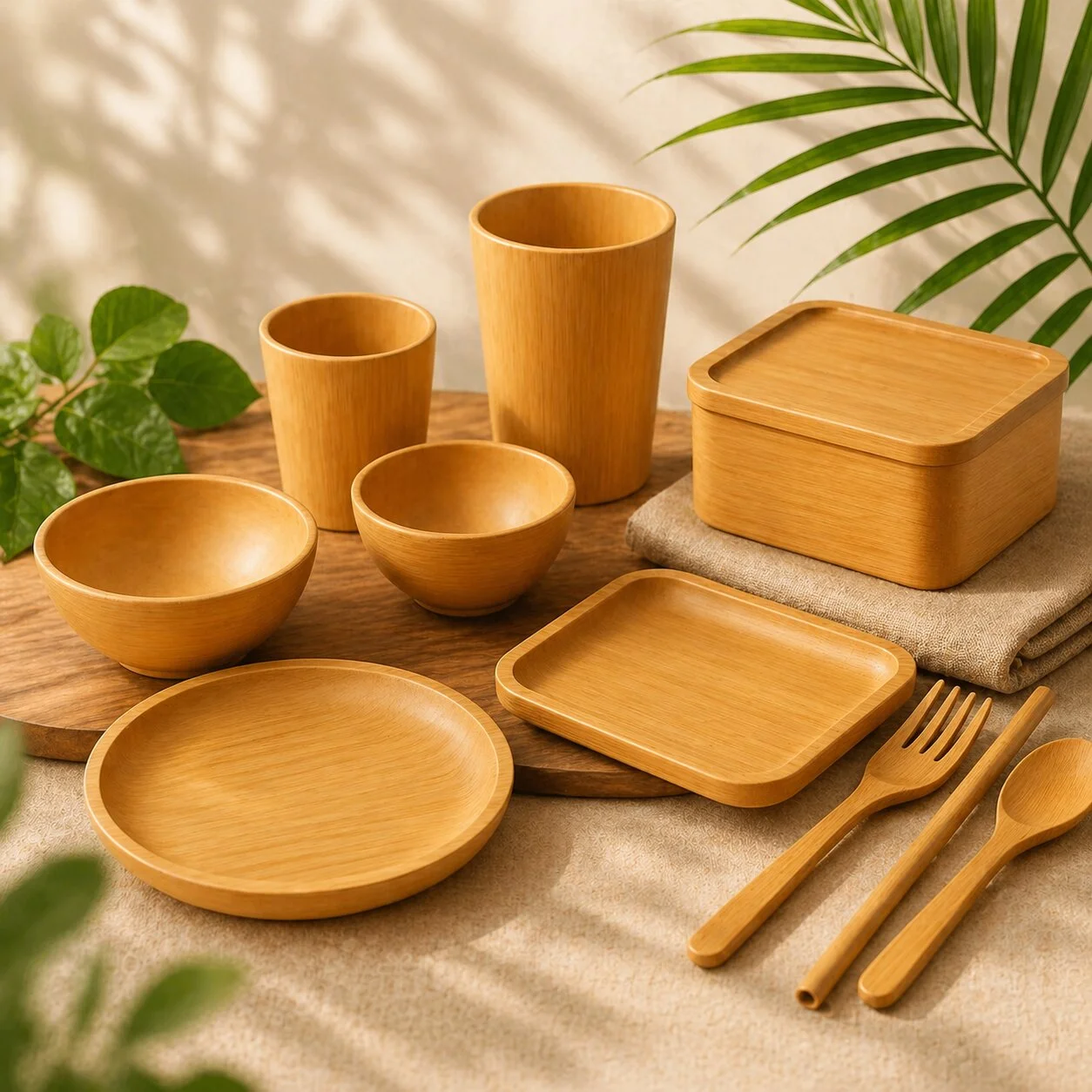
Bamboo products — cutlery, plates, straws, chopsticks, skewers, tableware — are manufactured using established processes (cutting, steaming, pressing, sanding) that scale efficiently. Global bamboo cultivation already covers over 36 million hectares, producing approximately 220 million tonnes of usable raw bamboo annually. The supply infrastructure exists. The manufacturing knowledge is mature. The logistics networks are in place.
When a global QSR chain needs to replace plastic cutlery across 5,000 locations, bamboo is the material that can deliver at that scale without supply disruption.
The Economics Are Closing the Gap
Five years ago, the cost argument was the biggest barrier to bamboo adoption. Bamboo cutlery cost two to three times more than the cheapest plastic alternatives. That gap has narrowed dramatically.
At current wholesale volumes of 50,000 units or more, bamboo cutlery costs roughly $0.02 to $0.05 per unit. Standard plastic cutlery costs $0.01 to $0.03 per unit. The difference is measured in fractions of a cent.
But raw material cost is only one line on the spreadsheet. When you factor in the full cost of ownership, bamboo often comes out ahead.
Regulatory compliance costs. Businesses still using plastic in regulated markets face fines, forced inventory write-offs, and emergency sourcing at premium prices. Bamboo is compliant everywhere.
Waste management costs. Many municipalities now charge premium rates for non-recyclable plastic waste. Bamboo is compostable, often reducing waste disposal fees.
Brand and revenue impact. Multiple surveys show that more than 65 percent of consumers prefer businesses that use sustainable materials. This preference translates into customer acquisition, retention, and willingness to pay — all of which affect revenue in ways that a per-unit cost comparison cannot capture.
Price stability. Plastic pricing fluctuates with global petroleum markets. When oil prices spike, plastic packaging costs follow. Bamboo pricing is driven by agricultural supply chains that are structurally more stable. For procurement teams managing annual budgets, price predictability has real value.
The bamboo cutlery market specifically has seen pricing decline by roughly 25 to 30 percent over the past five years as production volumes have scaled and manufacturing automation has improved. The trajectory suggests continued gradual declines, which means the cost argument against bamboo weakens with every passing quarter.
The Consumer Shift Is Not Reversing
Consumer preference for sustainable products is not a pandemic-era blip. It is a generational shift that is now embedded in purchasing behaviour across demographics.
Over 65 percent of consumers globally say they prefer products made from renewable materials. In the food service sector specifically, more than half of takeaway customers consider sustainable packaging when choosing where to order. Among millennials and Gen Z — demographics that are increasingly driving food service revenue — the preference is even stronger.
This is not just about personal values. It is about brand signalling. When a customer picks up a bamboo fork from a delivery order, they receive a tactile, immediate signal about the brand’s quality and values. That signal shapes their perception of the food, the restaurant, and the likelihood of reordering.
Hotels and corporate clients report similar dynamics. Procurement managers at major hotel chains now require FSC-certified sustainable disposables as a condition of supplier qualification — not because of personal preference, but because their guests expect it and their ESG reporting demands it.
The consumer shift creates a self-reinforcing cycle. Demand grows. Manufacturers invest in capacity. Costs come down. More businesses switch. Demand grows further. Bamboo is now deep into this cycle, and there is no credible scenario in which consumer preference reverses toward plastic.
What is particularly striking is how this preference translates into measurable business impact. Restaurants that prominently communicate their switch from plastic to bamboo report increased positive reviews mentioning packaging quality. Hotels that replace plastic amenities with bamboo alternatives see improved satisfaction scores in their sustainability-related guest feedback categories. And in the delivery segment, branded bamboo cutlery sets — with the restaurant’s logo on the wrapper — are consistently cited as a driver of repeat ordering in operator surveys.
The signal-to-cost ratio is extraordinary. For pennies per customer, bamboo cutlery sends a message that would cost thousands in advertising to communicate through any other channel.
The Supply Chain Is Mature — Not Experimental
One concern that held back early adoption was supply chain risk. Five years ago, sourcing bamboo cutlery at scale meant navigating a fragmented network of small factories with inconsistent quality and unreliable delivery timelines.
That era is over.
The bamboo manufacturing sector has consolidated and professionalised significantly. Today’s leading manufacturers operate automated production lines, hold full stacks of international certifications (FSC, FDA, ISO 9001, ISO 14001, BPI, LFGB), and support OEM and private-label programmes for clients in over 30 countries.
Production capacity has scaled to meet industrial demand. A single modern bamboo cutlery facility can produce millions of pieces per month, with CNC cutting, automated hot-press forming, and inline quality inspection ensuring consistency across every batch.
Export logistics are equally mature. Experienced manufacturers handle HS code classification, phytosanitary documentation, container loading optimisation, and customs compliance for destination markets across the EU, North America, the Middle East, Australia, and Southeast Asia.
For procurement teams, this means bamboo is no longer an “alternative” sourcing category that requires special handling. It is a mainstream industrial supply chain with the same reliability infrastructure that buyers expect from any category.
The remaining gap is awareness. Many procurement managers still assume that bamboo sourcing is more complicated or riskier than it actually is in 2026. That assumption creates opportunity for businesses willing to act on current market reality rather than outdated perceptions.
FriendlyBamboo has operated in this space for over 12 years — long enough to have navigated the transition from fragmented artisanal supply to industrialised, certified manufacturing. Our customers range from single-location restaurants placing their first eco-friendly order to national distributors sourcing hundreds of thousands of units per quarter. The supply chain works. The question is whether your business is connected to it yet.
Industry by Industry: Where Bamboo Is Winning Fastest
The bamboo-over-plastic shift is not happening evenly. Some industries are moving faster than others, driven by a combination of regulatory pressure, customer visibility, and operational economics.
Quick-Service Restaurants and Food Delivery
This is ground zero for the transition. QSR chains and delivery platforms operate at massive scale — millions of cutlery pieces per month across hundreds or thousands of locations. The operational simplicity of bamboo cutlery (same sizes, same dispensing systems, no staff retraining) makes switching frictionless. Major chains in Europe and Asia-Pacific have already completed the transition. North American chains are following as state-level bans expand.
The food delivery economy accelerated this shift. When your brand has no physical restaurant — just a bag landing on a doorstep — the packaging and cutlery become the entire brand experience. Cloud kitchens and virtual restaurant brands were among the earliest adopters of bamboo cutlery and bagasse containers because they understood something that dine-in operators sometimes miss: in delivery, your packaging is your storefront.
Hospitality and Hotels
Hotel chains are moving aggressively toward bamboo for two reasons. First, their guests increasingly expect it — sustainability is now a standard element of the luxury and premium hospitality experience, not a differentiator. Second, ESG reporting requirements from investors and brand standards require documented sustainable procurement. Bamboo with FSC certification provides the paper trail that hotel sustainability officers need for annual reports.
The applications extend beyond dining. Bamboo toothbrushes, bamboo stirrers in mini-bars, bamboo cutlery for room service, bamboo straws at pool bars — hotels are systematically replacing plastic touchpoints with bamboo alternatives across the entire guest experience.
Events and Catering
The catering industry discovered something surprising about bamboo: it saves money. Not compared to plastic, but compared to metal rental. When a 300-guest corporate dinner costs $750 to $2,250 in metal flatware rental (plus cleaning, loss charges, and return logistics), bamboo cutlery at $45 to $90 for the same headcount changes the economics completely.
Outdoor festivals, sports venues, and concert caterers have been especially fast adopters because their waste management challenges are most severe. A three-day festival serving 30,000 meals eliminates roughly 90,000 pieces of non-biodegradable plastic waste by switching to bamboo. For venue operators managing waste contracts and sustainability commitments, that switch pays for itself in waste disposal savings alone.
Retail and Distribution
This is where the growth opportunity is richest. As consumer demand for sustainable products grows, retailers and distributors are building private-label bamboo product lines — cutlery sets, plates, straws, tableware — that carry higher margins than branded plastic alternatives.
The Amazon ecosystem has been a particularly strong channel. Bamboo cutlery sets, bamboo plates for parties, and bamboo straw packs rank consistently in the top results for “eco-friendly party supplies” and related searches. Sellers with well-branded, FSC-certified bamboo products command premium pricing because the sustainability narrative is built into the product itself.
Wholesale distributors are consolidating supply from manufacturers like FriendlyBamboo to build complete eco-product catalogues — bamboo, bagasse, and wooden products from a single source — which they then distribute to regional restaurant suppliers, hotel procurement departments, and retail chains.
Bamboo vs Other Plastic Alternatives: Why It Keeps Winning the Comparison
Bamboo is not the only plastic alternative on the market. Understanding why it consistently outperforms the others in adoption rate explains why the market is growing so fast.
Bamboo vs PLA Bioplastics
PLA (polylactic acid) is a plant-based plastic made from corn starch or sugarcane. It looks and feels like conventional plastic, which is its advantage. Its disadvantage is critical: PLA requires industrial composting facilities to decompose, and those facilities do not exist in most regions. In the absence of industrial composting, PLA ends up in landfills where it behaves essentially like conventional plastic — persisting for decades.
PLA also has a low heat tolerance (it softens above 60°C), making it unsuitable for hot food and beverages without crystallisation treatment (CPLA), which adds cost and complexity.
Bamboo composts in home and commercial settings, handles temperatures up to 200°C, and does not require specialised disposal infrastructure. For businesses seeking a practical, no-asterisk alternative to plastic, bamboo wins.
Bamboo vs Paper
Paper products — plates, cups, bags — are widely used, but they have hidden environmental costs. Paper production requires tree harvesting (even from managed forests, the 7 to 10 year growth cycle is slow), chemical pulping, bleaching, and significant water consumption. Many paper food products are coated with polyethylene or PFAS to resist grease and moisture, which compromises their compostability and introduces chemical contamination concerns.
Bamboo products made from solid bamboo (cutlery, chopsticks, straws) require no chemical processing, no coatings, and no bleaching. Bagasse products made from sugarcane fibre use agricultural waste rather than harvested trees. Both offer a cleaner lifecycle than paper while matching or exceeding paper’s functional performance.
Bamboo vs Areca Palm Leaf
Palm leaf products have a genuine sustainability story — they are made from naturally fallen leaves, not harvested material. The limitation is scale. Palm leaf supply is seasonal, geographically concentrated, and limited by the number of naturally falling leaves. This makes it suitable for niche, premium applications (boutique events, specialty retail) but impractical for the high-volume, consistent supply demands of QSR chains, hotel groups, and industrial catering.
Bamboo cultivation covers 36 million hectares globally, producing 220 million tonnes of raw material annually. The supply infrastructure supports industrial-scale demand. For any business that needs reliable supply at volume, bamboo’s scalability is decisive.
Bamboo vs Bagasse
Bagasse (sugarcane fibre) is not a competitor to bamboo — it is a complement. Bagasse excels in moulded packaging: plates, bowls, clamshell containers, cups, trays. Bamboo excels in solid products: cutlery, chopsticks, skewers, straws, tableware.
The smartest procurement strategies use both materials together — bamboo cutlery inside a bagasse container, for example — to create a fully compostable, plastic-free food service solution. FriendlyBamboo supplies both material lines precisely because the market demands them as a pair, not as alternatives.
What This Means for Your Business
If you are in food service, hospitality, events, retail, or distribution, the bamboo-over-plastic shift has practical implications for your procurement strategy.
If you are still buying plastic cutlery, plates, or packaging: you are operating on borrowed time in most markets. The regulatory environment is tightening, not loosening. The cost premium for bamboo is minimal. The brand perception cost of continuing with plastic is rising every year. The switch is not a question of if, but when — and switching proactively is always cheaper and smoother than switching under regulatory pressure.
If you are already buying bamboo but from inconsistent suppliers: now is the time to consolidate your supply chain with a certified, reliable partner. As demand scales, supplier quality variance is becoming a bigger risk. Manufacturers with FSC, FDA, and ISO certifications, established export infrastructure, and documented quality control processes are the partners that will grow with your business without surprises.
If you are a distributor or retailer looking for market opportunity: the bamboo product space is growing at nearly 8 percent annually with strong tailwinds from regulation, consumer preference, and corporate sustainability mandates. Private-label bamboo product lines — cutlery, plates, straws, tableware — offer margins that branded plastic alternatives cannot match, combined with a market narrative that sells itself.
If you are an event or catering company: bamboo cutlery and bagasse tableware are now standard for corporate events, sustainable weddings, outdoor festivals, and institutional catering. The combination of premium aesthetics, compostable disposal, and cost savings over metal rental makes bamboo the default choice for any event planner who has run the numbers.
The Next Five Years
The global bamboo market is projected to grow from $79 billion in 2025 to $115 billion by 2030. Within the food service and packaging segment specifically, growth rates are even higher as plastic bans continue to expand and enforcement tightens.
Several developments will accelerate this trajectory.
The EU’s PPWR regulation — taking effect in stages from August 2026 — will ban PFAS in food packaging and restrict single-use plastic packaging in hospitality settings. This creates immediate demand for certified bamboo and bagasse alternatives across all 27 EU member states.
Indonesia’s planned comprehensive ban on single-use plastics by end of 2026 opens a massive market for bamboo food service products across Southeast Asia’s largest economy.
China’s BASP initiative is channelling government investment into bamboo processing technology, reducing manufacturing costs and improving product quality. As China accounts for roughly 59 percent of global bamboo output, these improvements cascade across the entire global supply chain.
Manufacturing automation in the bamboo cutlery and tableware sector is advancing steadily. Automated hot-press lines, CNC cutting systems, and inline quality inspection are increasing output per factory while reducing per-unit costs. This trend will continue to close the remaining cost gap with plastic.
The businesses that position themselves on the right side of this transition — sourcing bamboo now, building supplier relationships, and communicating their sustainability credentials — will have a structural advantage over competitors who wait.
The Bottom Line
Bamboo is not outpacing plastic because of environmental idealism. It is outpacing plastic because the math works, the regulations demand it, the consumers prefer it, the supply chain supports it, and the performance matches or exceeds plastic for the applications that matter.
The question is not whether your industry will switch. The question is whether your business will lead the switch or be forced into it by regulators, competitors, and customers who already moved.
The window to be early is closing. But it is still open.
Explore FriendlyBamboo’s complete product range and request your wholesale quote →