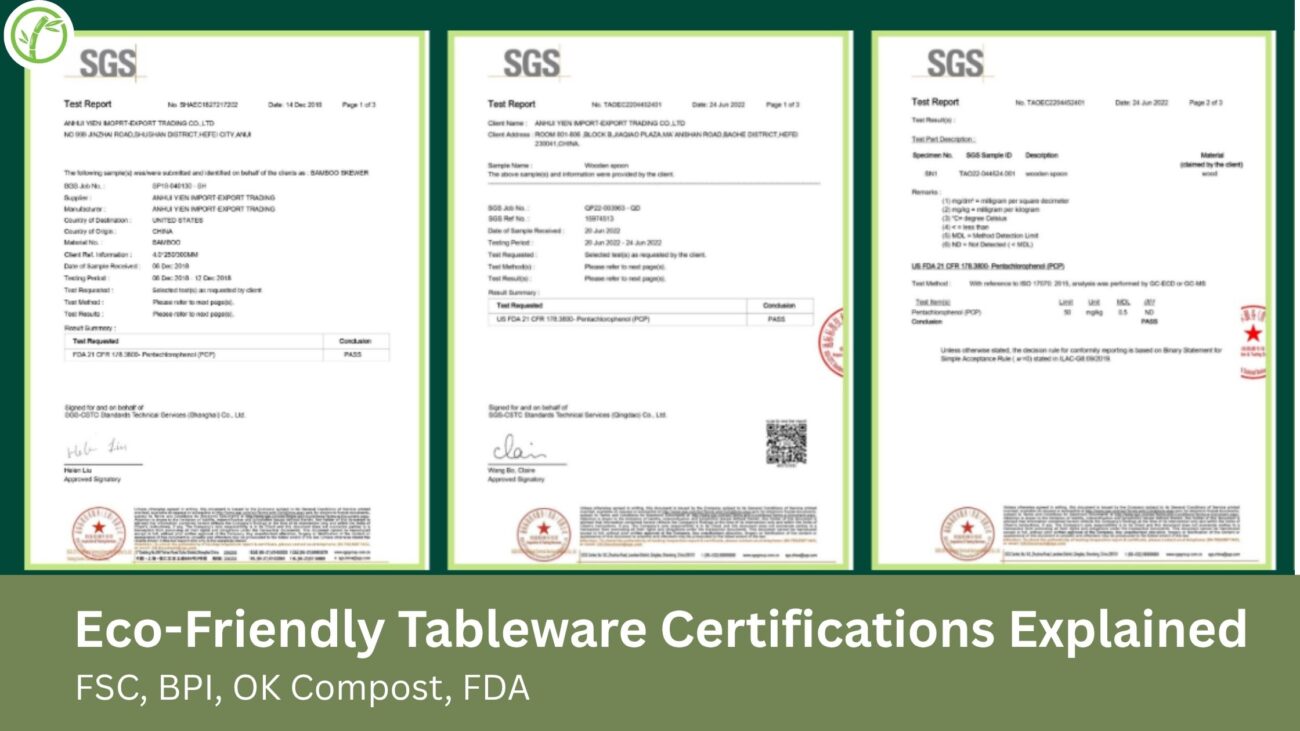
FSC verifies the raw material came from a responsibly managed forest, BPI and OK Compost verify the finished product actually breaks down in a composting facility, and FDA verifies the product is safe for direct food contact. Importers need all three types, not just one, because each certifies a different stage of the product’s life. A plate can be compostable and still fail food-safety testing, or be food-safe and still made from illegally logged wood. No single certification covers all three questions.
Eco-friendly tableware certifications verify a product’s sustainability claims, material safety, and compostability. Key certifications like BPI and ASTM D6400 guarantee that items made from plant-based materials like sugarcane or bamboo actually break down in commercial composting facilities
Quick Reference Table
| Certification | Issuing Body | What It Verifies | Region Focus |
| FSC | Forest Stewardship Council | Raw material sourced from a responsibly managed forest, with chain-of-custody traceability | Global, especially required in EU, North America, Australia |
| BPI | Biodegradable Products Institute | Industrial compostability under ASTM D6400/D6868 standards | North America |
| OK Compost (Industrial / Home) | TÜV Austria | Compostability under EN 13432 (industrial) or home composting conditions | EU and global, TÜV Austria is internationally recognized |
| FDA | U.S. Food and Drug Administration | Food-contact safety under 21 CFR 176/177 — non-toxic, safe migration levels | United States, widely referenced elsewhere |
| LFGB | German food-contact law | The EU/German equivalent of FDA compliance, includes migration testing | Germany, widely recognized across the EU |
| Seedling Logo | DIN CERTCO | Visual mark confirming EN 13432 compliance | Germany and wider EU |
What Does Each Certification Actually Verify?
FSC: Where the Raw Material Came From
FSC (Forest Stewardship Council) certification confirms that the wood or bamboo in a product came from a forest managed under a documented sustainability plan — covering biodiversity protection, worker and indigenous rights, and long-term forest health, verified through annual third-party audits.
Two details matter for importers evaluating an FSC claim:
- The forest and the factory need separate certificates. Even if the raw bamboo or wood comes from an FSC-certified forest, the manufacturer must separately hold FSC Chain-of-Custody (CoC) certification to legally sell the finished product as FSC-certified. A supplier citing “FSC-sourced material” without their own CoC number is not enough.
- FSC labels come in tiers — FSC 100% (all material from certified sources), FSC Mix (a documented blend), and FSC Recycled. A legitimate FSC Mix claim is fully compliant, but the label should say which tier applies.
How to verify: Every valid FSC certificate carries a license number that can be checked against the FSC public database. If a supplier won’t provide one, treat the claim as unverified.
Also read – Wooden Cutlery Sourcing
BPI: Compostability in North America
BPI (Biodegradable Products Institute) certification confirms a product meets ASTM D6400 or D6868 standards and will break down in a commercial composting facility, under controlled high-heat conditions around 55–60°C, within the required timeframe — typically 180 days.
BPI is the certification North American composting facilities and municipal programs most commonly recognize, which matters directly for importers: a product can be genuinely biodegradable in a lab sense and still be rejected by a commercial composter if it lacks BPI certification, because facilities often screen incoming material by certification rather than material type.
OK Compost: Compostability in the EU and Beyond
OK Compost is issued by TÜV Austria and comes in two versions — OK Compost Industrial, which certifies breakdown in commercial composting facilities under the EU’s EN 13432 standard, and OK Compost Home, a stricter certification confirming the product composts in a home compost bin at lower, ambient temperatures.
The distinction matters for importers selling into markets with limited industrial composting infrastructure: a product certified only for industrial composting may have nowhere to actually go in a region without commercial composting facilities, even though the certificate itself is valid.
The Lab Standards Behind BPI and OK Compost
BPI and OK Compost are certification programs, but the actual pass/fail thresholds come from underlying test standards. Knowing these helps an importer understand what “certified compostable” really requires in a lab:
| Standard | Region | Key Thresholds |
| ASTM D6400 | United States / Canada | At least 90% of the material converts to CO₂ within 180 days under composting conditions; at least 90% breaks into pieces small enough to pass a 2mm screen within about 12 weeks; the resulting compost supports normal plant growth with no toxic residue |
| EN 13432 | European Union | At least 90% biodegradation within six months; less than 10% of the original dry weight remains as visible fragments after 12 weeks; mandatory plant-growth testing, sometimes paired with earthworm toxicity testing; tighter limits on heavy metals and contaminants than ASTM D6400 |
| ISO 17088 | International | Broadly equivalent pass criteria to ASTM D6400 and EN 13432, designed so a product meeting ISO 17088 often qualifies for both regional marks without separate testing |
For an importer selling into multiple regions, a product tested to ISO 17088, or one that already carries both BPI and OK Compost marks — usually means a single production batch can legally ship to both North America and the EU without commissioning a second round of lab testing.
FDA: Is It Safe to Eat Off Of
FDA compliance means the tableware has been tested and approved for direct food contact under 21 CFR Part 176 or 177, covering safe migration limits for any substance that could transfer from the material into food. It says nothing about compostability or forest sourcing; it is a food-safety certification only.
For importers, FDA compliance is typically the baseline requirement retailers and restaurant chains check first, since a supplier qualification failure here creates direct liability risk (recalls, import rejections) in a way a missing compostability certificate does not.
Documents to request: the FDA food-contact declaration or certificate of compliance, migration and heavy-metal test reports from an accredited lab, and the specific CFR section that applies to the product’s material.
FSC vs. BPI vs. OK Compost vs. FDA: What Each One Does NOT Cover
This is the most common sourcing mistake, assuming one certification implies the others.
| Certification | Confirms sustainable sourcing? | Confirms compostability? | Confirms food safety? |
| FSC | Yes | No | No |
| BPI | No | Yes (North America standard) | No |
| OK Compost | No | Yes (EU standard) | No |
| FDA | No | No | Yes |
A product needs certifications from more than one column to be genuinely “sustainable and safe”, an FSC-certified plate with no FDA documentation has an unverified food-safety profile, and a BPI-certified container made from non-certified wood has an unverified sourcing chain.
Also read – Bagasse vs Bamboo Tableware
How to Verify a Supplier’s Certification Claims
- Ask for the certificate itself, not just a logo on the website. Certificates include a license or registration number.
- Check the license number against the issuing body’s public database — FSC, BPI (bpiworld.org), and TÜV Austria all maintain searchable registries.
- Confirm the certification scope matches the product, not just the company. A supplier may hold FSC certification for one product line but not another.
- Request independent lab test reports for food-safety and compostability claims, from an accredited lab such as SGS or Intertek, rather than relying on the supplier’s own internal testing.
- Check the certificate’s validity date. FSC and BPI certifications require annual renewal; an expired certificate is not a valid claim regardless of when it was originally issued.
- Ask about PFAS-free testing separately. A product can be BPI-certified and still contain fluorinated grease-resistant coatings unless it has also been independently tested and verified PFAS-free, which is an increasingly common requirement as more US states restrict PFAS in food packaging.
Regional Regulations Snapshot
Certification requirements often track regional plastic and packaging law, so which certificate matters most depends on the destination market:
| Region | Governing Rule | What It Means for Importers |
| United States (federal) | FDA 21 CFR 176/177 | Baseline food-contact requirement for any tableware sold in the US |
| United States (state-level) | State-specific plastic and PFAS restrictions, e.g. California | Certain states require compostable or PFAS-free alternatives beyond the federal baseline |
| European Union | Single-Use Plastics Directive, EN 13432 | Restricts single-use plastic tableware and sets the compostability bar for anything sold as an alternative |
| Germany | LFGB | Food-contact safety law that functions as the EU’s most-referenced national standard |
Because these rules shift by region and are revised periodically, the certificate an importer needs is really a function of the destination market, not a fixed checklist — which is why requesting a supplier’s full certification stack up front, rather than assuming one certificate covers every market, saves a rejected shipment later.
Why This Matters More in 2026
Retailers and restaurant chains are tightening supplier qualification standards, and several US states now restrict or ban PFAS in food packaging, which makes independent PFAS-free verification a practical necessity alongside compostability certification rather than an optional extra. Certified products also tend to clear customs and port inspection faster in the EU, UK, and California, where documentation is increasingly checked at the border rather than only at the retail level.
What Certified Eco-Tableware Looks Like in Practice
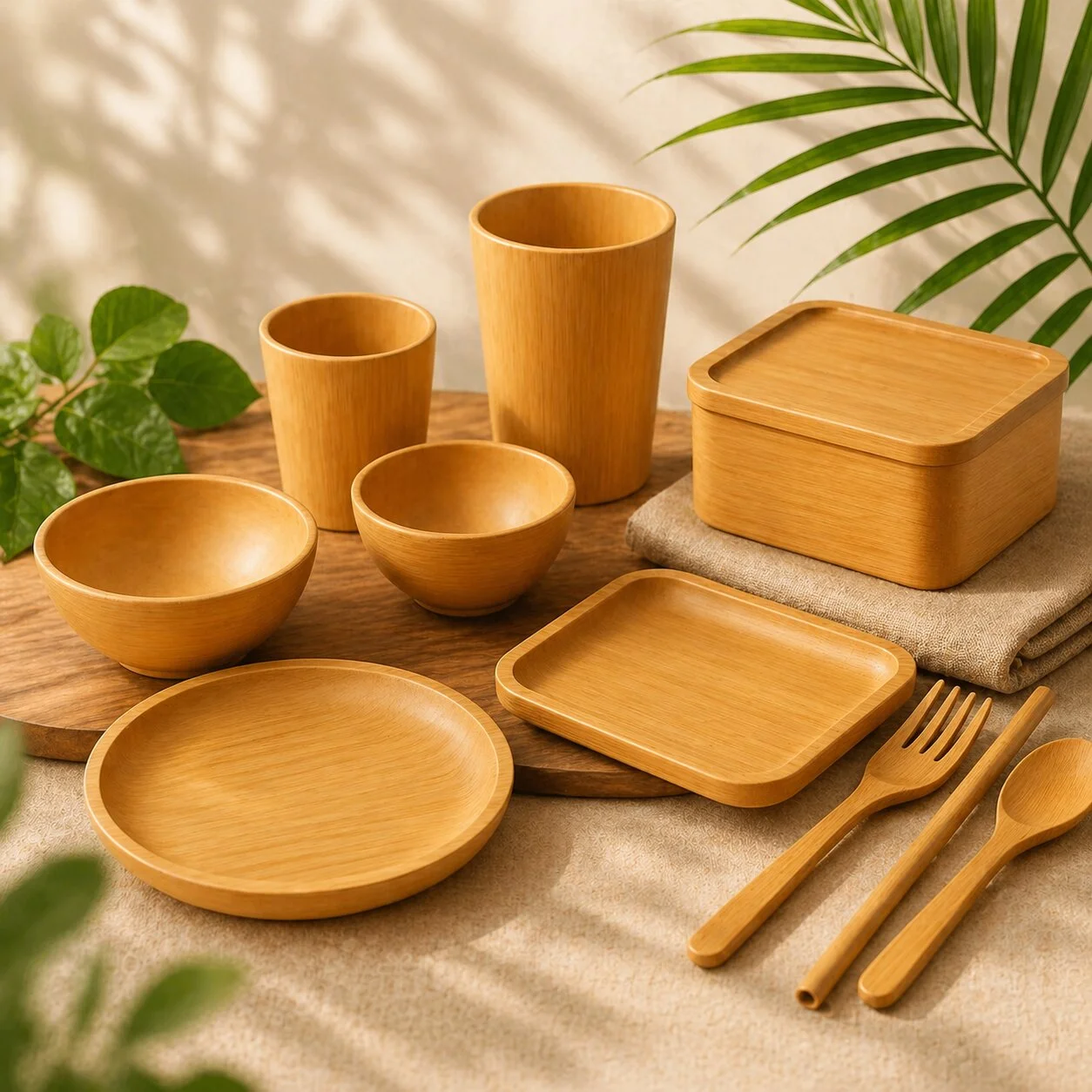
Bamboo, wood, and bagasse tableware manufactured without adhesives, coatings, or bleach can typically carry the full certification stack relevant to importers: FSC or FSC Mix for sourcing, FDA 21 CFR 177 and LFGB for food-contact safety in the US and EU, and ISO 9001/14001 for factory-level quality and environmental management. FriendlyBamboo publishes this documentation across its bamboo cutlery, bamboo plates, and wooden plates product pages, including certificate downloads for procurement and ESG reporting.
Frequently Asked Questions
No. FSC only verifies that the raw wood or bamboo came from a responsibly managed forest. Compostability is a separate claim verified by BPI (North America) or OK Compost/EN 13432 (EU).
It depends on where the product will be composted. BPI is the standard most recognized by North American composting facilities; OK Compost, issued by TÜV Austria under EN 13432, is the standard most recognized across the EU. Many importers selling in both regions request both.
No. FDA compliance only confirms the product is safe for direct food contact — it says nothing about sourcing, compostability, or environmental impact. A plastic product can be FDA-compliant without being eco-friendly at all.
Both test industrial compostability, but EN 13432 (the EU standard) adds stricter ecotoxicity testing and a tighter fragmentation deadline than ASTM D6400 (the US/Canada standard). BPI certification is built on ASTM D6400; OK Compost Industrial is built on EN 13432. A product tested to ISO 17088 often satisfies both.