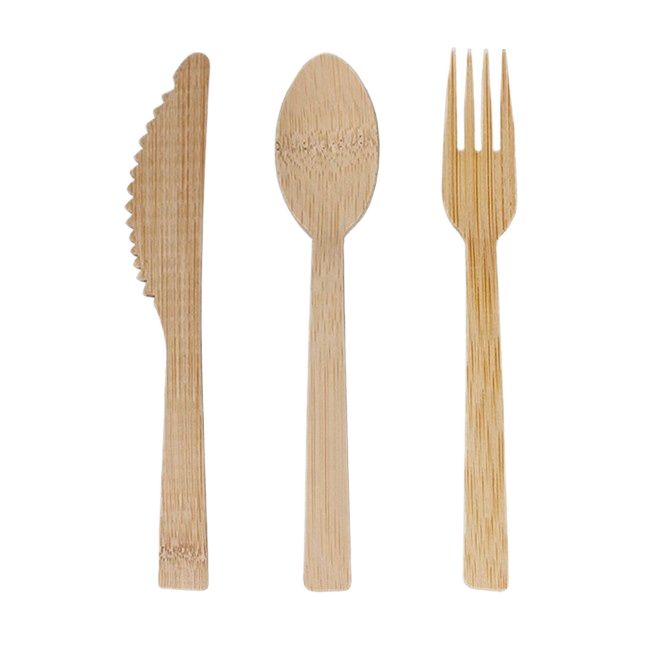
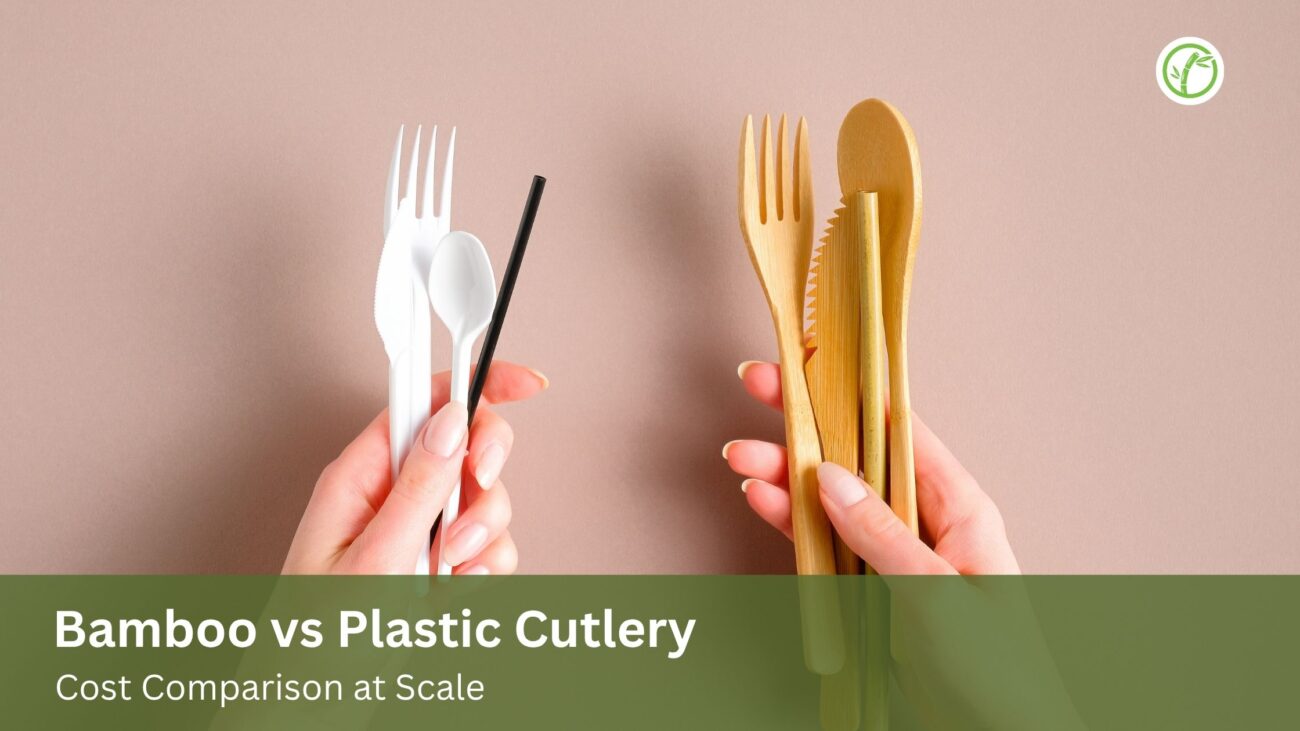
Bamboo vs Plastic Cutlery: At wholesale volume, plastic cutlery is cheaper on sticker price, roughly $0.01–$0.03 per fork versus $0.02–$0.05 for bamboo, but the gap is a fraction of a cent per unit, and it narrows further once regulatory risk, disposal exposure, and customer perception are counted as real costs rather than externalities. For a business ordering in the tens or hundreds of thousands of units, that per-unit difference adds up to real dollars, which is exactly why the decision deserves a proper scale comparison rather than a single price point pulled from one supplier’s listing.
Bamboo vs Plastic Cutlery: Per-Unit Pricing by Order Volume
| Order Volume | Plastic Fork (per unit) | Bamboo Fork (per unit) | Price Gap |
| 1,000–10,000 units | $0.015–$0.03 | $0.04–$0.06 | ~2–3x |
| 50,000 units | $0.01–$0.02 | $0.02–$0.04 | ~1.5–2x |
| 100,000+ units | $0.008–$0.015 | $0.02–$0.03 | ~1.5–2x |
| 500,000+ units | $0.007–$0.012 | $0.015–$0.025 | ~1.3–1.8x |
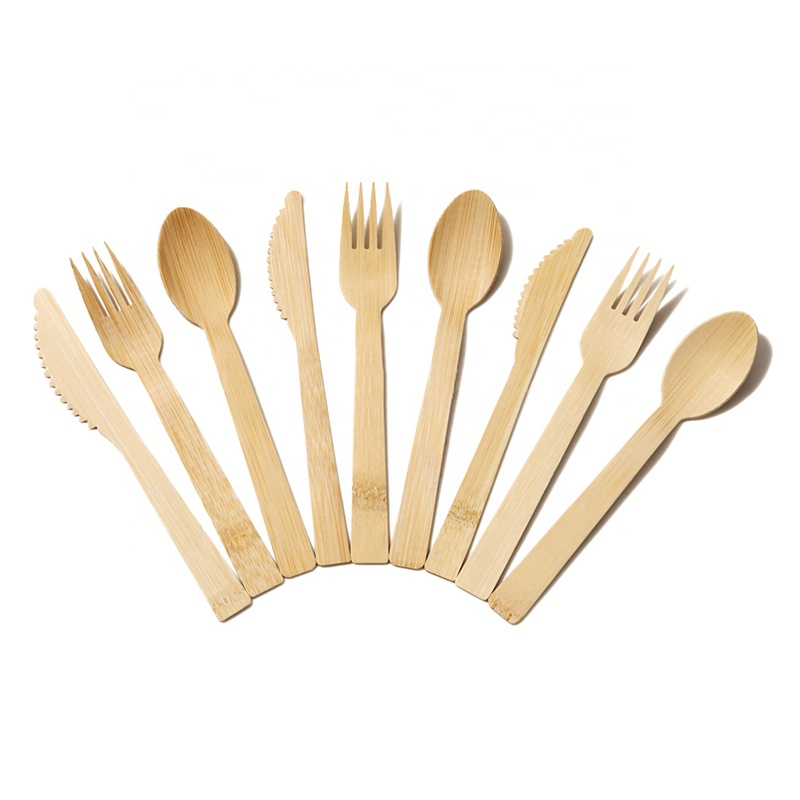
Bamboo knives generally run $0.03–$0.05 per unit at wholesale volume, a few tenths of a cent above forks and spoons, due to the extra serration step in production. Pre-wrapped three-piece bamboo cutlery sets (fork, knife, spoon, napkin) typically cost $0.08–$0.15 unbranded and $0.12–$0.20 with custom branding, which is the format most restaurants and delivery platforms actually order rather than loose utensils.
The pattern across every volume tier is the same: the absolute price gap shrinks as order size grows, but it never fully closes, because plastic’s raw material and molding cost per unit stays structurally lower than bamboo’s harvesting and pressing cost. If your only metric is the lowest possible sticker price, plastic wins at every volume tier tested here.
Also read – How long do bamboo disposable products last in storage before use?
What “Cost” Actually Means at Scale
Sticker price is the easiest number to compare and the least complete one. For a buyer ordering hundreds of thousands or millions of units a year, three additional cost categories matter more the larger the operation gets:
Regulatory risk. Over 250 cities and counties in the United States have passed restrictions on single-use plastic foodware, the EU banned single-use plastic cutlery outright in 2021, and India, Australia, Canada, and the UAE have all introduced or expanded similar bans. A large buyer holding a big plastic inventory when a new restriction takes effect locally isn’t just facing a compliance problem — they’re facing an emergency sourcing situation, and emergency sourcing on short notice is reliably more expensive than planned procurement at normal lead times.
Disposal and waste-handling exposure. Some municipalities now charge higher waste-disposal or landfill fees for non-compostable foodservice packaging, or exclude businesses using plastic disposables from reduced-fee green-waste programs. This is a genuine operating cost, not a marketing consideration, in jurisdictions where it applies.
Customer perception, at scale. For a business processing tens of thousands of covers a week, a visible material choice becomes a repeated brand signal across a very large number of customer touchpoints. That’s not quantifiable the way a per-unit price is, but it compounds in a way a single small business’s utensil choice doesn’t.
A Worked Example at 1 Million Units a Year
For a large caterer or delivery operation ordering 1 million forks annually:
| Cost Component | Plastic | Bamboo |
| Base unit cost (approx.) | $8,000–$15,000/year | $15,000–$25,000/year |
| Sticker price difference | — | +$7,000–$10,000/year |
| Regulatory risk exposure | Real, if operating in or expanding into a restricted jurisdiction | None |
| Disposal fee exposure | Possible, depending on local waste rules | Generally none, and sometimes reduced |
| Emergency resourcing risk if a ban takes effect | High — full inventory and supplier relationship needs replacing on short notice | None |
At this scale, the sticker-price gap is a five-figure annual difference — real money, and not one to wave away. But it’s also a fixed, plannable cost, whereas the regulatory and emergency-sourcing risk on the plastic side is an unplanned cost that only shows up if and when a restriction hits, at which point it tends to be far more disruptive than the cumulative savings that got you there.
When Plastic Still Makes Sense
In fairness to the sticker-price argument: if your operation serves exclusively cold food, in a jurisdiction with no existing or pending plastic restrictions, and cost per unit is genuinely the only variable that matters to your margins, plastic remains the cheaper choice at every volume tier in this comparison. Bamboo’s performance advantages — heat resistance, structural strength with hot or oily food — are real but irrelevant if your menu never puts a utensil under that kind of stress. The decision isn’t a moral one; it’s a question of which cost factors actually apply to your specific operation and market.
Sourcing at Volume
Large-volume buyers evaluating this switch typically want firm pricing at their specific order size rather than a general range, since the exact price point shifts meaningfully between a 50,000-unit trial order and a 500,000-unit annual contract. FriendlyBamboo manufactures bamboo cutlery forks, knives, spoons, and pre-wrapped sets — to FDA 21 CFR 177 standards with volume-tiered pricing, and supplies bamboo chopsticks and straws for buyers standardizing an entire disposables line on one material. Operations sizing a large annual order can request a bulk quote for exact pricing at their specific volume tier.
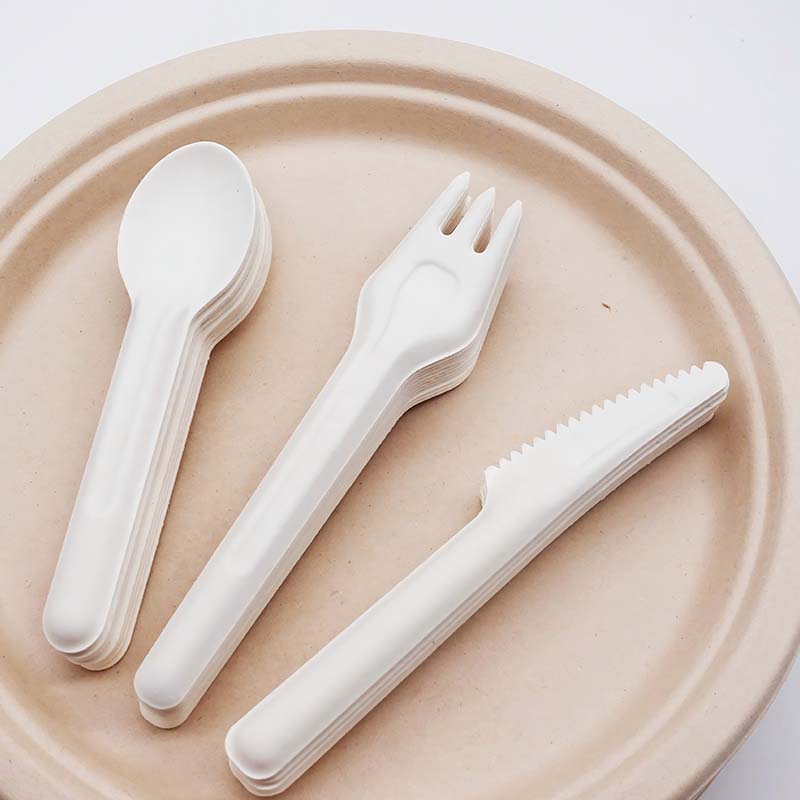
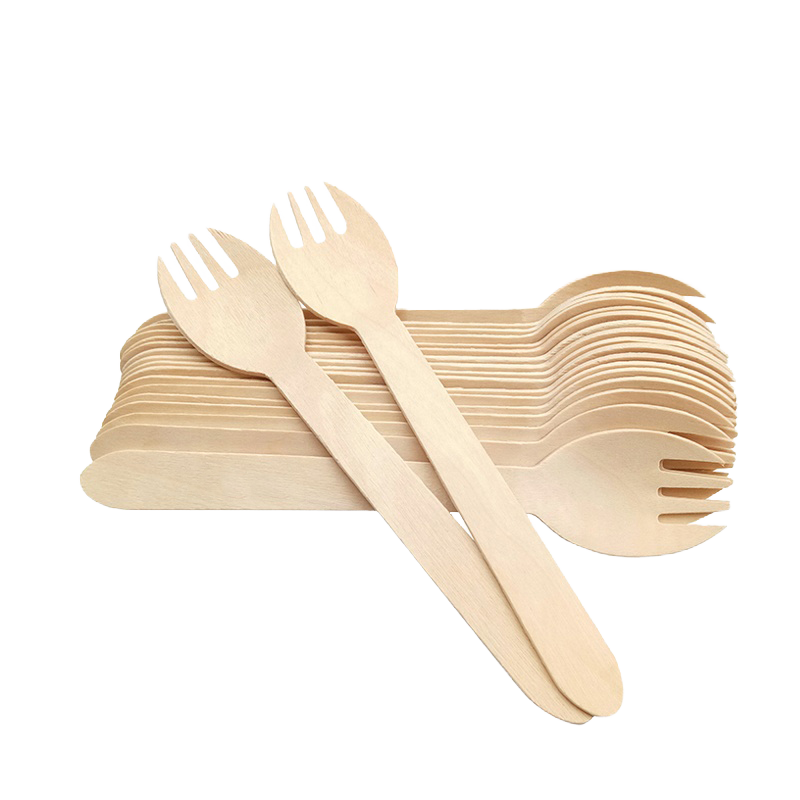
Must read – Bamboo vs bagasse vs wood
Frequently Asked Questions – Bamboo vs Plastic Cutlery
At high volume (100,000+ units), bamboo typically costs roughly $0.02–$0.03 per fork versus $0.008–$0.015 for plastic — a gap of about $0.01–$0.02 per unit, or roughly $10,000–$20,000 more per million units ordered.
Yes, proportionally — both materials get cheaper per unit as order volume increases, and bamboo’s relative markup over plastic narrows from roughly 2–3x at small volumes to 1.3–1.8x at very large volumes. It doesn’t fully close because the two materials have different underlying production costs.
Not on a pure per-unit basis — plastic remains cheaper at the register in every scenario. Bamboo becomes the stronger financial decision once regulatory risk, potential disposal fees, and the cost of emergency resourcing after a ban are counted as real, if unpredictable, costs rather than ignored.
Operations serving only cold food, in markets without existing or likely plastic restrictions, where per-unit cost is the only decision factor, will still find plastic the cheaper option at every volume level — the calculation changes specifically when hot food performance, regulatory exposure, or customer-facing brand signal become relevant.