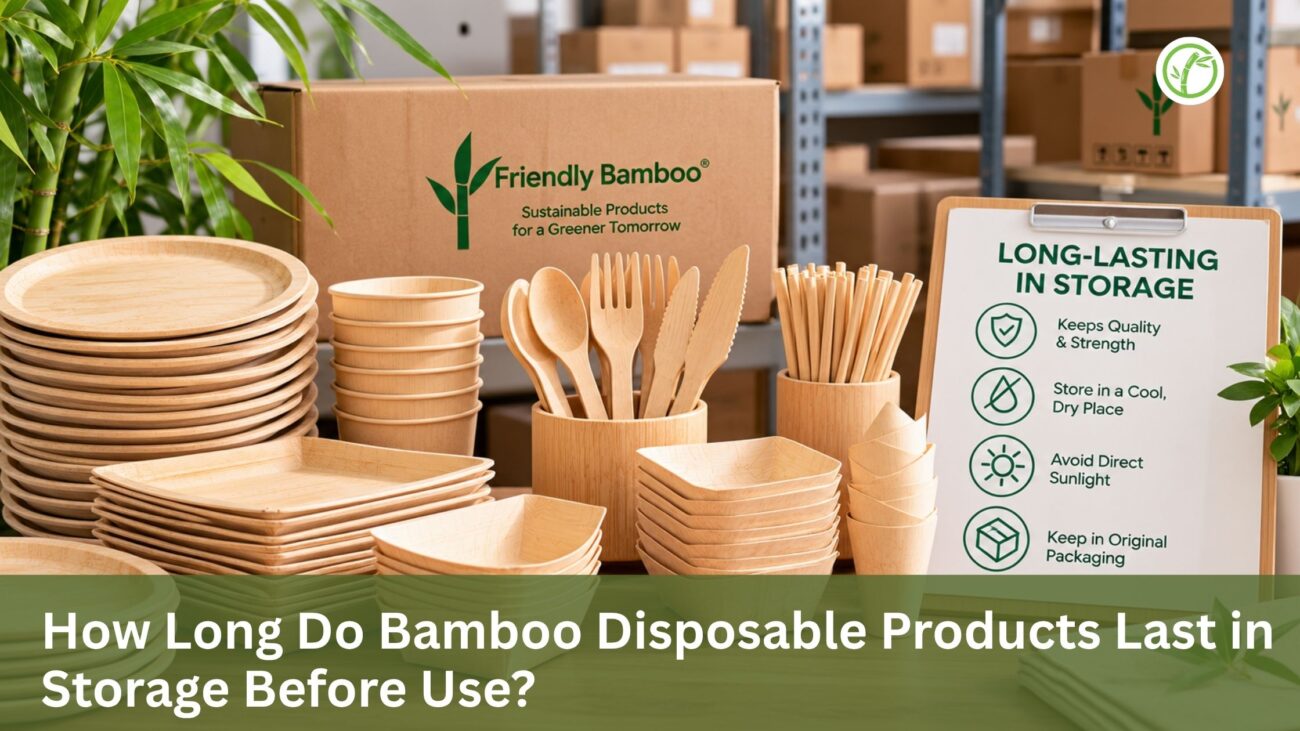
How Long Do Bamboo Disposable Products Last in Storage Before Use? Disposable bamboo tableware and cutlery typically last one to three years in storage before use, with two to three years being the figure most commonly cited by manufacturers for products stored sealed, dry, and off the ground. The actual lifespan depends far more on storage humidity than on time alone. This “shelf life before use” is a completely different measurement from compost time after disposal, which is only 60–180 days a distinction worth being clear on before placing a bulk order sized for a full year or more of inventory.
Shelf Life vs. Compost Time: Two Different Numbers
These get confused constantly, and they matter for different reasons:
| Measurement | Typical Range | What It Tells You |
| Shelf life (storage before use) | 1–3 years | How long unused stock stays usable in your warehouse or back-of-house storage |
| Compost time (after disposal) | 60–180 days | How quickly the product breaks down once it’s thrown out or composted |
A product with a short compost time isn’t a product that degrades quickly on your shelf; bamboo is designed to hold up in storage for years and then break down relatively quickly once it’s actually composted under the right conditions. Confusing the two can lead a buyer to either under-order out of unfounded worry about stock “going bad,” or over-order without accounting for the fact that storage conditions, not just time, determine how long that stock is actually reliable.
What Actually Determines Shelf Life: Humidity, Not Just Time
Bamboo is a natural, porous material, and its main enemy in storage isn’t age; it’s moisture. Research on bamboo storage shows mold risk is directly tied to relative humidity (RH), not simply how long a product sits in a warehouse:
- Below roughly 60% RH, mold growth is minimal regardless of storage duration.
- Around 70% RH, visible mold can develop in roughly 100 days.
- At 80% RH, that drops to roughly 10 days.
- At 90–100% RH — the kind of condensation that can build up inside a shipping container during temperature swings at sea, sometimes called “container rain” visible mold can appear in as little as 1–2 days.
This is why two cartons of the same product, packed on the same day, can have very different outcomes: one stored in a cool, dry, ventilated space easily reaches the 2–3 year range, while one left in a humid, poorly ventilated storeroom can develop surface mold within weeks, regardless of how it was packaged at the factory.
Also read – Bamboo vs Bagasse vs Wood
Recommended Storage Conditions
- Keep humidity below 60% RH where possible. This is the single biggest lever for extending usable shelf life, more significant than temperature control alone.
- Store in a cool, dry, well-ventilated area — avoid basements, garages, or any space prone to dampness or poor air circulation.
- Keep cartons off the floor, on pallets or shelving, to avoid moisture wicking up from concrete or damp flooring.
- Avoid sealing products in plastic film for long-term storage. Breathable cartons with ventilation allow trapped moisture to escape; sealed plastic can trap humidity against the product and accelerate mold risk rather than prevent it.
- Keep products away from heat sources like ovens, steam tables, or direct sunlight, which can accelerate material degradation over time even without a humidity problem.
- Use first-in, first-out (FIFO) rotation — the same principle used for food inventory, so older stock is used before newer stock, keeping your actual average storage time well under the maximum shelf life.
Signs a Batch Has Gone Bad
Before using stored bamboo tableware, cutlery, chopsticks, or straws, especially stock that’s been sitting for a year or more, or that came from a shipment with an uncertain storage history, check for:
- Visible surface mold or dark spotting, especially in corners, folds, or anywhere air circulation is limited.
- A musty or damp smell when opening a carton, which often shows up before visible mold does.
- Softness, warping, or a spongy feel compared to a fresh piece from the same product line, indicating the material has absorbed moisture.
- Discoloration beyond normal grain variation — natural bamboo grain varies piece to piece, but uniform darkening or blotching is a different signal.
If any of these show up, the safest move is to isolate and discard the affected batch rather than use it, particularly for anything going into direct food contact.
How This Affects Ordering and Inventory Planning
Because shelf life is measured in years rather than weeks, most distributors and restaurants can safely order 2–3 months of covers at a time, the standard recommendation for wholesale bamboo tableware for restaurants — without worrying about stock expiring before it’s used, as long as storage conditions are reasonable. The bigger planning consideration is usually reorder lead time (20–35 days by sea freight from most manufacturers) rather than shelf life itself, since a well-stored batch of bamboo cutlery, bamboo chopsticks, or bamboo straws will comfortably outlast a normal reorder cycle.
The one exception worth planning around is humid climates or seasonal storage gaps; a distributor in a tropical or coastal region, or one holding stock through a rainy season, should budget for active humidity control (dehumidifiers, climate-controlled storage) rather than assume the general 2–3 year figure applies unconditionally, since that figure assumes reasonably controlled storage conditions to begin with.
Also read – Bamboo Cutlery Manufacturers in China
Frequently Asked Questions
Most manufacturers cite a general shelf life of two to three years for bamboo disposable tableware and cutlery stored properly — cool, dry, ventilated, and off the ground. This is separate from how quickly the product composts after use, which is a matter of weeks or months, not years.
Not in the same sense. There’s no safety cutoff date the way there is for perishable food; the real risk is mold growth from prolonged high humidity, not a fixed expiration point. A product stored well can remain fully usable well past the general 2–3 year guideline, while one stored poorly can develop problems in weeks.
Keeping storage humidity below roughly 60% relative humidity keeps mold risk minimal regardless of storage duration. Risk increases sharply above 70% RH, and at 90%+ RH — the kind of condensation that can occur inside a shipping container- visible mold can develop in as little as a day or two.
No — discard any affected pieces, and inspect the rest of that carton closely, since the humidity that caused visible mold on some pieces has likely affected the whole batch even where it isn’t visible yet. Don’t use affected stock for direct food contact.