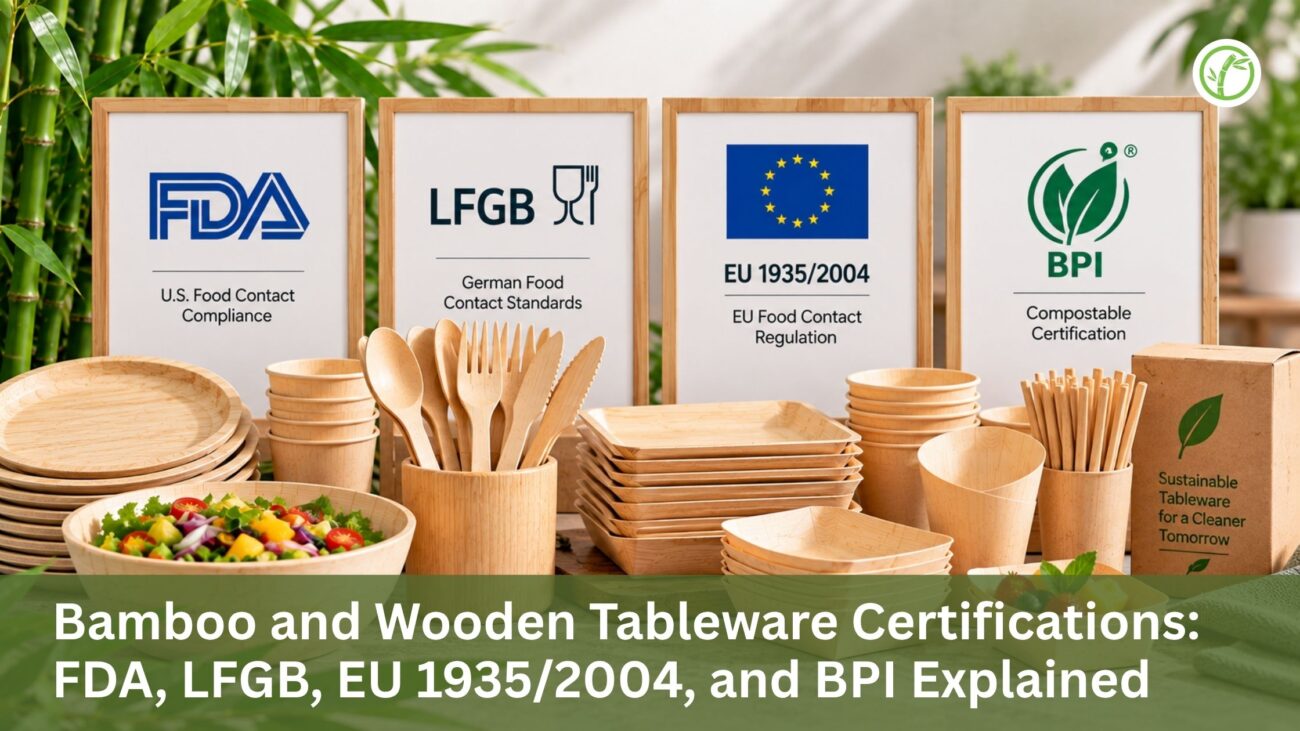
Bamboo and wooden tableware certifications: FDA compliance confirms a product meets US food-contact safety standards. LFGB is Germany’s equivalent and the common benchmark requested across the broader EU market. Neither one substitutes for the other, and buyers selling into both regions need both, not just the version that applies to their home market.
Here’s what each certification actually covers, which one applies to which market, and what documentation to request before placing an import order.
FDA compliance vs. LFGB: what’s the actual difference?
FDA compliance verifies a product meets US food safety standards for materials that touch food, and it’s required for import and sale in the United States. LFGB (Germany’s Food and Feed Code) is the food contact materials standard used across Germany and, in practice, treated as a common reference point for the broader EU market, particularly by German and other European retailers.
Both certify food safety. Neither one certifies compliance with the other market. A supplier being “FDA compliant” says nothing about whether their product has passed LFGB testing, and vice versa. If you’re selling into Germany or other EU supermarkets, request LFGB test reports specifically, don’t assume FDA documentation covers it.
What does EU Regulation 1935/2004 require for imported bamboo and wooden tableware?
EU Regulation 1935/2004 is the overarching EU framework requiring that any material or article intended to contact food is safe and doesn’t transfer substances into that food in quantities that could harm human health. It applies broadly; food packaging, kitchenware, tableware, and food-processing equipment are all covered.
Importers bringing bamboo and wooden tableware into the EU need to be able to demonstrate compliance, typically through a Declaration of Conformity backed by third-party lab test reports. This isn’t optional paperwork; it’s the baseline requirement for legally placing the product on the EU market at all.
What is a Declaration of Conformity, and when is it required?
A Declaration of Conformity (DoC) is a formal written statement from the manufacturer or importer confirming a product complies with the relevant EU regulations, primarily EU 1935/2004 for food contact materials. It’s required for any bamboo, bagasse, or wooden food-contact product sold in the EU, and it should be backed by third-party test reports rather than issued as an unsupported claim.
If you’re importing into Europe, request this document from your supplier at the time of ordering, not after the shipment has already left the factory. A supplier that regularly exports to EU markets should have this readily available; if they don’t, that’s worth treating as a red flag rather than a formality to chase down later.
Also read – wholesale bamboo disposable products
What documents does the US require to import bamboo food-contact products?
US import of bamboo food-contact products typically requires:
- Commercial invoice
- Packing list
- Bill of lading
- Certificate of origin
- FDA prior notice (for food-contact items specifically)
- Test reports demonstrating compliance with FDA food contact material standards
The FDA prior notice and compliance test reports are the parts that trip up buyers unfamiliar with food-contact imports specifically; standard customs paperwork alone doesn’t cover this category. FDA’s own guidance on food contact substance compliance outlines how this determination is made if you want to verify a supplier’s documentation against the actual regulatory standard rather than taking a compliance claim at face value.
What does FSC certification mean, and why does it matter?
FSC (Forest Stewardship Council) certification confirms a product’s raw material comes from responsibly managed sources, verified through an independent chain-of-custody audit rather than a supplier’s self-declaration. For bamboo and wood products specifically, this is the standard sourcing claim buyers should request, and it should come with a checkable license number, not just a logo printed on a spec sheet or product page.
A license number lets you verify the certification independently through FSC’s own database, which matters more than it might seem, unverifiable sustainability claims are common enough in this category that verification is worth the extra 5 minutes.
What is BPI certification, and when does it matter for North American buyers?
BPI (Biodegradable Products Institute) certification is the leading North American standard for compostability, verifying a product meets ASTM D6400 (for plastics and films) or ASTM D6868 (for coated paper and packaging). It’s specifically relevant if you’re selling into the US or Canada and want to make a “compostable” claim, since that labeling requires BPI verification to carry credibility with retailers, commercial composting facilities, and sustainability-conscious buyers.
Not every bamboo or bagasse product line will have BPI certification by default; confirm availability for the specific product you’re sourcing rather than assuming it applies across a supplier’s full catalog.
Are third-party lab reports (SGS, Intertek, Bureau Veritas) available on request?
They should be. A supplier confident in their compliance documentation will make third-party test reports from SGS, Intertek, Bureau Veritas, or an equivalent accredited lab available for specific products on request, not just a general certification summary. If a supplier can’t produce a specific report tied to the product you’re ordering, that’s a gap worth resolving before placing a bulk order, not after.
Also read – Bagasse Tableware Manufacturers in China
What certifications do European supermarkets actually require?
Buyers targeting major European supermarket chains typically need a fuller stack than a single certification covers:
- FSC certification for sourcing claims
- EU food contact compliance (a Declaration of Conformity under 1935/2004)
- Compostability certification where relevant (commonly EN 13432 for the EU market, the rough equivalent of BPI/ASTM in North America)
- BSCI or an equivalent ethical sourcing audit
- Test reports from an accredited lab
This is a meaningfully higher documentation bar than a single-market US or general wholesale order, since European retail buyers are themselves accountable to regulators and their own sustainability commitments. Confirm your supplier holds the specific combination your target retailer requires, rather than assuming general “certified” language on a product page covers the full stack.
A quick reference: which certification for which market
| Certification | Market | Confirms |
| FDA compliance | United States | Food-contact material safety |
| LFGB | Germany, broader EU benchmark | Food-contact material safety |
| EU 1935/2004 (via DoC) | European Union | Food-contact material safety, EU legal requirement |
| FSC | Global, sourcing claims | Responsibly managed raw material sourcing |
| BPI (ASTM D6400/D6868) | US, Canada | Compostability |
| EN 13432 | European Union | Compostability, EU equivalent to BPI |
| BSCI | Global | Ethical supply chain practices |
Verifying documentation before you order
Certification claims are only as useful as your ability to verify them. Before placing a bulk order, request the specific test reports and license numbers relevant to your target market, and confirm them independently rather than relying on marketing language. For a broader look at sourcing, MOQ, and private label questions alongside certification, our wholesale bamboo disposable products FAQ guide covers the rest of what buyers typically need answered before a first order.
Also read – bamboo vs plastic cutlery
Frequently asked questions
No. FDA and EU food-contact standards (1935/2004, LFGB) are separate regulatory frameworks. A product compliant with one isn’t automatically compliant with the other, request the specific documentation for the market you’re importing into.
They verify different things entirely. BPI confirms compostability, that a product breaks down safely in a commercial composting facility. FSC confirms sourcing, that the raw material came from a responsibly managed forest or bamboo source. A product can hold one, both, or neither.
Yes, for any bamboo, bagasse, or wooden product intended for food contact. The DoC should be backed by third-party test reports, not issued as a standalone statement without supporting documentation.
It’s not a legal EU-wide requirement in the way 1935/2004 is, but it’s a commonly requested benchmark by German and other European retailers specifically, treat it as a practical requirement if you’re targeting those buyers, even though the underlying legal requirement is 1935/2004.