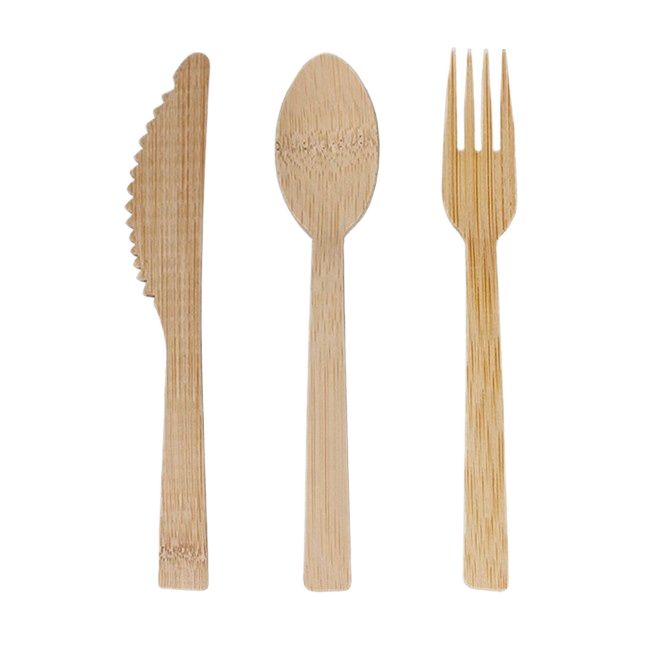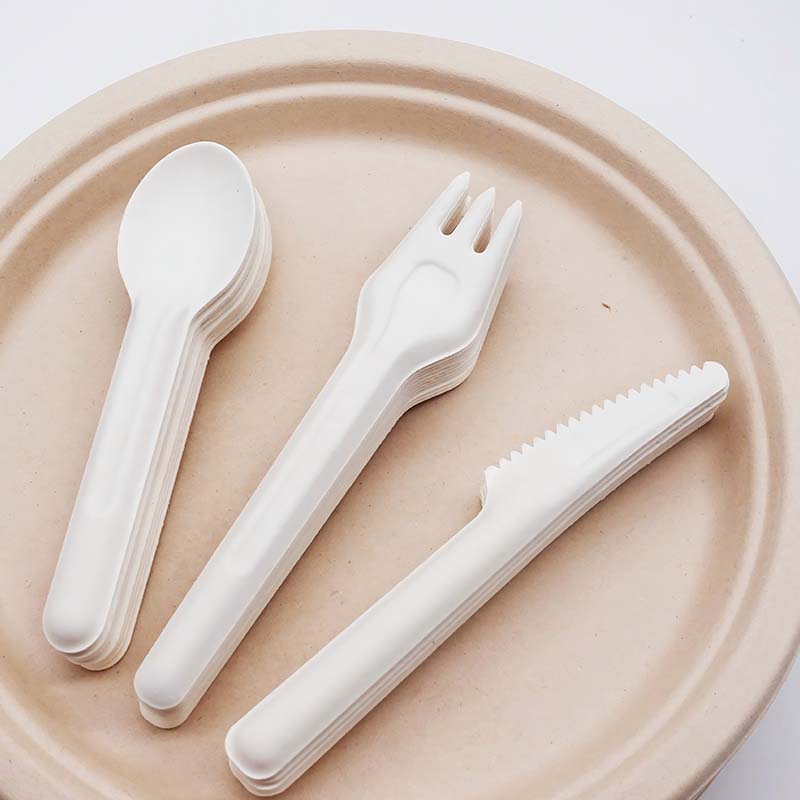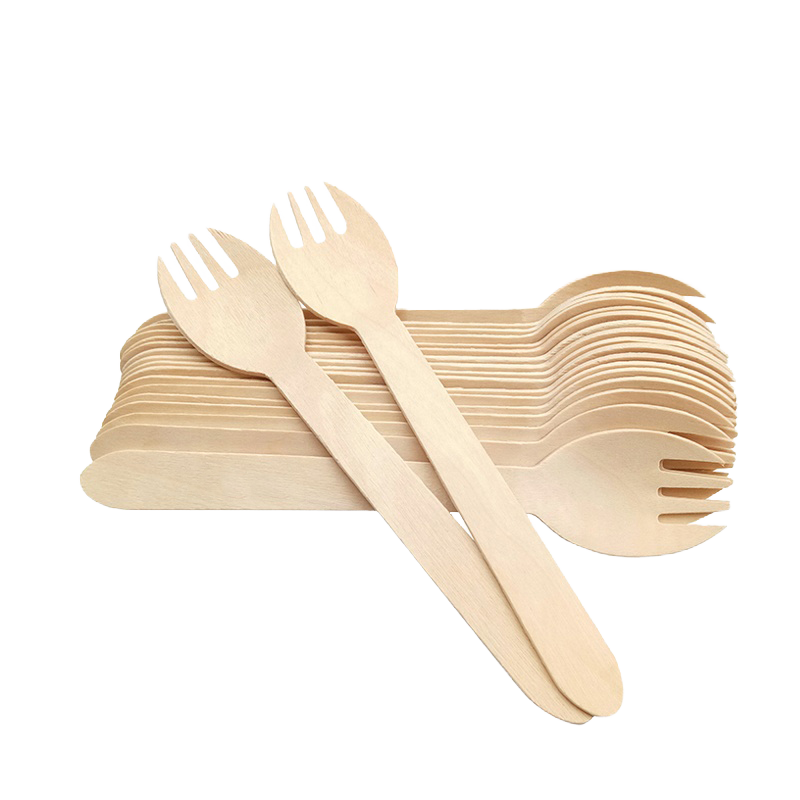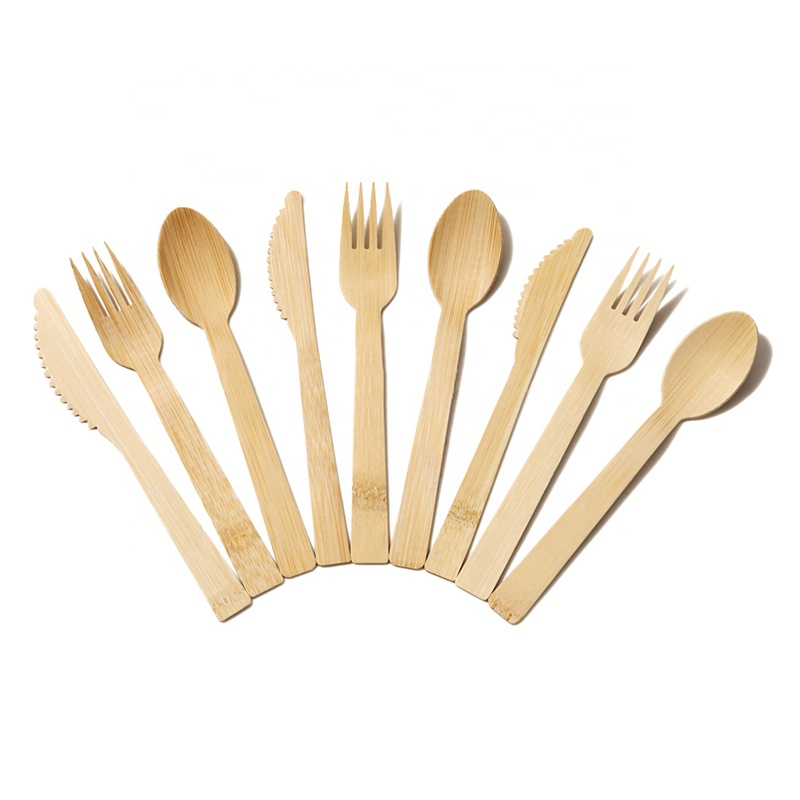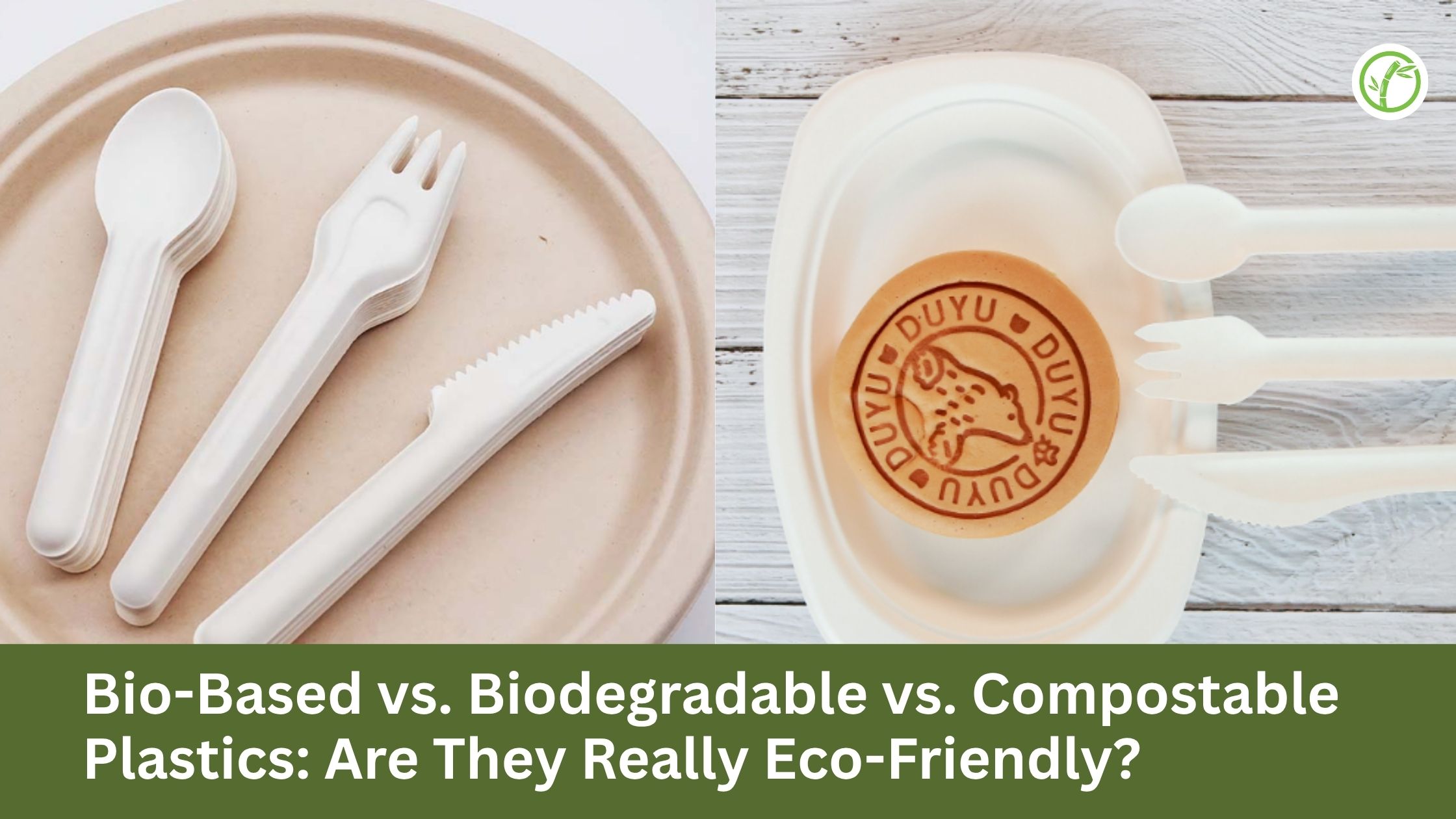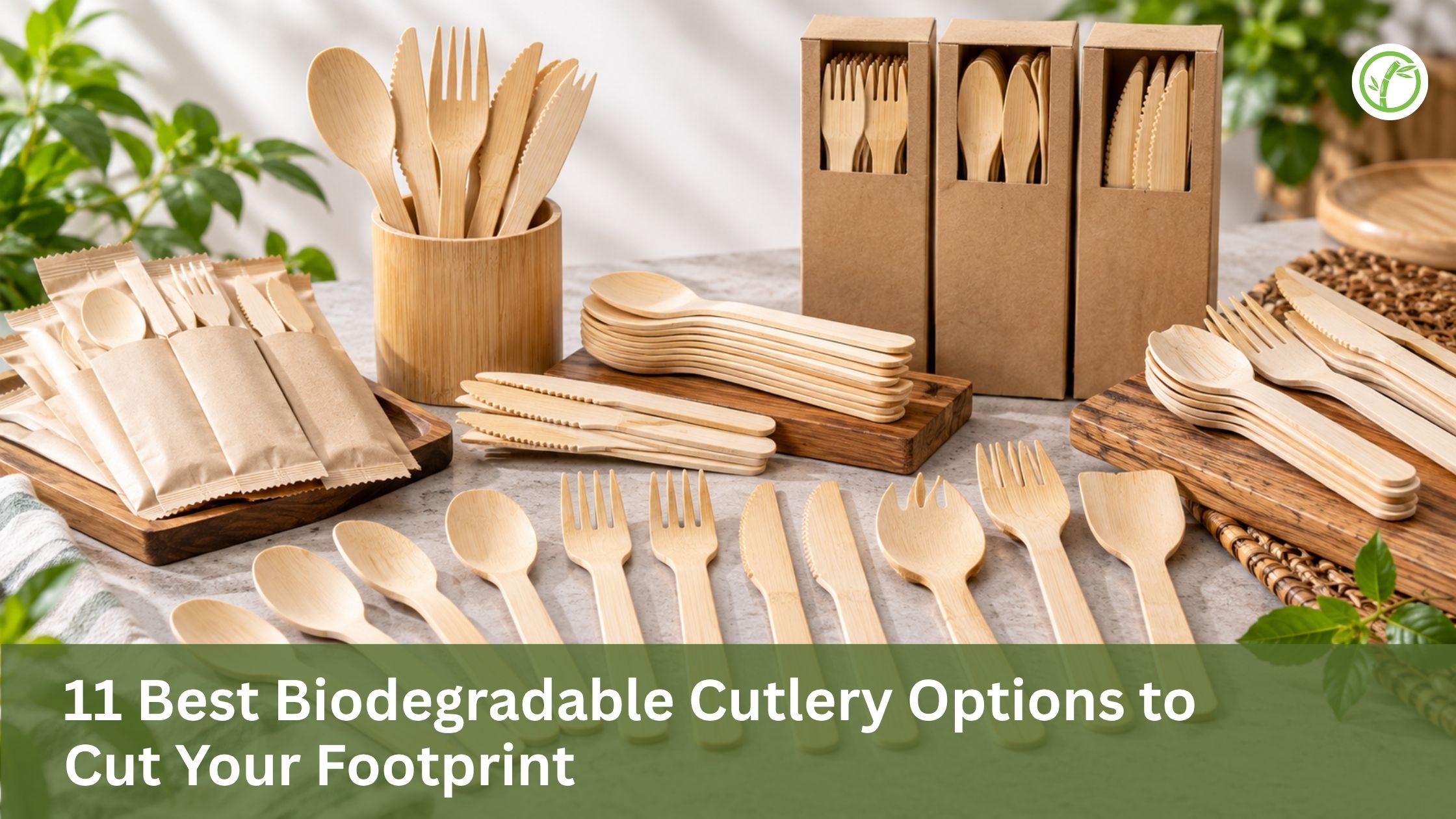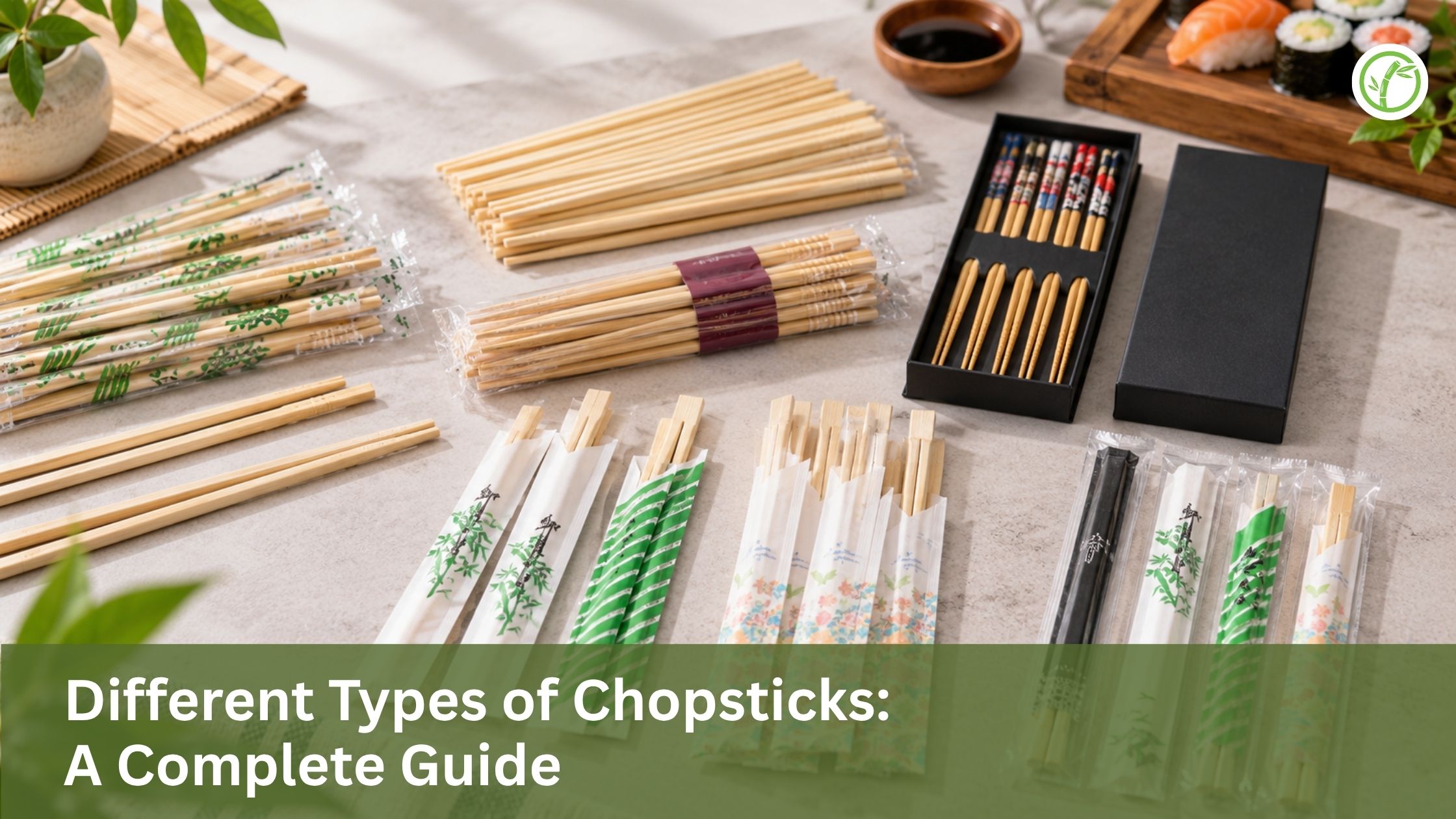
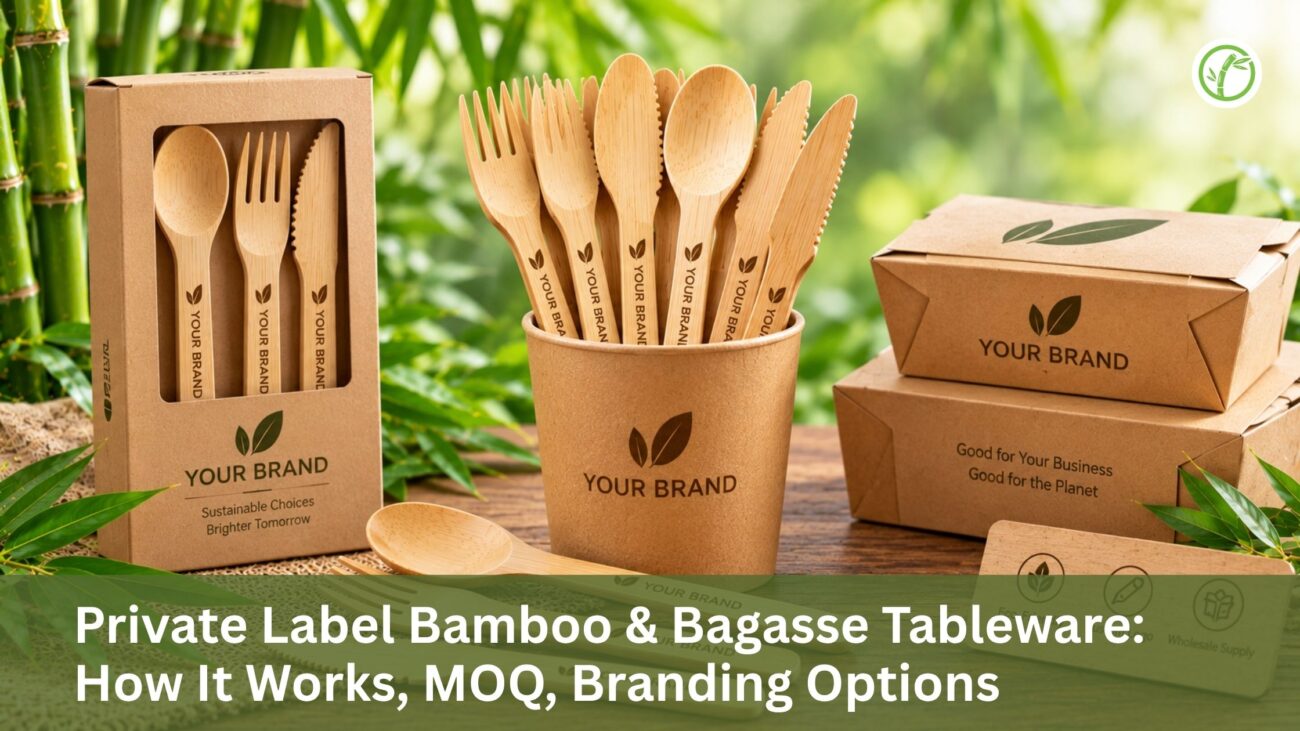
Private label bamboo and bagasse tableware means a factory manufactures plates, bowls, cutlery, or straws under your own brand name, logo, and packaging rather than the manufacturer’s. MOQs typically start around 10,000 pieces for basic logo printing and rise for custom molds or full retail packaging, with sample production taking 7–10 days and mass production 25–35 days. The lower the level of customization, the lower the MOQ: printing your logo on an existing product shape is far more accessible than commissioning a custom mold or fully bespoke retail packaging.
What “Private Label” Actually Means in This Industry
Private label (sometimes called OEM or white-label) covers a spectrum, not a single service. It’s worth knowing where each option sits before requesting quotes:
- Logo printing on an existing product — your logo applied to a standard plate, bowl, or cutlery shape the factory already produces. Lowest cost, lowest MOQ, fastest turnaround.
- Branded sleeves or wraps — a printed paper band around the product (common on bagasse bowls and cups) carrying your logo, artwork, and sustainability messaging. Cost-effective when order volumes don’t yet justify direct printing.
- Custom carton and retail packaging — your branding on the outer shipping carton or a retail-ready box with barcodes and product information, while the product itself may remain unbranded or lightly branded.
- Full private label / white-label — your brand across the product, lids, packaging, and accompanying documentation, with no visible trace of the manufacturer. This is the complete programme distributors and retail brands typically mean by “private label.”
- Custom mold/custom shape — a genuinely bespoke product shape or size made specifically for your brand, rather than customization of an existing product. This is the most expensive and highest-MOQ tier, since it requires new tooling.
MOQ by Branding Method
| Branding Method | Typical MOQ | Lead Time (Sample) | Lead Time (Mass Production) |
| Logo printing on existing product | 10,000 pcs | 7–10 days | 25–35 days |
| Branded sleeve/wrap | 10,000 pcs | 7–10 days | 25–35 days |
| Custom carton / retail packaging | 10,000–20,000 pcs | 10–14 days | 25–35 days |
| Full private label (product + packaging) | 10,000–50,000 pcs | 10–14 days | 30–45 days |
| Custom mold / bespoke shape | 5,000+ pcs (tooling-dependent) | 3–5 weeks (mold development) | 30–45 days after mold approval |
MOQ depends primarily on the level of customization rather than the material itself. Bamboo and bagasse products follow broadly similar MOQ tiers for the same branding method, since the constraint is usually the printing or packaging minimum run, not the base material batch.
Also read – How to Start an Eco-Friendly Tableware Distribution Business
How the Private Label Process Works, Step by Step
- Choose your base products. Select from the manufacturer’s existing catalog — for example, bamboo plates, bagasse bowls, or bamboo cutlery — rather than starting from a blank design, unless you specifically need a custom mold.
- Decide your branding tier. Match your order volume and budget to one of the five branding levels above. Most first-time private label buyers start with logo printing or branded sleeves rather than a full white-label programme.
- Submit design files. Suppliers generally require print-ready artwork (vector files for logos) that meets their printing specifications; most can also assist with basic design adaptation.
- Approve a physical sample. Always request a physical sample before committing to a bulk order; a proof on screen doesn’t show how ink sits on a natural, grained bamboo surface or a matte bagasse finish, which can shift color and clarity from the digital mockup.
- Confirm certifications transfer correctly. Private labeling changes the packaging and branding, not the underlying material, but confirm your supplier will provide certificate documentation (FSC, FDA, BPI) that matches your branded SKU, not just the generic product line.
- Place the bulk order and confirm Incoterms. Standard export terms (FOB, CIF, DDP) apply the same way to private label orders as to unbranded wholesale orders.
- Plan for a repeat-order buffer. Because mass production runs 25–45 days depending on complexity, private label buyers typically reorder before stock is fully depleted rather than waiting for a stockout, given the lead time involved.
Branding Options by Product Type
Different products in the bamboo and bagasse range support different branding methods based on their surface and shape:
- Plates and boards: Laser engraving works well on bamboo’s smooth, dense surface for a permanent, elegant mark; bagasse plates typically use printed branding instead, since laser engraving suits bamboo’s density better than bagasse’s more porous molded-fiber surface.
- Bowls and cups: Direct food-safe ink printing on the exterior, branded paper sleeves for lower-volume orders, and branded lids — often the first branding element a customer actually sees when opening a delivery order.
- Cutlery: Laser engraving on the handle is common for bamboo cutlery, giving a durable mark that doesn’t wear off during use, unlike printed ink on a utensil handled repeatedly.
- Straws: Laser engraving on wider-diameter bamboo straws; wrapper or box branding for reed and wheat straws, where the straw itself is too narrow for legible engraving.
- Packaging (all products): Branded outer cartons, retail boxes with barcodes and compostability messaging, and custom carton labeling are available across the full product range regardless of whether the product itself is branded.
Also read – Bagasse vs Bamboo Tableware
Bamboo vs. Bagasse for Private Label: What to Consider
| Factor | Bamboo | Bagasse |
| Best branding method | Laser engraving, premium print | Direct print, sleeves, branded lids |
| Typical price premium for branding | $0.10–$0.20/pc added to base price | $0.03–$0.05/pc added to base price |
| Visual branding impact | High — grain and warm tone read as premium | Moderate — clean surface, functional look |
| Best positioning | Premium hospitality, gifting, retail-boxed sets | High-volume takeaway, delivery, institutional private label |
| MOQ sensitivity | Similar tiers to bagasse for equivalent branding method | Similar tiers to bamboo for equivalent branding method |
Many private label distributors run both materials under one brand: a bamboo line for premium, dine-in-facing products and a bagasse line for high-volume takeaway rather than committing the whole brand to a single material.
Cost Considerations
Custom packaging and full private label programmes add real cost on top of the base wholesale price, and this premium is generally more justifiable for established brands with proven sales volume than for a first-time buyer still validating demand:
- Logo printing: typically adds a modest per-unit cost over the unbranded base price.
- Branded sleeves/wraps: similar or slightly lower cost impact than direct printing, useful as a lower-commitment entry point.
- Full private label with custom packaging: adds the most significant per-unit premium, reflecting both the branding and the retail-ready packaging work.
- Custom molds: carry a one-time tooling cost in addition to any per-unit branding premium, which is amortized across the order volume — the more units ordered against a custom mold, the lower that tooling cost is per piece.
Verifying Certifications on Private Label Orders
Because the product is sold under your brand rather than the manufacturer’s, buyers are responsible for being able to produce accurate certification documentation to their own customers and to customs. Two practices help avoid problems:
- Confirm the certificate covers the specific product line, not just the company generally — a manufacturer can hold FSC chain-of-custody certification without every product in their catalog being covered under it. The Forest Stewardship Council’s public database lets buyers check a supplier’s certificate number directly rather than relying on a logo on their website.
- Check compostability certification status separately for private label SKUs, since a custom mold or a coated finish can, in some cases, change whether a product still qualifies under an existing compostability certificate. The Biodegradable Products Institute’s certified product directory is the standard reference for verifying North American compostability claims.
Frequently Asked Questions
Most logo-printing and branded-sleeve programmes start around 10,000 pieces. Full private label with custom retail packaging often starts at a similar or slightly higher threshold, and custom molds carry their own tooling-dependent minimum, typically from 5,000 pieces upward.
Sample production typically takes 7–10 days, and mass production takes 25–35 days for standard branding methods, or 30–45 days for full private label with custom packaging. Custom molds add 3–5 weeks of tooling development before mass production begins.
The underlying material certification (FSC, FDA, BPI) generally carries over, but buyers should confirm with their supplier that the specific branded SKU is covered under the certificate, and independently verify certificate numbers rather than assuming a private label product automatically inherits every claim made about the base product line.
Bamboo generally supports more premium branding methods like laser engraving and carries a stronger visual “premium” signal from its natural grain. Bagasse is typically printed or sleeve-branded and suits high-volume, cost-driven private label programmes better. Many brands use both, positioned for different parts of their product range.