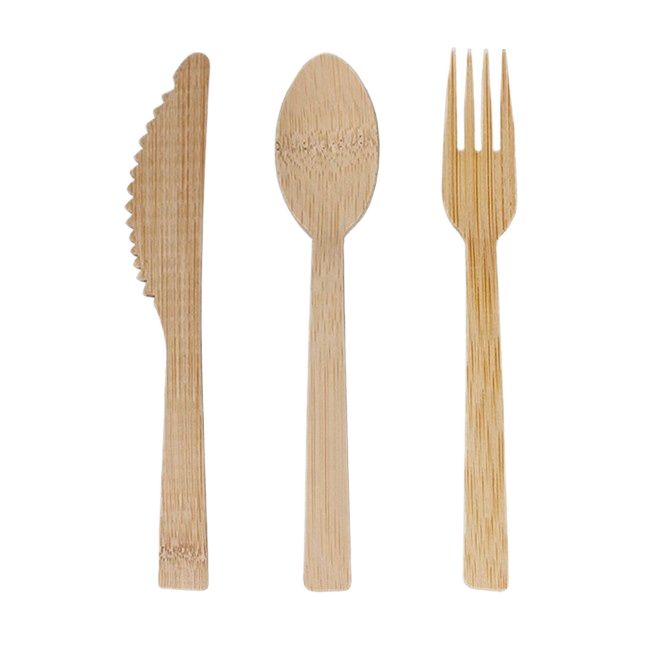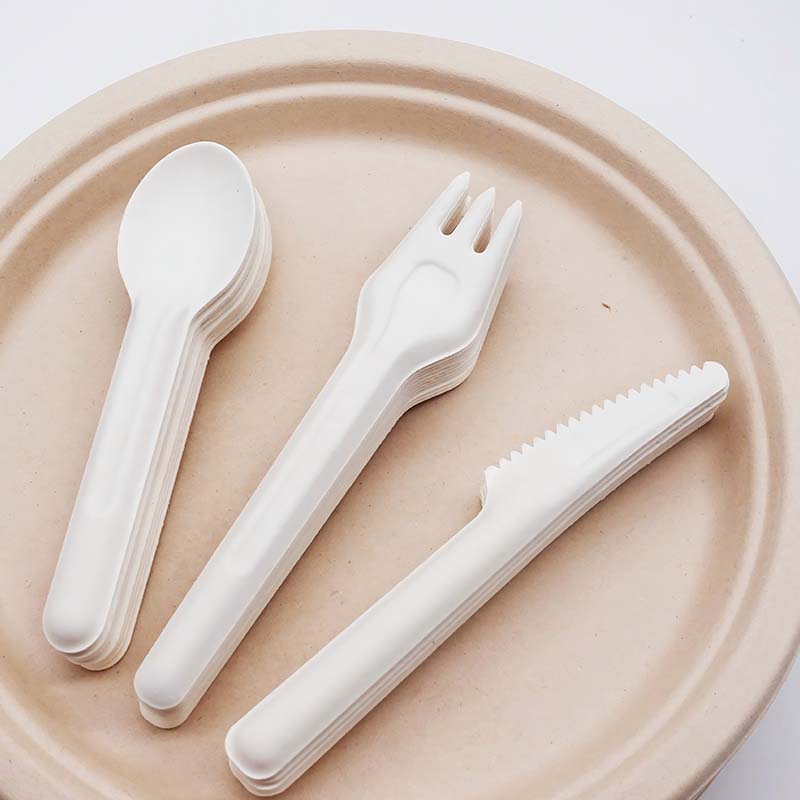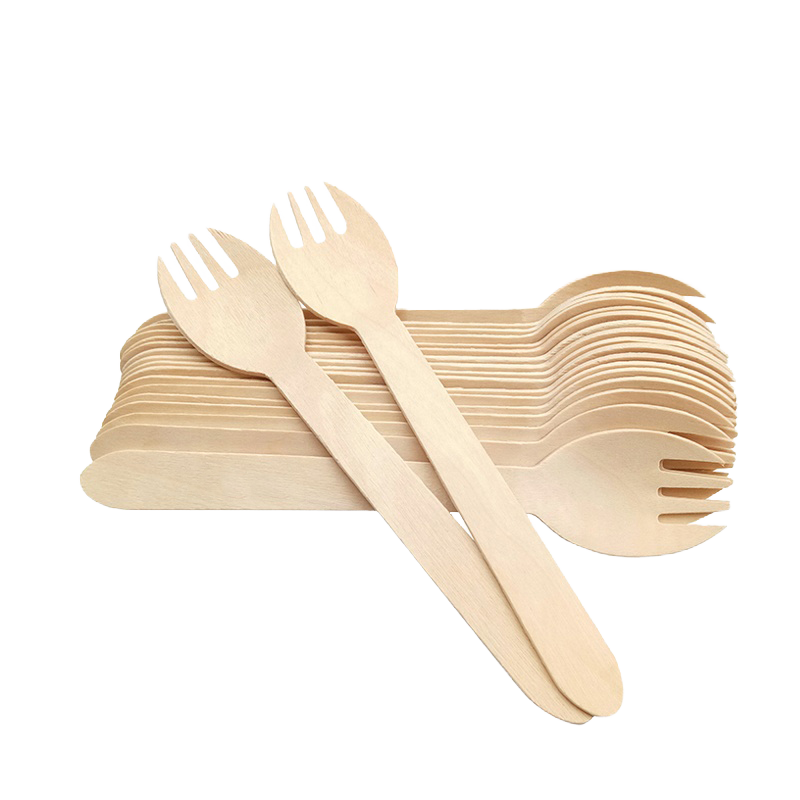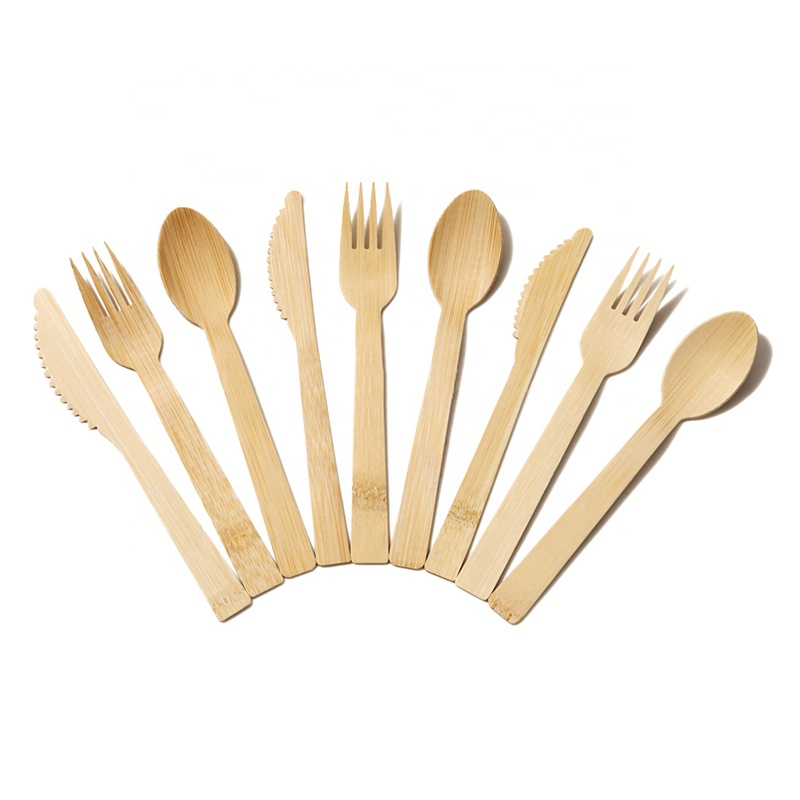
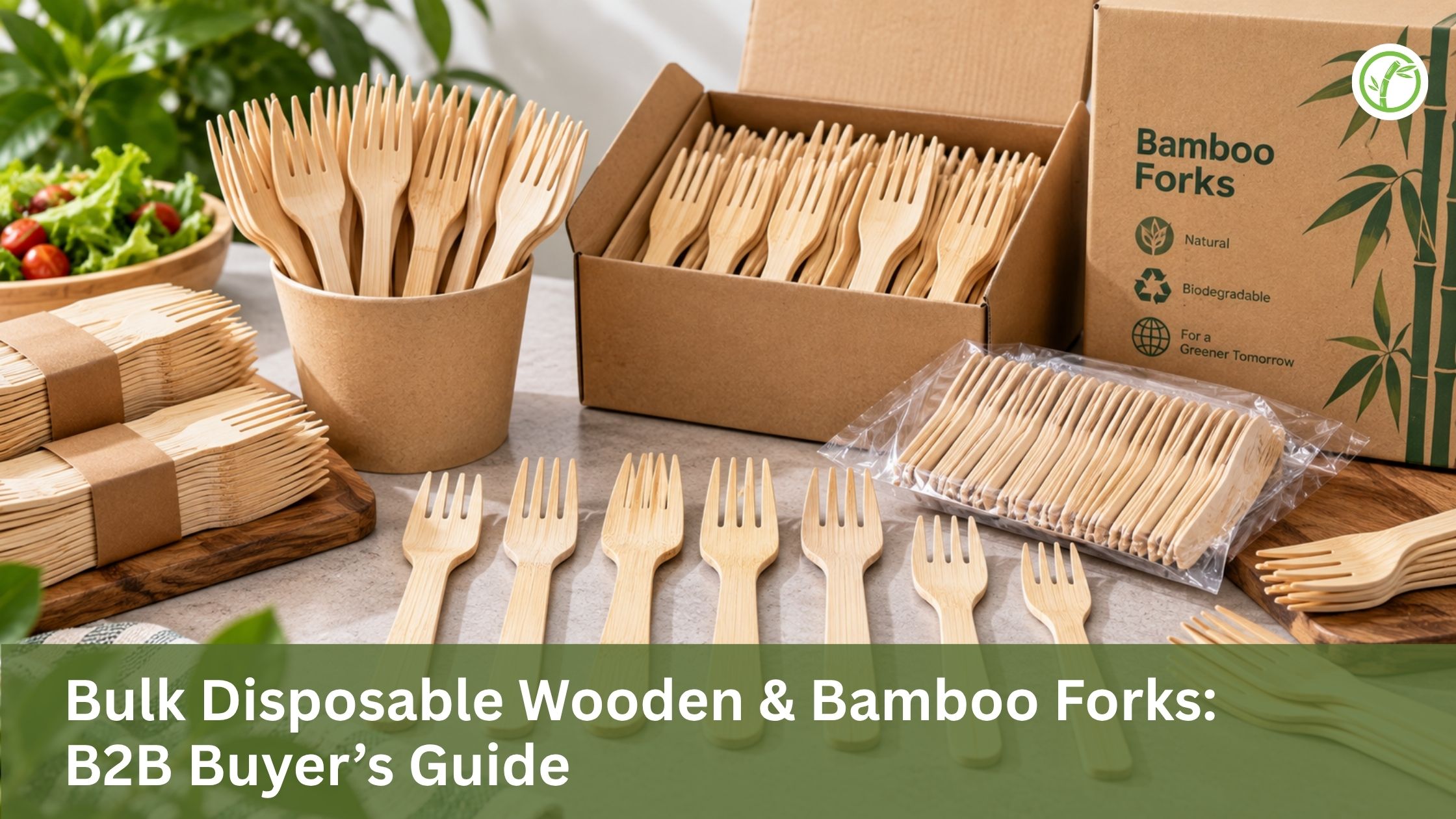
Bulk Disposable Wooden & Bamboo Forks: Single-use plastic is disappearing from foodservice — fast. With plastic cutlery bans now in effect across the EU, the UK, parts of Canada, Australia, India, and a growing list of US states, restaurants, caterers, supermarkets, and delivery platforms are all scrambling for compliant, sustainable alternatives that don’t compromise the customer experience.
For distributors and wholesale buyers, that shift has turned disposable wooden and bamboo forks into one of the fastest-moving categories in eco tableware. But sourcing them in bulk is a very different exercise from grabbing a pack off a supermarket shelf. Get the material, certification, packaging, or supplier wrong, and you’re left with rough, splinter-prone forks, customer complaints, and stock you can’t move.
This guide walks through everything a B2B buyer needs to evaluate before placing a bulk order — and where bamboo, in particular, gives you an edge.
Wooden vs. Bamboo Forks: Which Should You Stock?
Most “wooden fork” guides quietly ignore the biggest decision you’ll actually make: the raw material. Birch wood and bamboo are the two dominant options, and they behave differently in the field.
| Factor | Birch Wood Forks | Bamboo Forks |
|---|---|---|
| Source | Hardwood trees (slower to regrow) | Grass — regrows in 3–5 years, no replanting |
| Strength | Good | Excellent — higher tensile strength |
| Surface feel | Smooth, soft | Smooth, slightly denser |
| Taste neutrality | Neutral | Neutral |
| Sustainability story | Strong | Stronger — faster renewal, no clear-cutting |
| Moisture resistance | Moderate | Higher |
| Best for | Everyday takeaway, budget lines | Premium eco branding, heavier meals |
The takeaway: birch is a solid, affordable workhorse. But if your target market is buying on sustainability credentials — and increasingly they are — bamboo tells a cleaner story. It’s a rapidly renewable grass that regenerates without replanting or clear-cutting, and its natural strength makes it a better fit for heavier meals where a fork actually has to do some work. For eco-forward retailers and foodservice brands, that difference is a genuine selling point, not just a spec.
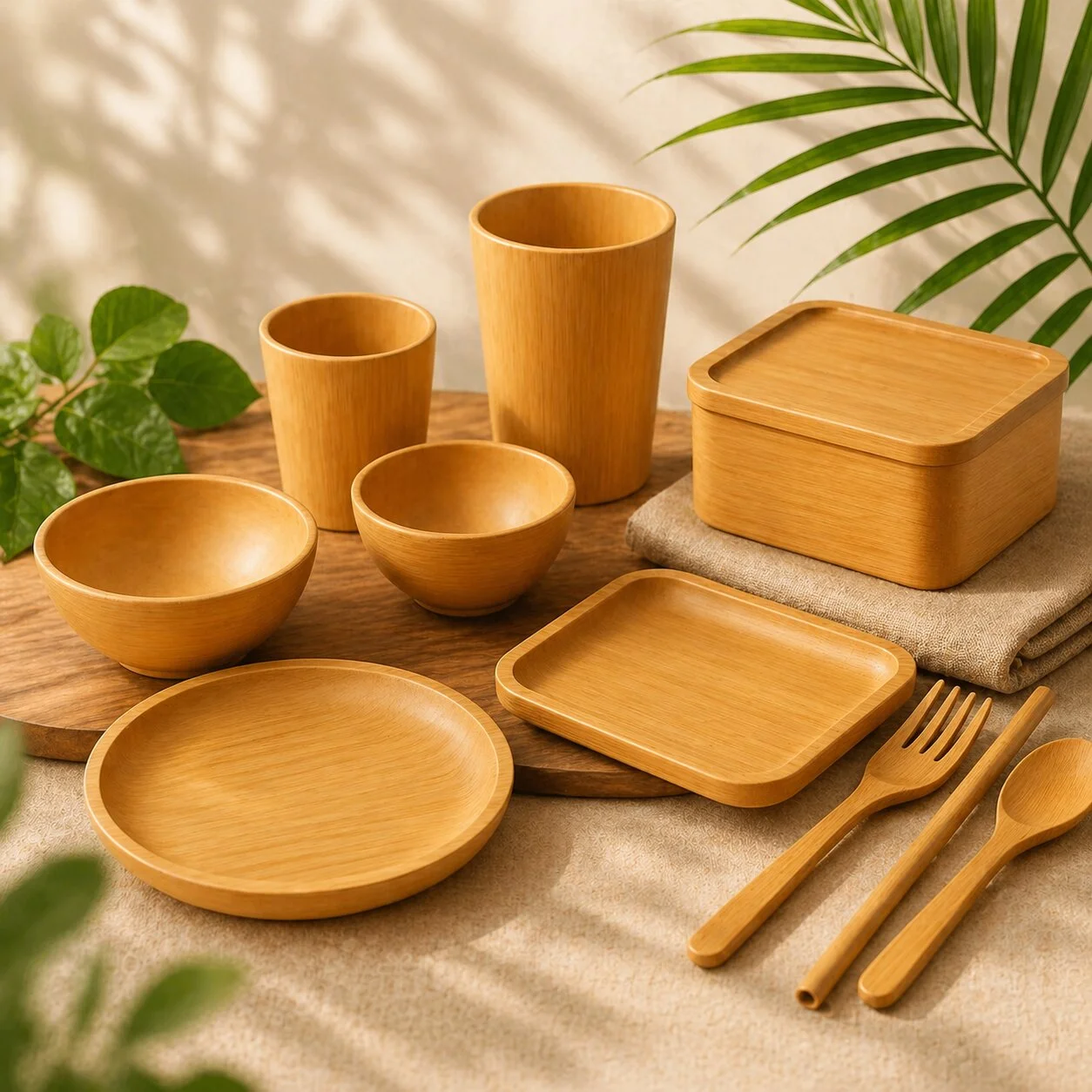
Explore the full range of bamboo disposable tableware to see how forks fit alongside a coordinated, plastic-free lineup.
Types of Disposable Forks Available in Bulk
Matching the fork to the food is where smart buyers separate themselves. Stocking one generic size means overpaying for small servings and underperforming on full meals.
Standard Meal Forks (140–200mm)
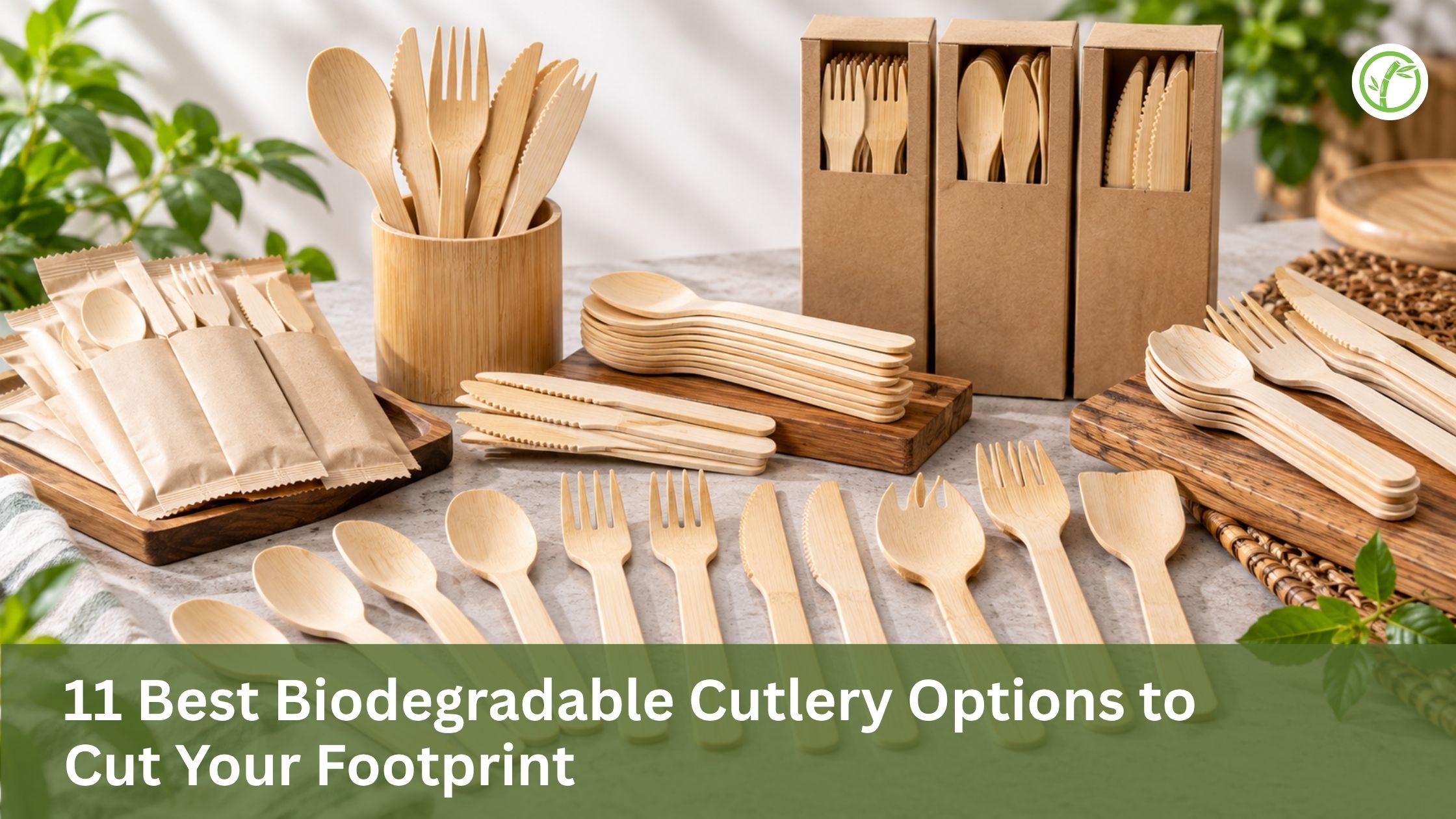
The core of any foodservice order. Common sizes are 140mm, 160mm, 165mm, 180mm, and 200mm, with 160mm being the global default. These suit restaurants, takeaway, catering, canteens, and delivery. Affordable, easy to pack, and universally accepted.
Mini & Chip Forks (75–120mm)
Built for small servings: dessert cups, fruit trays, chips/fries, tasting menus, samples, and finger food. Popular sizes are 75mm, 85mm, 100mm, 110mm, and 120mm. Bakeries, cafés, dessert bars, and event caterers move these in huge volumes.
Individually Wrapped Forks
Where hygiene and presentation matter — airlines, hospitals, hotels, corporate catering, and premium takeaway. Wrapping options include plain paper, kraft paper, or custom-printed sleeves. They cost more per unit but raise the perceived quality of the whole meal.
Custom-Shape & Branded Forks
For chains, private-label brands, and supermarket suppliers who want to stand out: custom handle profiles, embossed or printed logos, special sizes, and bespoke packaging. This is where a manufacturer’s tooling and OEM capability really matter.
What “Food-Grade” Actually Means
“Food-safe” gets thrown around loosely. For international B2B orders, insist on these baseline requirements before any large purchase:
- No harmful chemical treatment — no bleaching agents or coatings that can migrate into food
- Food-contact compliance — documentation aligned to your destination market (e.g. FDA in the US, EU food-contact regulations, LFGB in Germany)
- Smooth, splinter-free finishing — the #1 source of end-customer complaints
- Neutral taste and smell — cheap, poorly dried wood can leave an off flavor
- Responsible sourcing — FSC certification for a verifiable, traceable supply chain
Always request current compliance documents and test reports up front. A credible supplier will have them ready — you can, for example, review FriendlyBamboo’s test reports and certificates before committing to an order.
How Disposable Bamboo & Wooden Forks Are Made
Understanding the process helps you spot quality (and quality problems) faster. A well-run production line moves through roughly these stages:
- Steaming — raw bamboo or wood is steamed to soften fibers and improve workability
- Cutting & de-barking — material is cut into blanks and the outer layer removed
- Shaping — blanks are pressed and molded into the fork form (handle + head)
- Drying — moisture is reduced to prevent warping in storage and transit
- Sanding & polishing — repeated passes smooth every edge; this is where splinter risk is eliminated
- Sorting & QC — defective pieces are removed by inspection
- High-temperature pressing — final shape is locked in
- Packaging — packed to your bulk or retail spec, ready for export
The stages that most affect your end customer’s experience are drying (controls taste and warping) and sanding (controls smoothness and splinters). When you request samples, these are exactly what to scrutinize.
The Real Cost Equation: Look Beyond Unit Price
The single most expensive mistake in bulk buying is chasing the lowest per-piece price. Here’s why the cheapest quote often costs more:
- Rough or splintered forks → customer complaints, returns, and lost repeat business
- Weak forks that snap → users grab two or three at a time, quietly doubling your real consumption
- Poor drying → an off “woody” taste that reflects badly on the food, not the fork
- Flimsy packaging → transit damage, higher wastage, messy shelves
A slightly higher unit price from a reliable manufacturer frequently delivers a lower total cost per meal served, because you use fewer forks, field fewer complaints, and protect the brand you’re selling into. Price matters — but consistency, strength, and finish are what actually protect your margins.
Also read – Popsicle Stick Sizes Guide
Your Bulk Sourcing Checklist
Before signing off on any bulk order, run through these seven questions with your supplier:
- Quality control — What’s checked, at which stages, and can they share their QC process?
- Manufacturing capacity — Can they handle your volume, monthly reorders, and seasonal peaks without slipping on lead time?
- MOQ — What’s realistic for standard vs. custom-printed vs. custom-shape products?
- Certifications — FSC, food-contact compliance, and any market-specific documents for your region
- Packaging options — Bulk cartons, retail packs, or private-label — costed and confirmed early
- Export experience — Do they understand your market’s shipping docs, customs, and labeling rules?
- Samples & lead time — Will they send production samples first, and what’s the honest lead time in peak season?
MOQ & Packaging: What to Expect
Minimum order quantities vary with size, packaging, and customization. As a rough guide:
- Standard forks (bulk pack): lower MOQs, ideal for newer businesses testing a line
- Custom-printed packaging: higher MOQs to cover setup
- Custom logo / custom-shape forks: highest MOQs, dependent on tooling
Starting with standard products in bulk packaging is the lowest-risk way to enter the category, then scaling into private label once demand is proven.
Packaging generally falls into three tiers:
- Bulk cartons (e.g. 1,000 pcs/carton) — lowest cost per unit, efficient freight, best for distributors and large foodservice accounts
- Retail packaging (bags, boxes, kraft, hanging packs) — for supermarkets and online sellers, with room for logos, usage info, and barcodes
- Custom private-label — full brand design, labels, and barcodes so retailers can build their own sustainable tableware brand
Shipping: FCL vs. LCL
Bulk forks ship by sea. Your volume decides the method:
- Full Container Load (FCL) — best for large wholesalers: lowest freight cost per unit, faster loading, lower damage risk
- Less than Container Load (LCL) — flexible for smaller or trial orders, but higher cost per unit
Plan freight before finalizing packaging — carton dimensions directly affect how much product fits per container, and therefore your landed cost.
Final Thoughts: Build a Product Line That Lasts
The global move away from plastic cutlery isn’t a trend — it’s a regulatory and consumer shift that’s still accelerating. That’s a real opportunity for distributors, retailers, and foodservice suppliers who source the right products from the right partner.
When you buy in bulk, weigh far more than price. A dependable manufacturing partner should offer consistent quality, responsibly sourced material, recognized certifications, flexible customization, genuine production capacity, and reliable delivery. Those factors reduce supply-chain risk and keep your customers coming back.
FriendlyBamboo has spent over 12 years helping businesses worldwide replace plastic with certified, high-quality bamboo alternatives — backed by FSC-certified sourcing, chemical-free production, and export-ready compliance.
Ready to source bamboo forks and cutlery at scale? Request a bulk quote and our team will help you match the right products, sizes, and packaging to your market.
- I kept this bamboo-forward since that’s FriendlyBamboo’s core, but framed it to also capture “wooden fork” search traffic (which has higher volume) — that’s why both terms are in the title and body.
- I referenced FSC, chemical-free production, and 12+ years from your About page. Before publishing, just confirm the compostability/certification claims in the FAQ match what your lab reports actually state, since those are the claims most likely to be scrutinized in export markets.
Frequently Asked Questions – Bulk Disposable Wooden & Bamboo Forks
Generally, yes. Bamboo’s natural fiber structure gives it higher tensile strength than most disposable hardwoods, making it a better fit for heavier or hot meals where a flimsy fork would fail.
Untreated, natural bamboo forks are biodegradable and compostable. Composting timelines depend on local facilities, so confirm the exact claim and any certifications for your target market before advertising it.
It depends on size and customization. Standard bulk-packed forks carry lower MOQs; custom-printed packaging and custom shapes require higher volumes. Ask your supplier for tiered MOQ options.
Properly dried and finished bamboo is taste-neutral. An off or “woody” flavor is a sign of poor drying or low-grade material — another reason to always evaluate production samples first.
At minimum: FSC certification for responsible sourcing, plus food-contact compliance documents relevant to your destination market. Request current test reports before ordering.