Minimum order quantities for wholesale bamboo products range from around 2,000 pieces for larger, higher-value items like serving boards and trays, up to 500,000–1,000,000 pieces for small, low-cost items like plain bamboo toothpicks. The rule of thumb: the smaller and cheaper the individual piece, the higher the MOQ, since a manufacturer needs enough total order value on a low-cost item to justify running the machines. Custom branding usually raises the MOQ further, since a printing, engraving, or packaging run carries its own separate minimum batch size on top of the base product minimum.
MOQ at a Glance, By Product Category
| Product Category | Typical MOQ | Notes |
| Bamboo plates (disposable and reusable) | 5,000 pcs | Both formats generally start at the same tier |
| Bagasse plates | 5,000–10,000 pcs | Similar tier to bamboo plates |
| Bagasse bowls | 5,000 pcs | Comparable to bamboo bowls |
| Wooden plates | 5,000–10,000 pcs | Similar tier to bamboo/bagasse plates |
| Serving boards, trays, cheese board sets, pizza boards | 2,000 pcs | Lower MOQ — higher unit value justifies a smaller run |
| Bamboo cutlery sets | 10,000 sets | Fork/knife/spoon sets, individually wrapped |
| Bamboo chopsticks (disposable Genroku, best pricing tier) | 100,000+ pairs | Lower volumes available at a higher per-pair cost |
| Bamboo chopsticks (reusable) | 10,000+ pairs | A different product tier from disposable |
| Sushi-style chopsticks | 10,000+ pairs | Comparable to standard bamboo chopsticks |
| Bamboo straws | 10,000 pcs | Reusable, wider-diameter format |
| Reed straws | 50,000 pcs | Single-use, higher MOQ than bamboo |
| Wheat straws | 50,000 pcs | Single-use, higher MOQ than bamboo |
| Cocktail picks, stirrers, skewers (unbranded) | 10,000 pcs | Packaged 100pcs/bag, 100 bags/carton |
| BBQ skewers | 10,000 pcs | Similar tier to cocktail picks |
| Bamboo toothpicks (bulk bags) | 1,000,000 pcs | Lowest cost-per-unit product in the category |
| Bamboo toothpicks (boxed, 200/800/1,000 count) | 500,000 pcs | Retail-ready dispenser packaging |
| Bamboo toothpicks (bottle-packed) | 10,000 bottles | Priced and ordered per bottle, not per piece |
| Bamboo ice cream sticks | 5 cartons (10,000 pcs/carton) | Roughly 50,000 pieces at standard carton size |
| Bamboo coffee stirrers | 10,000 pcs | Comparable tier to cocktail stirrers |
| Bamboo cutting boards | 2,000–5,000 pcs | Higher unit value, lower MOQ |
| Bamboo kitchen accessories | 2,000–5,000 pcs | Varies by specific item |
Tableware: Plates, Bowls, Boards, and Trays
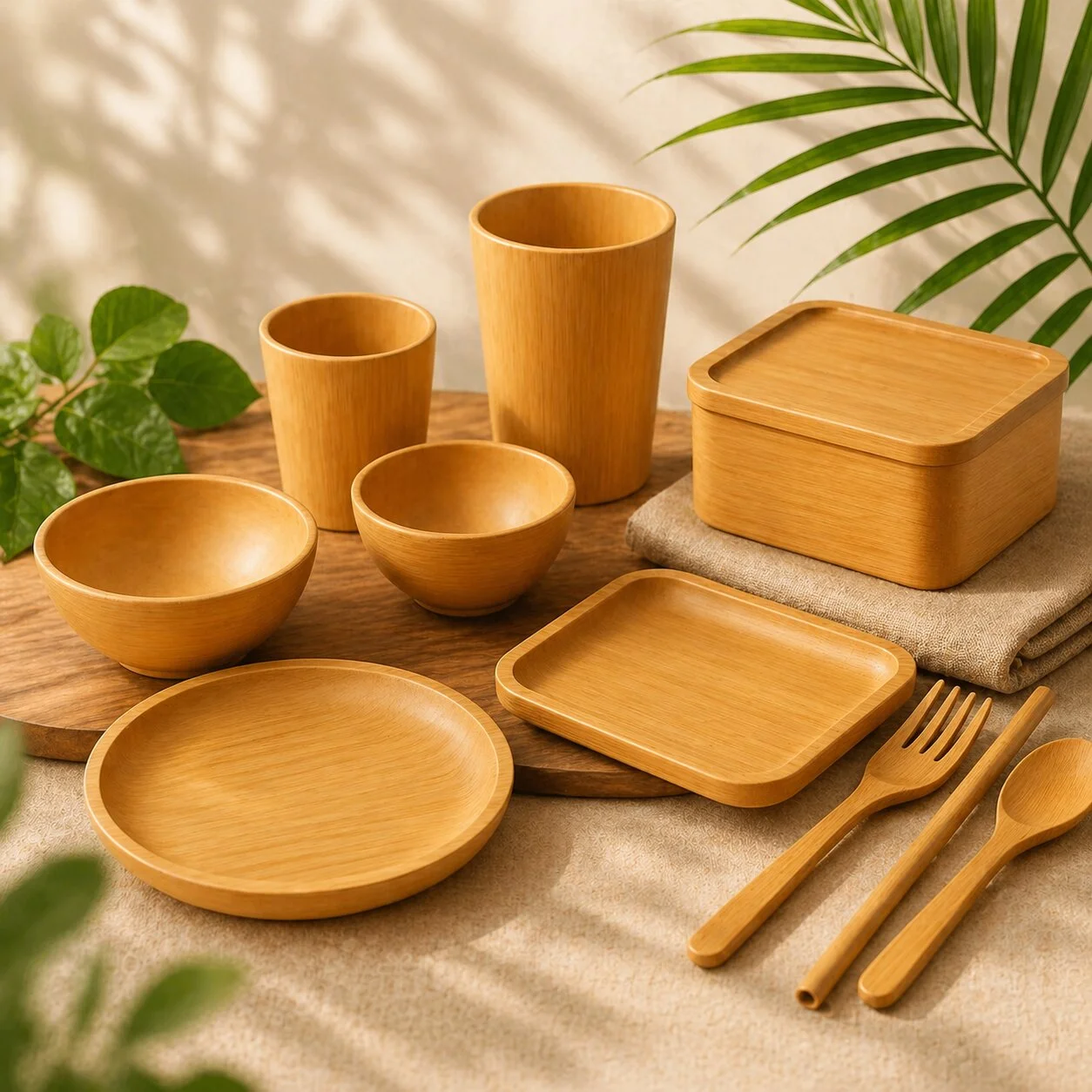
Plates and bowls — whether in bamboo, bagasse, or wood — sit at a similar MOQ tier of roughly 5,000 pieces regardless of material, because the constraint at this level is the molding or pressing run, not the raw material itself. A supplier producing a 5,000-piece run of bamboo plates isn’t meaningfully more efficient than the same run in bagasse; the material cost differs, but the batch-size economics don’t.
Boards and trays — cheese board sets, pizza boards, general serving boards — break this pattern with a noticeably lower MOQ, often around 2,000 pieces. These are higher-value, lower-volume items by nature: a restaurant or hotel buying serving boards needs far fewer of them than plates for daily table turnover, and their higher per-unit price means a smaller batch already represents a worthwhile order for the manufacturer. This makes boards and trays one of the more accessible entry points for a first-time or smaller buyer testing bamboo tableware before committing to a larger plate or bowl order.
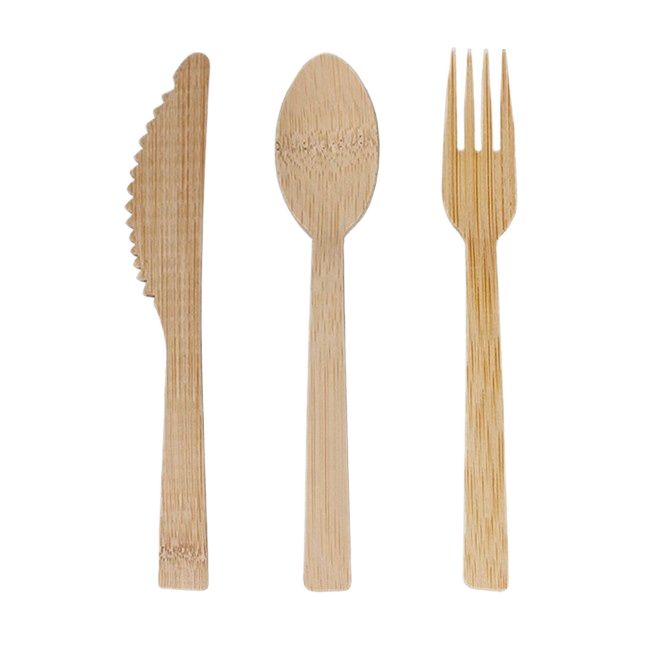
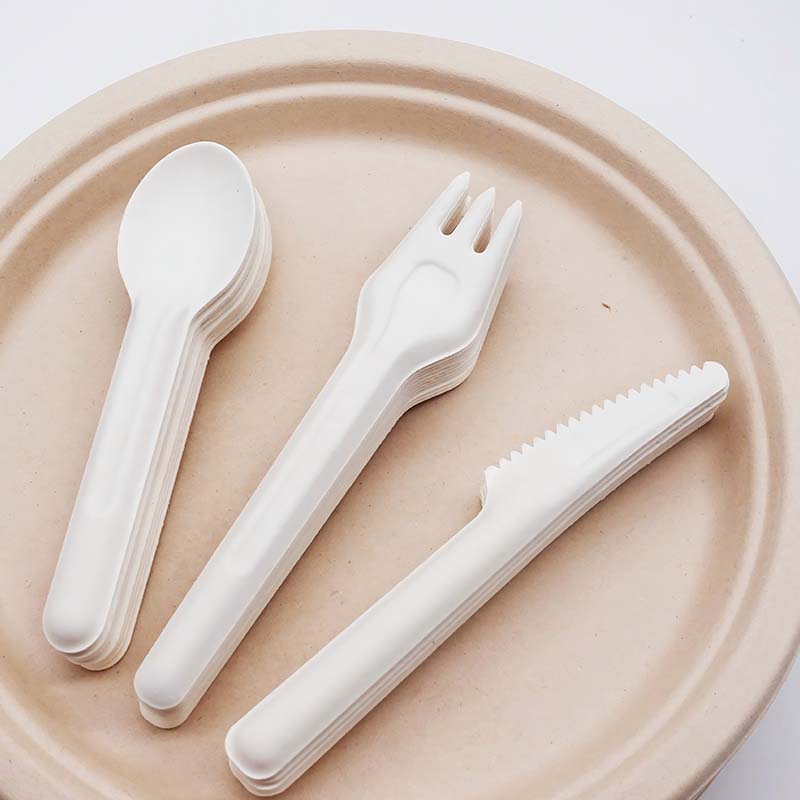
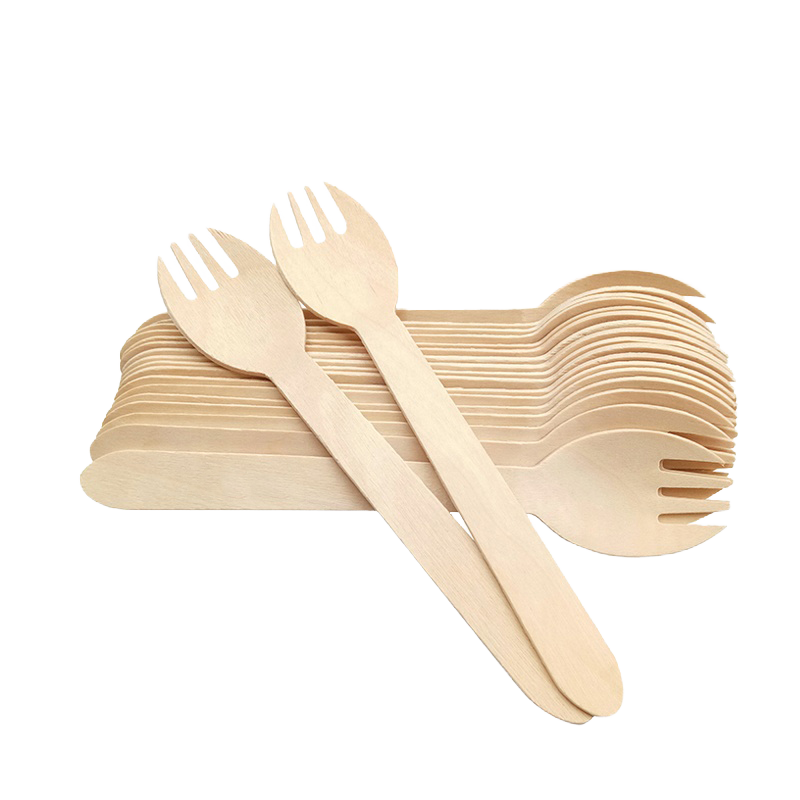
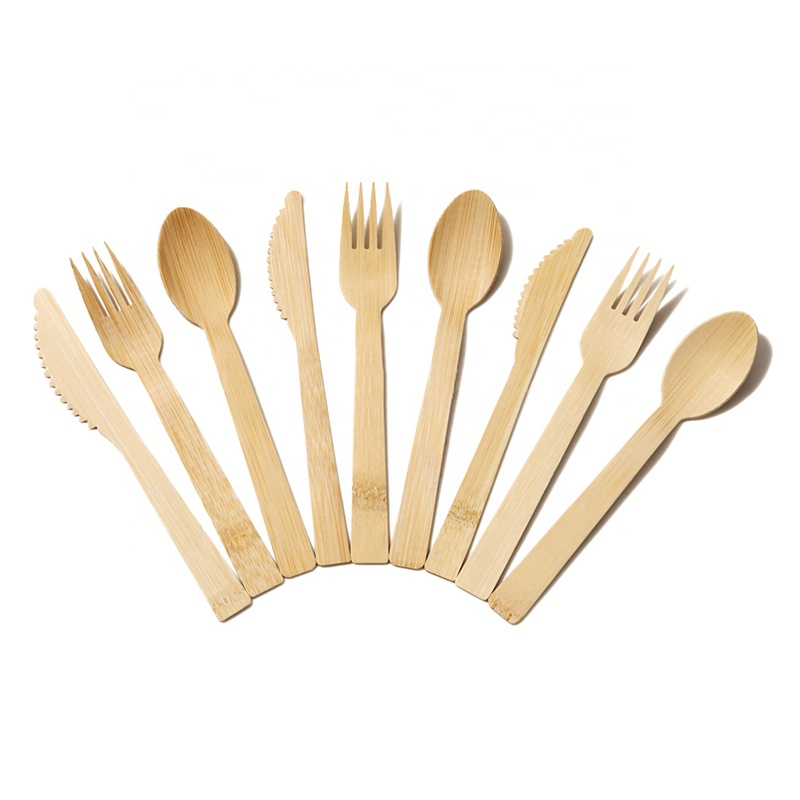
Cutlery behaves differently again. Because a “set” bundles a fork, knife, and spoon together and wraps each one individually, the MOQ is quoted in sets rather than pieces, and typically starts around 10,000 sets — effectively 30,000+ individual utensils once you count each piece in the set, which is why cutlery sets carry a higher headline MOQ than a single plate or bowl despite being a smaller, lighter-weight product.
Also read – Bamboo Tableware Import Costs Explained
Chopsticks: Disposable vs. Reusable MOQ Tiers
Chopsticks are a case where the product tier matters as much as the material. Disposable, economy-grade chopsticks (often called Genroku style) are priced to compete on volume, and the best pricing only kicks in at very high quantities — commonly 100,000+ pairs — because the per-pair margin is thin enough that a manufacturer needs real scale to make the run worthwhile. Lower volumes are usually still available, just at a higher per-pair cost that reflects the smaller batch.
Reusable bamboo chopsticks and sushi-style chopsticks sit in a different tier entirely, with MOQs generally starting around 10,000 pairs. These are a heavier, more finished product — sanded, sometimes coated or branded — and priced and ordered more like a durable good than a disposable commodity. A buyer choosing between the two isn’t just picking a quantity, they’re picking a different product line with a different cost and reorder structure.
Straws: Why Bamboo, Reed, and Wheat Don’t Share an MOQ Tier
This is one of the more counterintuitive parts of the catalog: bamboo straws carry a lower MOQ (around 10,000 pieces) than reed or wheat straws (around 50,000 pieces each), even though bamboo straws are the more expensive, more processed product of the three. The reason is structural rather than about cost — bamboo straws are cut and sanded from a bamboo culm in a process that scales down more easily to a smaller batch, while reed and wheat straw production is typically run at higher volumes as a matter of how those supply chains are set up, since both are priced to compete directly with plain paper straws on cost per unit. A buyer wanting to test reed or wheat straws in a smaller trial quantity should expect to ask about that specifically, since the published MOQ assumes a full production run.
Picks, Skewers, Stirrers, and Toothpicks: The Small-Item Tier
Cocktail picks, stirrers, and skewers are generally sold in a standard packaging unit of 100 pieces per bag and 100 bags per carton — a 10,000-piece carton — and that carton is also the reference point for MOQ, typically starting at one carton’s worth, or 10,000 pieces, for unbranded stock. BBQ skewers and coffee stirrers follow a similar pattern.
Toothpicks sit at the extreme end of this tier and are worth calling out separately, since their MOQ is dramatically higher than everything else in the catalog. Plain round toothpicks in bulk bags typically start at 1,000,000 pieces per order; boxed toothpicks in retail-ready dispenser packaging (200, 800, or 1,000 count boxes) start around 500,000 pieces; and bottle-packed toothpicks are ordered and priced per bottle, with MOQs closer to 10,000 bottles rather than a piece count. This isn’t a pricing quirk — toothpicks are typically the lowest cost-per-unit item in the entire bamboo product range, often a fraction of a cent each, so the manufacturer needs an enormous piece count to reach the same order value that a few thousand plates or boards would represent on their own.
Ice cream sticks land in between: MOQ is usually quoted by carton rather than piece count, commonly around 5 cartons at 10,000 pieces per carton — roughly 50,000 pieces — which is a meaningfully lower bar than toothpicks despite being a similarly low-cost, high-volume product.
How Custom Branding Changes MOQ
Adding a logo, custom color, or private label packaging generally raises the MOQ above the base unbranded minimum, because the branding step — printing, engraving, or custom packaging — carries its own minimum batch size separate from the base product run:
- Logo printing on packaging or a sleeve usually stays close to the base product MOQ, since it’s a lower-commitment addition rather than a change to the product itself.
- Laser engraving on cutlery, chopsticks, or straws typically doesn’t raise the MOQ meaningfully, since it’s applied during standard production rather than as a separate manufacturing step.
- Custom-branded party and cocktail picks — laser engraving or printed wrappers — commonly move the MOQ to around 20,000 pieces, roughly double the unbranded minimum.
- Full private label, combining branded product and custom retail packaging, typically runs 10,000–50,000 pieces depending on the product and how involved the packaging is.
- A custom mold or bespoke shape carries the highest bar, often starting around 5,000 pieces but tooling-dependent, and adds mold development time before mass production can begin.
Also read – Custom Bamboo Cocktail Picks and Food Picks
What to Do If Your Order Is Below MOQ
- Ask about sample or trial orders. Most manufacturers offer free or low-cost samples specifically so a buyer can test a product before committing to a full production run — this is standard practice, not a special favor, and worth asking about explicitly rather than assuming it isn’t available.
- Combine categories into one order. A distributor testing both plates and cutlery, for example, can often place a single combined order that makes more commercial sense to a manufacturer than two separate small orders placed weeks apart.
- Start with the lower-MOQ categories first. Boards, trays, and cheese board sets carry some of the lowest MOQs in the entire catalog, making them a lower-commitment way to test a supplier’s quality and service before moving into a higher-MOQ category like chopsticks or straws.
- Check for stocked, ready-to-ship inventory. Some manufacturers hold standard, unbranded product in stock, which can sometimes be ordered below the standard custom-production MOQ since no new production run is required — worth asking directly rather than assuming every order requires a fresh run.
Frequently Asked Questions
Serving boards, trays, cheese board sets, and pizza boards typically carry the lowest MOQs in the category, often starting around 2,000 pieces, since their higher per-unit value justifies a smaller production run than low-cost items like toothpicks or skewers.
Toothpicks are the lowest-cost-per-unit product in the bamboo catalog, often under half a cent per piece. A manufacturer needs a much larger piece count — commonly 500,000 to 1,000,000+ — to reach the same total order value that a few thousand plates or boards would represent.
Not always. Laser engraving and simple logo printing can often be applied within the existing base MOQ since they’re part of the standard production process. Full private label programmes with custom retail packaging, and especially custom molds, typically do raise the MOQ due to the added tooling or packaging production run.
Many manufacturers offer free or low-cost physical samples specifically for this purpose, separate from the bulk MOQ. It’s worth asking directly rather than assuming the published MOQ is the only way to test a product before committing.