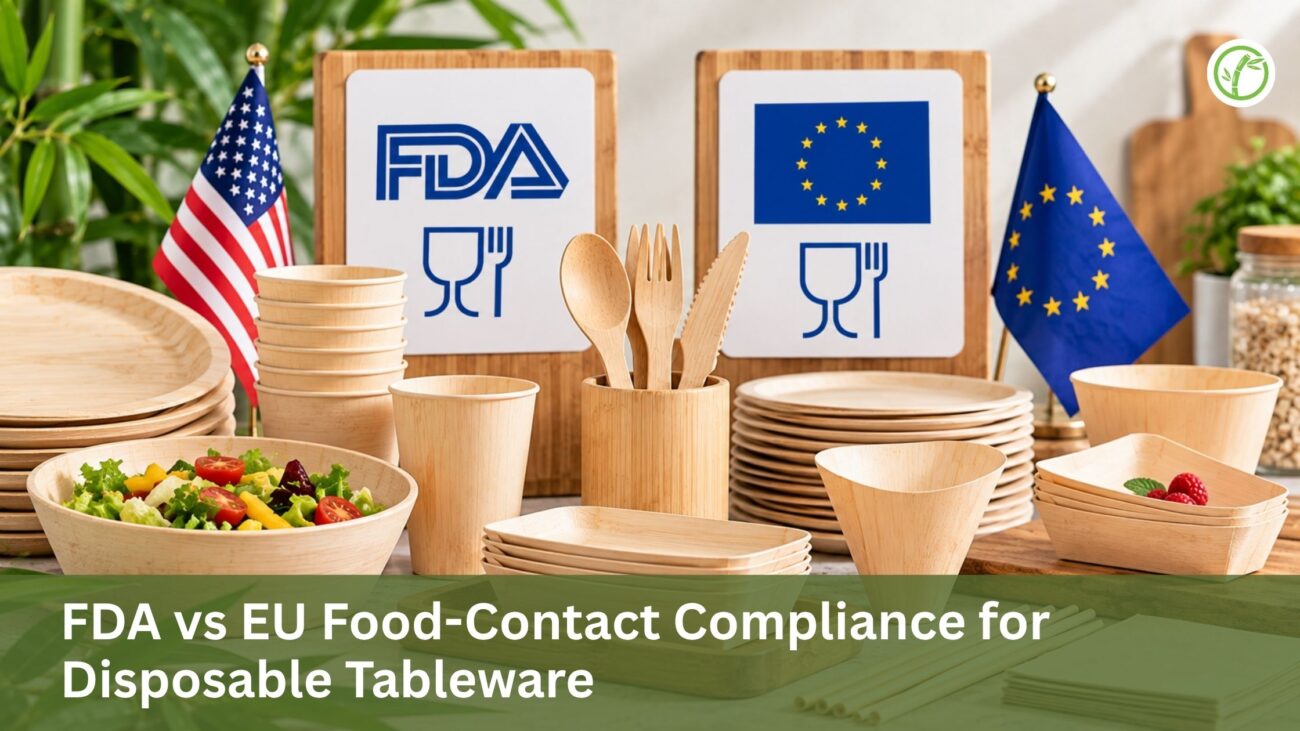
Both the FDA (US) and the EU use a self-declaration system with no official government “approval” stamp. Still, they differ in almost everything else that matters practically: the FDA authorizes specific substances against a list under 21 CFR. At the same time, the EU sets a general safety principle under Regulation 1935/2004 and layers material-specific and national rules like Germany’s stricter LFGB on top of it. For a buyer sourcing the same disposable plate or fork into both markets, that difference shows up as two separate documentation packages, two different testing approaches, and, as of 2026, two very different PFAS rules not one certificate that happens to satisfy both.
Quick Comparison
| Factor | United States (FDA) | European Union |
| Core legal basis | 21 CFR Parts 170–189 (substance-by-substance) | Regulation (EC) 1935/2004 (general framework) + GMP Regulation 2023/2006 |
| Approach | Substance-based — each ingredient/material needs its own regulatory basis | Principle-based — materials must not transfer harmful substances, alter food composition, or affect taste/odor/appearance |
| Government certificate issued? | No — self-declaration | No — self-declaration |
| Required documentation | Letter of Guarantee (LoG) + lab test reports | Declaration of Compliance (DoC) — legally required to accompany the product |
| Typical testing method | Total extractives (e.g., chloroform-soluble content) | Specific Migration Limits (SML) per substance, plus Overall Migration Limit, for regulated material categories |
| Stricter national standard | None — federal baseline applies nationally | LFGB (Germany) — adds mandatory sensory testing on top of migration testing |
| Bamboo/wood specifically named? | No dedicated bamboo regulation — assessed via paper/paperboard or general indirect-additive rules | Yes — bamboo is one of 17 explicitly recognized material categories under 1935/2004 |
| PFAS limits (2026) | No single federal threshold — state-by-state restrictions | Hard numerical thresholds under PPWR from 12 August 2026: ≤25 ppb individual PFAS, ≤250 ppb sum of targeted PFAS, ≤50 ppm total fluorine |
How FDA Compliance Actually Works
The FDA regulates food-contact materials as “indirect food additives” under Title 21 of the Code of Federal Regulations, and the system is substance-based rather than product-based — meaning compliance is assessed at the level of each individual ingredient or material component, not just by looking at the finished plate or fork as a category. A material qualifies for legal use through one of several pathways: it’s already listed in the relevant 21 CFR section (176 for paper and paperboard, 177 for polymers, 175 for adhesives and coatings), it qualifies as Generally Recognized as Safe (GRAS), it falls under a Threshold of Regulation exemption for very low-risk substances, or it has cleared an individual Food Contact Notification (FCN) submitted to the FDA.
Critically, there’s no physical “FDA certificate” a manufacturer receives. Compliance is demonstrated through accredited lab test reports and a Letter of Guarantee from the manufacturer — essentially a signed assurance that the product meets the applicable CFR sections — rather than a government-issued document. Testing itself often looks different from the EU approach too: rather than setting a migration limit for each substance, FDA testing frequently measures total extractives removed by a selected solvent (chloroform is common for certain polymers and paper components), giving an aggregate rather than substance-by-substance result.
One practical gap worth knowing about specifically for bamboo, wood, and bagasse products: the FDA doesn’t have a dedicated regulation written for these materials the way it does for plastics or paper. Compliance is generally demonstrated by analogy — treating bamboo and wood products under the paper/paperboard provisions (21 CFR 176) or the general indirect food additive framework — which is a defensible and standard approach, but it means the documentation trail is less standardized than it would be for a material with its own dedicated CFR section.

How EU Compliance Actually Works
The EU takes a framework-first approach. Regulation (EC) 1935/2004 sets out the general safety principle — Article 3 requires that food-contact materials not transfer their constituents to food in quantities that could endanger health, unacceptably change the food’s composition, or deteriorate its sensory characteristics, including taste, odor, and visual appearance — and applies this principle across 17 recognized material categories, explicitly including bamboo alongside plastics, ceramics, metals, and glass. Good Manufacturing Practice under Regulation 2023/2006 sits alongside it, and full supply chain traceability is a stated requirement, not just a best practice.
Where a material has its own harmonized EU regulation — plastics under EU 10/2011 being the clearest example — Specific Migration Limits are set for individual substances, in addition to an Overall Migration Limit for the material as a whole. That’s a materially different testing philosophy from the FDA’s aggregate extractives approach: a plastic product tested to EU 10/2011 is checked against named substance limits, not just a total dissolved-content figure.
The EU also legally requires a Declaration of Compliance to accompany certain food-contact materials when sold or distributed in the market — a self-issued document, typically the responsibility of the manufacturer or the company placing the product on the EU market, that states the product meets the applicable requirements. This is functionally similar in spirit to the FDA’s Letter of Guarantee, but the DoC is a more formally defined, legally required document under EU law specifically, rather than an industry-standard practice that’s grown up around FDA compliance.
Germany’s LFGB deserves a specific mention, since it’s frequently treated as the practical benchmark for premium tableware entering the EU. LFGB is widely regarded as the strictest food-contact standard globally because it requires both migration testing and sensory testing — the product must not alter the color, odor, or taste of food it contacts, a requirement FDA and the base EU framework don’t test for as explicitly. A product that clears LFGB testing has cleared a meaningfully higher bar than the EU’s general 1935/2004 baseline alone.
The Biggest Practical Difference: What You Actually Get as Documentation
For a buyer, the clearest operational distinction is this: request a Letter of Guarantee and lab test reports for the US market, and request a Declaration of Compliance specifically for the EU market — they are not interchangeable, and a supplier who only offers one when you need both for a dual-market product line is missing something. Neither market issues a physical government certificate the way FSC or BPI do for their respective certifications, which is part of why fake or vague “FDA approved” and “EU approved” claims are common in the market — technically, no product is ever “FDA approved” or “EU approved” in that sense, only demonstrated compliant through the documentation above.
The 2026 PFAS Divide
This is the newest and most consequential difference between the two markets right now. Under the EU’s Packaging and Packaging Waste Regulation, which reaches full application on 12 August 2026, food-contact packaging must meet specific numerical PFAS thresholds: no more than 25 parts per billion for any individual PFAS substance, no more than 250 ppb for the sum of targeted PFAS substances, and no more than 50 parts per million total fluorine. This is a hard, harmonized, EU-wide limit that applies to imported packaging as much as domestically produced packaging.
The US has no equivalent single federal threshold for PFAS in food-contact tableware. Instead, restrictions exist at the state level, with a growing but inconsistent patchwork of state laws banning or limiting PFAS in food packaging. For a buyer selling into both markets, this means EU compliance on PFAS is a single clear bar to clear, while US compliance depends on which specific states the product will be sold into — a meaningfully more fragmented picture that’s worth building into supplier due diligence rather than assuming one PFAS test report covers both markets.
What to Actually Request From a Supplier
For a disposable tableware product headed to both the US and EU markets, request:
- A Letter of Guarantee citing the specific 21 CFR sections the product complies with (176 for paper/fiber-based products, 177 for plastics, and the relevant sections by analogy for bamboo/wood).
- FDA-relevant lab test reports from an accredited lab, showing extractives testing results against the applicable CFR limits.
- An EU Declaration of Compliance, referencing Regulation 1935/2004 and, where applicable, the material-specific regulation (such as EU 10/2011 for plastic components).
- LFGB test reports specifically if selling into Germany or marketing the product as meeting the strictest available EU-adjacent standard — migration and sensory testing both.
- PFAS test results referencing the specific EU PPWR thresholds if the product is EU-bound after August 2026, since a general “PFAS-free” marketing claim isn’t the same as a lab report showing the product meets the 25 ppb / 250 ppb / 50 ppm limits specifically.
Also read – eco friendly disposable tableware market
Sourcing With Both Markets in Mind
Because the documentation requirements genuinely diverge between these two markets, it’s worth confirming a supplier can provide both packages: a Letter of Guarantee plus FDA test reports for the US, and a Declaration of Compliance plus (ideally) LFGB testing for the EU, rather than assuming one certification covers both. FriendlyBamboo provides FDA 21 CFR and LFGB documentation across its bamboo cutlery, bamboo and bagasse plates, and bamboo straws product lines. For the certification landscape beyond food-contact safety — including compostability standards and how to verify sourcing claims — see our guides to eco-friendly tableware certifications and FSC certification for bamboo sourcing, and for the wider EU regulatory picture affecting 2026 shipments, see our EU Single-Use Plastics Directive 2026 guide. Buyers sourcing for dual-market sale can request a bulk quote with both documentation packages confirmed before ordering.
Frequently Asked Questions – FDA vs EU Food-Contact Compliance for Disposable Tableware
Not in the strict sense. The FDA doesn’t issue approval certificates for finished food-contact products — compliance is demonstrated through a Letter of Guarantee and lab test reports showing the materials meet the applicable 21 CFR sections. “FDA compliant” or “FDA approved” as used in marketing, generally refers to this documentation trail, not a government-issued certificate.
No. The two systems test differently — FDA often measures total extractives, while EU regulations for materials like plastics set Specific Migration Limits per named substance. A product needs to be tested and documented separately for each market, and a supplier who only provides FDA documentation isn’t automatically compliant for EU sale.
LFGB is widely treated as the de facto premium standard across the EU because it’s the strictest available, including mandatory sensory testing that the base EU framework doesn’t require. Many EU retailers and distributors request LFGB documentation as their baseline expectation, even outside Germany specifically.
The EU’s Packaging and Packaging Waste Regulation sets hard numerical PFAS limits (25 ppb individual, 250 ppb summed, 50 ppm total fluorine) for food-contact packaging from 12 August 2026. The US has no equivalent federal limit, so PFAS compliance for the US market currently depends on the specific states a product is sold into rather than one national standard.