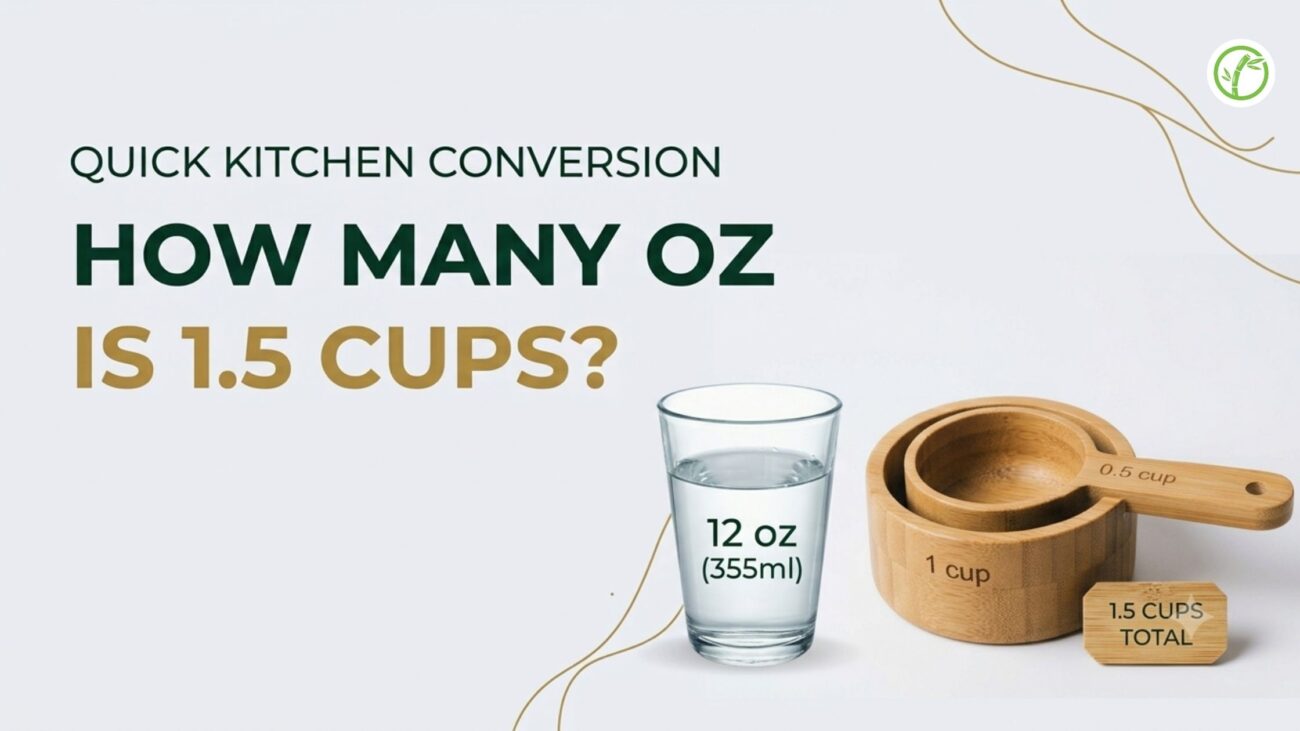
How many oz is 1.5 cups? The answer is exactly 12 fluid ounces, since 1 US cup is fixed at 8 fl oz, and 1.5 × 8 = 12. Flip the question around and it’s the same fact from the other direction: 12 oz to cups is 1.5 cups. This conversion holds for any liquid water, milk, broth, coffee but it stops applying the moment you’re measuring a dry ingredient by weight instead of a liquid by volume, which is where most kitchen measuring mistakes actually happen.
How Many Oz Is 1.5 Cups? The Quick Answer
1.5 cups = 12 fl oz. The math behind it:
1 cup = 8 fl oz, so 1.5 cups = 1.5 × 8 = 12 fl oz
| US Cup | Fluid Ounces | ml (Strict) | ml (Common Kitchen Rounding) |
| ¼ cup | 2 oz | 59.1 ml | 60 ml |
| ⅓ cup | 2.67 oz | 78.9 ml | 80 ml |
| ½ cup | 4 oz | 118.3 ml | 120 ml |
| ⅔ cup | 5.33 oz | 157.7 ml | 160 ml |
| ¾ cup | 6 oz | 177.4 ml | 180 ml |
| 1 cup | 8 oz | 236.6 ml | 240 ml |
| 1 ½ cups | 12 oz | 354.9 ml | 360 ml |
| 2 cups (1 pint) | 16 oz | 473.2 ml | 480 ml |
| 4 cups (1 quart) | 32 oz | 946.4 ml | 950–1000 ml |
12 oz to Cups: The Full Breakdown
Going the more common direction — starting from 12 oz and converting to cups uses the same relationship, just divided instead of multiplied:
cups = ounces ÷ 8, so 12 ÷ 8 = 1.5 cups
This rule strictly applies to liquids — water, milk, oil, broth, honey, molasses. If you’re measuring a dry ingredient like flour or chocolate chips by weight, the 1.5-cup answer won’t hold, and you’ll want the dry-ingredient section further down instead.
What Are Ounces and Cups, Exactly?
An ounce (oz) is a unit that can measure either volume or weight, depending on context, which is exactly why it confuses. A cup is a cooking-specific volume unit, and in the US, one standard cup equals 8 fluid ounces.
Not every country uses the same cup size, though. In the UK and Australia, one cup equals 10 fl oz rather than 8, which means 12 UK fl oz works out to 1.2 UK cups, not 1.5. If a recipe comes from outside the US, it’s worth checking which cup standard it’s using before you start measuring, since the difference is large enough to change how a dish turns out.
Also read – how many cups in 32 oz
Volume vs. Weight: Why “12 oz to Cups” Isn’t Always the Same Answer
This is the core concept behind every ounce-to-cup conversion, and it’s worth understanding rather than just memorizing.
Fluid ounces measure volume — the space something takes up. Water, milk, honey, and juice all behave predictably here: 12 fl oz of any liquid is always 1.5 cups, because volume doesn’t change based on what the liquid is.
Dry ounces measure weight — how heavy something is. Because different dry ingredients pack differently at the same weight, 12 oz of a light, airy ingredient like flour takes up far more space than 12 oz of a dense one like sugar. Flour, for instance, is light and fluffy, so 12 oz of it fills roughly 2.75 cups. Chocolate chips are denser, so 12 oz fills closer to 2 cups. Dried cranberries are lighter still, filling up to around 3 cups at the same 12 oz weight.
The practical rule: use a liquid measuring cup for drinks, and a dry measuring cup or, better, a kitchen scale for flour, oats, chocolate chips, and similar ingredients.
How Many Cups Is 12 oz of Common Dry Ingredients?
| Ingredient (12 oz by weight) | Approx. Cups |
| All-purpose flour | ~2¾ cups |
| Granulated sugar | ~1¾ cups |
| Chocolate chips | ~2 cups |
| Dried cranberries | ~3 cups |
| Rolled oats | ~3½ cups |
| Shredded cheese | ~3 cups |
| Dry pasta (rotini) | ~3.4 cups |
| Baking powder | ~1.6 cups |
For dry pasta specifically, the cup count varies more than most ingredients because shape matters as much as weight; macaroni and penne pack very differently even at the same 12 oz. A digital kitchen scale is the more reliable tool here than a cup measurement, for pasta and for dry ingredients generally.
Where You See 12 oz (and 1.5 Cups) in Real Life
Once you know the number, you’ll notice it constantly:
- A standard can of soda is exactly 12 fl oz 1.5 cups of liquid in every can.
- A “tall” coffee shop drink or a regular coffee mug commonly holds 12 oz, which is 1.5 cups of coffee.
- Baking recipes frequently call for 12 oz of chocolate chips in cookie recipes, or a 12 oz bag of pasta.
- Cooking often calls for 12 oz of broth in soups and sauces.
- Meat and fish portions are commonly sized at 12 oz; a 12 oz steak or fillet is a standard restaurant and recipe portion.
- Snack bags and frozen food portions frequently come packaged at 12 oz.
Tips for Measuring 12 oz (or Any Ounce Amount) Accurately
- Match the cup to the ingredient. Use a clear liquid measuring cup with markings for anything you pour, and a dry measuring cup meant to be filled to the brim and leveled off for anything you scoop.
- Read liquid measurements at eye level. Set the cup on a flat surface and bend down to check the line straight on, rather than looking down at an angle, which distorts the reading.
- Don’t pack dry ingredients down. Spoon flour or similar ingredients gently into the cup and level it off with a flat edge. Packing it down means you’ll use more than the recipe intends, which is a common cause of dense, heavy baked goods.
- Remember thick liquids weigh more than they measure. Honey and syrup are denser than water, so a cup of either weighs more than 8 oz even though the volume is still exactly 1 cup a distinction that matters if you’re converting a recipe between weight and volume.
- Use a scale for anything dry. It’s consistently more accurate than a cup measurement, especially for baking, where a slightly off flour measurement can noticeably change the result.
Also read – fda vs eu food contact compliance for disposable tableware
Other Helpful Conversions From 12 oz
| Unit | Equal to 12 oz |
| Cups (US) | 1.5 cups |
| Milliliters | ~355 ml |
| Tablespoons | 24 tablespoons |
| Pints | 0.75 pint |
| Liters | ~0.355 liters |
| Pounds | 0.75 lb (¾ lb) |
Pints, Quarts, Cups, and Gallons: How They All Connect
These units all belong to the same family and scale neatly into each other:
| Conversion | Equals |
| 2 cups | 1 pint |
| 2 pints | 1 quart |
| 4 quarts | 1 gallon |
| 8 pints | 1 gallon |
| 16 cups | 1 gallon |
The word “quart” comes from “quarter”; a quart is literally one-fourth of a gallon. It’s also worth knowing the US and UK don’t agree on pint size: a US liquid pint is about 473 ml, while a UK Imperial pint is about 568 ml, roughly 20% larger. Order a pint of beer in London, and you’re getting noticeably more than you would at a bar in the US, which is a fun fact but also a genuinely useful thing to know when reading a foreign recipe or menu.

Serving or Prepping in 12 oz Portions? Here’s What to Use
If 12 oz shows up in your work rather than just your recipe card a coffee shop pouring 12 oz “tall” drinks, a caterer plating 12 oz steak or fillet portions, a café serving soup by the cup the container and the utensils matter as much as the measurement itself. A 12 oz hot coffee sitting in a flimsy cup with a plastic stirrer is exactly the kind of everyday service moment where the wrong material shows: plastic stirrers can soften in a fresh 12 oz pour, and thin cups aren’t built to hold that size confidently for a full drink.
A bamboo coffee stirrer holds up through a full 12 oz hot drink without softening, and bamboo or bagasse cups sized for standard 8–16 oz pours give a 12 oz coffee or drink service the structure a thin paper cup doesn’t. For the plate side of a 12 oz portion — a steak, a fillet, a hearty main — bamboo plates handle hot, oily food without warping the way a standard disposable plate can under that kind of weight.
Single-use plastic stirrers and cups are squarely in the category facing tightening restrictions across US cities and the EU alike — switching a 12 oz drink or plating line to a compliant material now avoids a scramble later. Request a bulk quote to get your coffee, cup, and plating line sorted ahead of the next round of restrictions rather than after one lands.
Frequently Asked Questions
Exactly 1.5 cups. This applies to any liquid, since fluid ounces measure volume and water, milk, and broth all convert the same way.
There are 2 tablespoons per fluid ounce, so 12 fl oz equals 24 tablespoons.
12 US fluid ounces is approximately 354.9 mL, commonly rounded to 355 ml.
Dry pasta varies by shape, but 12 oz typically works out to roughly 3 to 4 cups by volume. Because shape affects the count more than weight alone, a kitchen scale is more reliable than a cup measurement for pasta specifically.
A standard “tall” or regular coffee mug holding 12 oz contains 1.5 standard cups of coffee — a common medium-sized serving.
Technically yes, but it’s not recommended. Liquid cups are designed to be filled to a line without spilling, while dry cups are meant to be filled to the brim and leveled flat — using the wrong type tends to throw off the accuracy of the measurement.
12 oz equals 0.75 lb (¾ pound), since there are 16 oz in a pound and 12 ÷ 16 = 0.75.
A standard 12 oz cup of regular brewed coffee typically contains between 120 and 140 milligrams of caffeine.
Divide the ounce amount by 16. For reference: 8 oz = 0.5 lb, 12 oz = 0.75 lb, 16 oz = 1 lb, and 32 oz = 2 lbs.