Every restaurant, hotel, and delivery brand spends money on marketing. Paid ads, social media, signage, loyalty programmes, email campaigns — all designed to keep the brand in front of customers.
But there is one marketing channel that most businesses overlook entirely: the cutlery.
Think about it. Every single takeaway customer picks up a fork. Every hotel guest uses a spoon at the breakfast buffet. Every event attendee holds a knife during dinner. That moment — when someone physically holds your product in their hand while eating — is one of the most intimate brand touchpoints in your entire customer journey.
And it costs pennies.
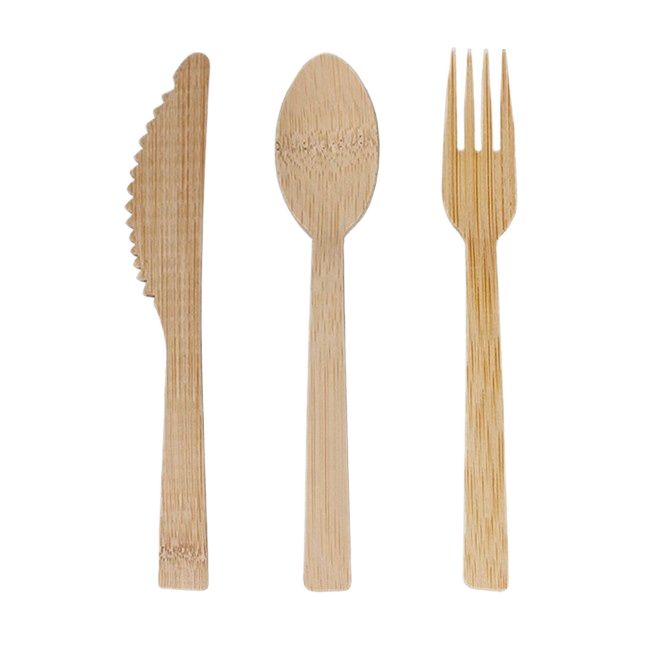
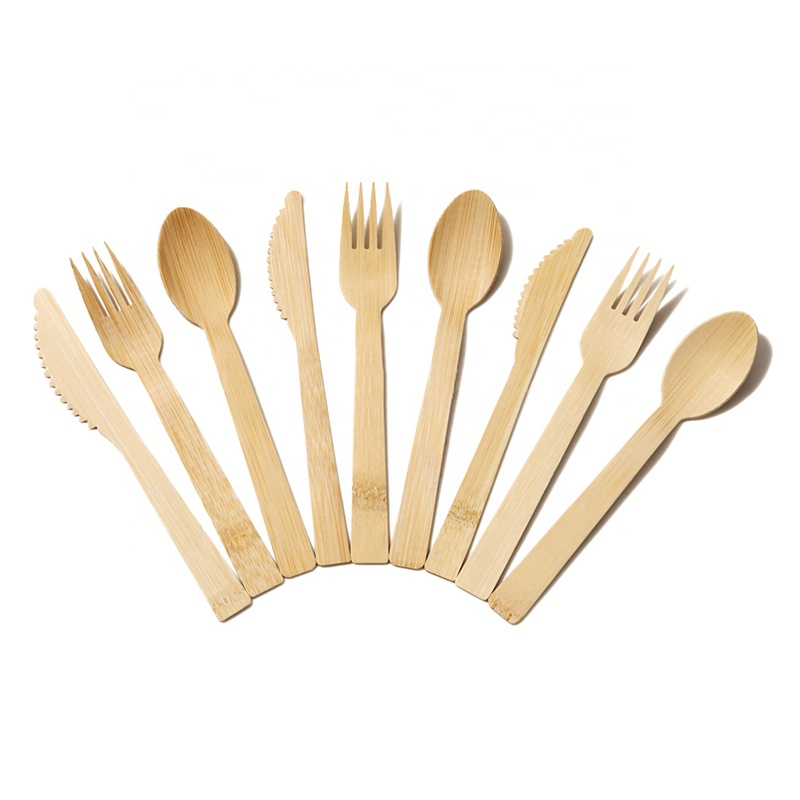
Custom branded bamboo cutlery transforms a commodity disposable into a marketing asset. This guide covers every branding method available, what each one costs, which method fits which use case, and how to get started.
The Four Branding Methods
There are four ways to put your brand on bamboo cutlery, each with different cost structures, visual results, and ideal applications.
1. Laser Engraving
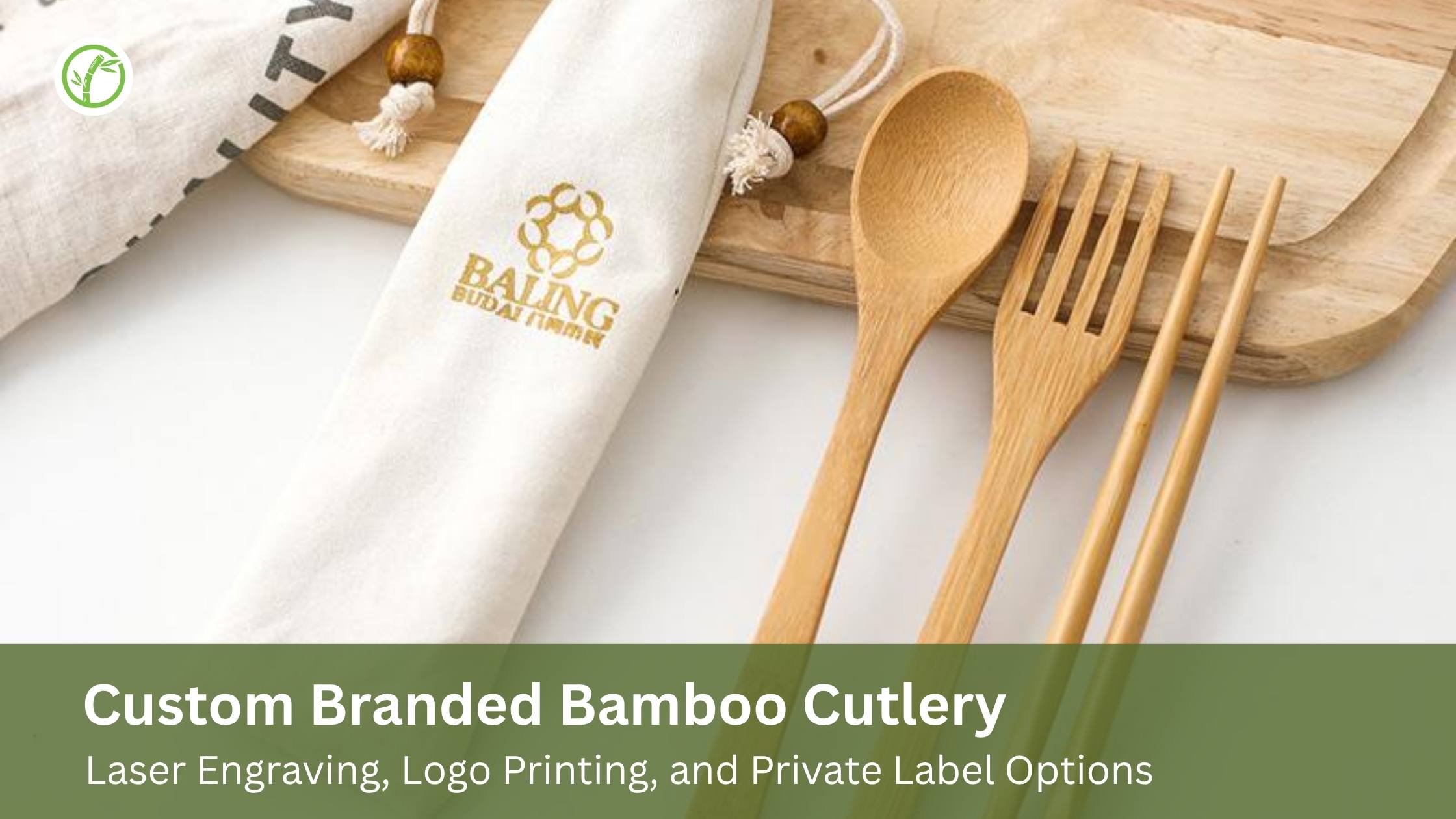
Laser engraving uses a focused laser beam to burn your logo, text, or design directly into the bamboo surface. The result is a permanent, tactile mark that cannot fade, wash off, or peel away.
How it looks: The engraved area appears as a darker brown against the natural bamboo colour. The contrast is subtle and elegant — not loud or corporate. It reads as intentional craftsmanship, not mass-produced branding.
Where it works best: The flat handle area of forks, knives, and spoons. Chopstick bodies. The outer surface of bamboo straws. Any flat or gently curved surface with enough area for a legible design.
Design constraints: Laser engraving works best with simple logos, monograms, text, and line-art designs. Highly detailed photographic images or very fine typography may not reproduce cleanly at the small scale of a utensil handle. Your logo should be recognisable at approximately 15mm to 25mm width.
Cost impact: Laser engraving adds approximately $0.01 to $0.03 per piece to the base price, depending on the design complexity and the number of items per batch. There is typically a one-time setup fee for the engraving template.
MOQ: Usually 10,000 to 20,000 pieces minimum for laser-engraved orders, though this varies by supplier.
Insight: Laser-engraved bamboo cutlery has the highest perceived value of any branding method. In consumer testing, diners consistently rate engraved bamboo cutlery as more premium than printed plastic alternatives — even when told the bamboo is disposable. This perception uplift is especially valuable for hotels, premium catering, and branded restaurant chains where every touchpoint reinforces brand positioning.
Best for: Hotels, premium restaurants, corporate events, wedding favours, brand activations.
2. Printed Wrappers and Sleeves
Rather than branding the cutlery itself, this method brands the packaging around it. Your logo, colours, messaging, and design are printed on the kraft paper sleeve or wrapper that holds the cutlery set.
How it looks: Full-colour printing on kraft or white paper. You control the entire visual — logo placement, brand colours, taglines, sustainability messaging, social media handles, QR codes. The wrapper is the first thing a customer sees and touches.
Where it works best: Pre-packaged cutlery sets (fork + knife + spoon + napkin). This is the dominant branding format for takeaway, delivery, and catered meals.
Design flexibility: Much higher than laser engraving. You can print full-colour artwork, photographs, complex logos, multi-language text, regulatory compliance information, and even unique designs for different events or promotions.
Cost impact: Printed wrappers add approximately $0.02 to $0.04 per set, depending on the printing method (flexographic for large volumes, digital for short runs). There is a plate fee or setup charge for new designs.
MOQ: Typically 5,000 to 10,000 sets for standard flexographic printing. Digital printing can accommodate smaller runs but at a higher per-unit cost.
Insight: The wrapper is the single highest-ROI branding opportunity in takeaway packaging. A study by a UK food delivery association found that 68 percent of customers notice branded packaging elements during their delivery experience, and 41 percent say branded packaging makes them more likely to reorder from the same restaurant. At $0.03 per wrapper, that is one of the cheapest customer retention tools available to any food business.
Best for: Takeaway restaurants, delivery brands, cloud kitchens, airline catering, corporate meal programmes.
3. Custom Packaging
Custom packaging goes beyond the individual wrapper to include the outer carton, sleeve, or display box that holds multiple cutlery sets. This is the branding method used by businesses that sell or distribute bamboo cutlery rather than just serving it.
How it looks: Your brand identity is on the retail-facing packaging — the box that sits on a store shelf, the carton that a wholesale customer unpacks, or the display unit at a trade show booth.
Where it works best: Retail eco-product brands, Amazon sellers, wholesale distributors, hotel purchasing departments that want branded inventory, corporate gift programmes.
Design options: Box shape and size, colour printing on all surfaces, interior packaging layout, branded tissue paper or insert cards, barcodes and SKU labels, compliance markings, and sustainability certifications prominently displayed.
Cost impact: Custom packaging is the most expensive branding option because it involves structural design, material sourcing, and printing across multiple surfaces. Total packaging cost typically adds $0.05 to $0.15 per unit depending on complexity and volume.
MOQ: Usually 5,000 to 10,000 retail units for custom packaging production.
Insight: For businesses selling eco-products on Amazon, Etsy, or through retail channels, the packaging is the product in the eyes of the consumer. A beautifully designed bamboo cutlery box with clear sustainability messaging can command a 30 to 50 percent price premium over unbranded competitors in the same category. The packaging investment pays for itself within the first batch.
Best for: Retail brands, e-commerce sellers, wholesale distributors, corporate gifting, hospitality procurement.
4. Full Private Label
Private labelling is the most comprehensive branding option. Your brand name, logo, and identity replace all supplier branding across every element — the cutlery, the wrapper, the outer packaging, and all documentation.
The product appears entirely as your own. Your customer has no way of knowing who manufactured it. This is standard practice in retail and wholesale distribution.
What is included: Custom-branded individual wrappers, branded outer cartons, your brand name on all labelling, sustainability certifications displayed under your brand, custom insert cards or instructions if needed.
Where it works best: Distributors building their own eco-product brand. Retailers who sell branded product lines. Hotel chains with proprietary sustainability programmes. Restaurant groups that want uniform branded disposables across all locations.
Cost impact: The total brand setup involves wrapper design, packaging design, engraving template (if applicable), print plates, and initial sampling. The one-time setup typically costs $200 to $1,000 depending on complexity. Per-unit cost for private-label products is similar to branded sets: $0.08 to $0.20 per set at volume.
MOQ: Typically 20,000 to 50,000 sets for a full private-label programme, though some suppliers offer lower entry points for first orders.
Insight: The private-label eco-products market is growing at over 15 percent annually. Distributors who build their own branded bamboo cutlery line own the customer relationship, control pricing, and build brand equity that compounds over time. Businesses that only resell other people’s brands compete solely on price. Businesses that build their own brand compete on value.
Best for: Wholesale distributors, retail chain buyers, hotel group procurement, restaurant franchises, Amazon private-label sellers.
Which Method Should You Choose?
The decision matrix is straightforward.
If you serve cutlery directly to diners in a premium setting and want a tactile brand impression, choose laser engraving.
If you package cutlery sets for takeaway, delivery, or catered meals and want visible branding at the point of unboxing, choose printed wrappers.
If you sell or distribute bamboo cutlery as a product and need shelf-ready or warehouse-ready branding, choose custom packaging.
If you want to build a standalone brand that you own and control across all channels, choose full private label.
Many businesses combine methods. A hotel might laser-engrave its crest on the spoons served at the pool bar, use printed wrappers for room-service cutlery kits, and carry custom-packaged sets in its gift shop. Each touchpoint uses the method that fits the context.
How to Get Started With Custom Branding
The process follows five steps.
Step one: Choose your branding method based on your use case and budget.
Step two: Prepare your artwork. For laser engraving, supply a high-resolution vector file (AI, EPS, or SVG) of your logo in single colour. For printed wrappers and packaging, supply your full brand kit including logo files, colour codes (Pantone or CMYK), fonts, and any specific design layouts.
Step three: Request a branded sample. Your supplier will produce a small batch of branded products for your approval before committing to full production. Review the sample carefully — check logo placement, colour accuracy, engraving depth, and print quality.
Step four: Approve the sample and confirm your order specification — quantity, delivery timeline, and shipping details.
Step five: Production and delivery. Standard branded orders take 20 to 35 days depending on the branding method and volume. Plan your first order well in advance of when you need the product.
At FriendlyBamboo, we support all four branding methods with accessible MOQs designed for growing businesses. Whether you need 10,000 engraved forks for a single event or 200,000 private-label sets for annual distribution, our team will guide you through every step.