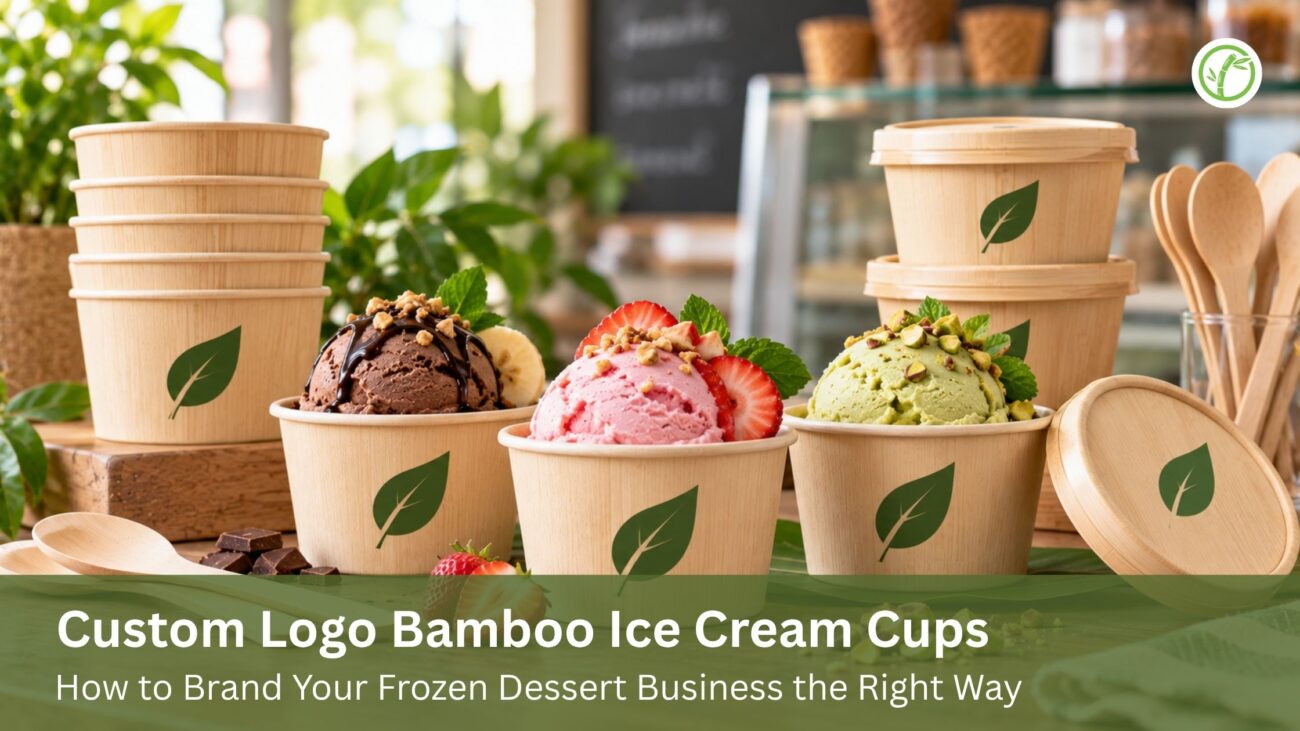
Your ice cream is the star. But in a crowded frozen dessert market, whether you are scooping at a pop-up, supplying a retail chain, running a gelato bar, or selling at a food festival, the cup your ice cream sits in is the first thing a customer sees, the thing they carry, and often the thing they photograph.
Custom logo ice cream cups do more than hold your product. They are a brand touchpoint, a social media asset, and a silent salesperson working every time a customer walks down the street with your branded cup in hand. When those cups are also made from certified eco-friendly materials, compostable bagasse rather than plastic or standard paper, they add a sustainability story that resonates with today’s dessert customers on top of the visual impression.
This article covers everything you need to know about custom logo ice cream cups: the materials available, what to look for in a wholesale supplier, how to brief your artwork, what minimum order quantities actually look like, and how to choose the right format for your specific operation.
Why Custom Branded Ice Cream Cups Are Worth the Investment
Walking Billboards at Zero Extra Media Cost
Every customer who walks out of your shop with a branded cup is displaying your logo at street level, at tables, at parks, and at every point on their journey home. In densely populated urban areas where your customers are also walking past your potential future customers, this exposure has genuine commercial value. Unlike paid advertising, you are paying for a functional product, and the brand exposure comes for free on top of it.
The incremental cost of adding a custom print to a wholesale cup order is typically USD 0.02–0.08 per unit above the cost of a plain cup at equivalent volumes. For a business selling a USD 5–8 ice cream product, this is a less-than-2% increase in packaging costs for a brand asset that works every time the cup leaves your shop.
Social Media Amplification
Frozen dessert is one of the most photographed food categories on social media. Customers photograph their ice cream before they eat it consistently, across every demographic. A distinctive, well-designed branded cup appears in every one of those photographs. When your logo, colour palette, or brand illustration is on the cup, it appears in posts, reels, and stories from customers you did not pay and cannot directly control.
Several independent ice cream and gelato brands have attributed meaningful follower growth directly to branded cup designs that customers want to photograph and share. This effect compounds: more photos mean more exposure, which means more in-store visitors, which means more photos. A quality branded cup is one of the most cost-effective organic marketing tools available to a food business.
Perceived Quality and Premium Positioning
There is a direct psychological link between branded packaging and perceived product quality. A gelato served in a plain white cup, and the same gelato served in a branded cup with a premium design feel different to the customer even when the product is identical. For businesses in the premium or artisan tier of the frozen dessert market, branded cups are not optional; they are a prerequisite for the price point customers are willing to pay.
Ice cream businesses that switch from plain to branded cups consistently report an increase in customer-generated social media content within the first month without any prompting or incentive.
Eco-Friendly Custom Cups: Why Material Choice Matters for Your Brand
The Problem with Standard Paper Cups
Most disposable ice cream cups on the market are made from paper with a plastic or wax inner liner. The liner is what makes the cup waterproof; without it, paper cups absorb moisture from ice cream almost immediately and lose structural integrity. The problem is that this plastic liner makes the cup non-compostable. It is marketed as paper packaging but ends up in landfills like plastic, where it cannot be composted or recycled in most waste streams.
For ice cream businesses marketing themselves as natural, artisan, or health-forward, the gap between a ‘natural’ product and a non-compostable cup is a values inconsistency that increasingly savvy customers notice.
Bagasse Cups: The Eco-Credible Alternative
Bagasse cups made from compressed sugarcane fibre achieve moisture and grease resistance through material density rather than plastic coating. A certified PFAS-free bagasse cup wholesale holds ice cream, gelato, and frozen yogurt without leaching or structural failure, while remaining fully compostable within 45–90 days under industrial conditions and 3–6 months in home composting. No plastic liner. No PFAS chemicals. No compromise on performance.
For branded cups, bagasse offers a further advantage: the natural off-white surface takes printing exceptionally well. The slightly textured, organic-feeling surface provides a premium backdrop for brand colours and typography that reads as artisan rather than mass-produced, an aesthetic that aligns perfectly with the positioning of most independent frozen dessert businesses.
Bamboo Ice Cream Sticks to Match
For businesses serving ice cream bars, lollies, or any stick-format frozen dessert alongside cup formats, bamboo ice cream sticks wholesale complete the eco-friendly presentation story. Natural bamboo sticks have a visual warmth and material quality that communicates the same values as a bagasse cup — and they can be custom laser-engraved or packaged in branded wrappers at volume, extending the brand identity to every product format you serve.
Also read – Which bamboo manufacturer exports to USA and Europe
Cup Formats: Which Style Is Right for Your Ice Cream Business?
Straight-Sided Cups (Classic Format)
The most common format for scooped ice cream and gelato. Straight sides make stacking easy for storage and transport, and provide a clean, consistent surface for branding. Available in 4 oz, 8 oz, 12 oz, and 16 oz sizes — the 8 oz and 12 oz formats cover the majority of single-serve ice cream portions in most markets.
- Best for: Scoop shops, gelato bars, frozen yogurt operations, dessert cafés
- Branding position: Full wrap print on the outer surface, maximum brand visibility
- Lid compatibility: Flat lids or dome lids, depending on topping height
Tub Format (Wide-Mouth)
A wider, shallower cup that provides a larger eating surface — popular for multi-flavour scoops, sundaes, and desserts with toppings. The wider mouth makes it easier for customers to eat standing, which suits outdoor and festival formats particularly well.
- Best for: Sundae bars, festival service, high-topping formats
- Branding position: Wide outer surface plus lid top — two print surfaces available
- Lid compatibility: Dome lids standard; flat lids for portion control formats
Portion Cups (Small Format)
2 oz and 4 oz mini cups for sample servings, children’s portions, and single-flavour tasting formats. These are the highest-frequency branded touchpoints for businesses offering free samples as a customer acquisition tool. Every sample delivered in a branded mini cup is a micro-impression of your brand.
- Best for: Sampling, children’s menus, high-end event catering
- Branding position: Small outer surface, keep design simple and logo large for readability at a small scale
Bowl Format (Larger Portions)
For premium ice cream sundaes, affogato formats, and any dessert served as a substantial portion with multiple components, a bagasse bowl wholesale in 16–24 oz provides a wider, more generous base for elaborate dessert presentations. The bowl format is increasingly popular in premium dessert concepts where the visual presentation of the dessert with toppings, sauces, and garnishes is as important as the ice cream itself.
How to Brief Your Custom Logo Cup Artwork
What Your Supplier Needs from You
Before placing a custom print order, prepare the following:
- Logo file in vector format (AI, EPS, or high-resolution SVG). Raster images (JPEG, PNG) at print resolution (300 dpi at final print size) are acceptable if a vector is unavailable — confirm with your supplier before submitting.
- Brand colour references in CMYK (for print). If you only have RGB or HEX values, your supplier’s design team can convert — but expect a small proof approval stage to confirm colour accuracy.
- Desired placement and sizing. Specify whether you want a full-wrap print (360° around the cup), a single-face print (front only), or a minimalist logo stamp. Full-wrap is most impactful for brand visibility; single-face is more cost-effective for first orders.
- Any additional copy. Taglines, website URLs, social handles, and compostability statements (e.g. ‘Made from sugarcane fibre — 100% compostable’) add brand value to the cup beyond the logo alone.
- Lid print requirements. Flat lids can carry a small logo or sticker; dome lids are typically unprinted but can be supplied with a separate branded sticker applied at your end.
Artwork Best Practices for Small-Format Printing
- Keep logo simple — intricate designs with fine lines or gradients do not reproduce well on textured bagasse surfaces at cup scale. Clean, bold logos with solid colour fills perform best.
- Use high-contrast colour combinations — light colours on the natural off-white bagasse background need sufficient contrast to read clearly. Dark green, navy, black, and deep red all work well; pale yellows and light pinks may need a white ink underprint.
- Leave a 3–5 mm bleed around the print area — cup surfaces have slight curvature that requires bleed to prevent white edges at the seam.
- Request a physical proof before committing to full volume — colour rendering on bagasse can vary slightly from screen preview; a physical proof eliminates surprises.
Minimum Order Quantities and Pricing: What to Expect
Standard MOQs for Custom Printed Cups
Custom printing adds a setup cost (plates, screen setup, or digital print calibration, depending on the printing method) that is amortized across the order quantity. This is why custom-printed cups have higher MOQs than plain cups. Typical MOQs:
- Screen/flexographic printing (most common for bagasse): 5,000–10,000 units per SKU
- Digital printing (suitable for smaller runs): 1,000–3,000 units per SKU
- Factory-direct wholesale (vs distributor): MOQs are typically 30–50% lower for the same print method
Price Guide at Volume
Indicative pricing for custom printed bagasse ice cream cups at factory-direct wholesale rates:
- 1,000–3,000 units (digital print): USD 0.18–0.28 per cup
- 5,000–10,000 units (screen print): USD 0.12–0.20 per cup
- 10,000–50,000 units: USD 0.08–0.14 per cup
- 50,000+ units: USD 0.06–0.10 per cup
For a scoop shop selling 150 cups per day, a 10,000-unit order represents approximately 67 days of stock — a manageable first run that brings the per-cup cost to a commercially sensible level. At USD 0.12–0.20 per branded bagasse cup, the packaging cost per transaction is under 3% of a typical ice cream sale price.
How to Source Custom Logo Ice Cream Cups from Friendly Bamboo
Friendly Bamboo supplies certified bagasse ice cream cups with custom logo printing, factory-direct to food businesses, ice cream brands, and distributors worldwide. The process is straightforward:
- Browse the cup range and select your size(s). Confirm the format (straight-sided, tub, or portion cup), the volume, and whether you need matching lids.
- Request a plain sample pack to test in your operation. Verify performance with your specific ice cream or gelato product — particularly for soft-serve and high-moisture formats.
- Submit your artwork brief. Friendly Bamboo’s team will provide a digital proof of the print layout on the cup template for approval before production begins.
- Confirm certifications. Request LFGB or FDA food-contact certification, PFAS-free confirmation, and EN 13432 compostability certification for your records.
- Place your production order. Standard lead time from artwork approval to shipment is 20–30 days for factory-direct orders — plan your initial order 6–8 weeks before you need stock.
- Reorder on a regular cadence. Once your design is set up, repeat orders typically have shorter lead times and qualify for improved pricing at higher cumulative volumes.
Every cup order from Friendly Bamboo comes with full food-safety certification documentation — ready for your food safety management file and any local authority inspections.
Ready to Brand Your Ice Cream Cups?
Custom logo ice cream cups are one of the most straightforward brand investments a frozen dessert business can make. The cost is low, the impact is high, and with certified bagasse as the base material, the cups also tell a sustainability story that resonates with customers who care about what they are holding in their hands.
Friendly Bamboo supplies custom printed bagasse ice cream cups factory-direct to businesses of all sizes, from single-site scoop shops ordering their first 1,000-unit print run to national brands ordering at scale. Every cup is PFAS-free, food-contact certified, and compostable without caveats.
Contact us to request a sample pack, get a custom print quote, or discuss your specific requirements. Our team is ready to take your ice cream cup from plain to branded — sustainably, affordably, and with the quality that your product deserves. Explore our full eco-friendly cup range here.
Frequently Asked Questions
Minimum order quantities typically start from 1,000 units for digital printing and 5,000 units for screen printing. Factory-direct suppliers like Friendly Bamboo often offer lower MOQs than distributor channels contact us for a quote based on your specific volume requirement.
Yes — certified bagasse cups from Friendly Bamboo are PFAS-free and tested to LFGB (EU/UK) and FDA (US) food-contact standards. Full test reports are available on request. They are safe for direct contact with ice cream, gelato, frozen yogurt, and all standard frozen dessert products.
You can print any design that fits within the printable cup area, logo only, full brand illustration, wrap-around pattern, or any combination. We recommend keeping designs bold and high-contrast for the best results on bagasse’s natural off-white surface. A digital proof is provided before production begins.
Standard production and shipping lead time is 20–30 days from artwork approval for factory-direct orders. For first orders, allow an additional 5–7 days for the artwork proof and approval stage. We recommend placing your first order 6–8 weeks before your required delivery date.
Yes — the inks used for printing on bagasse cups are food-safe and do not prevent composting. Certified printed bagasse cups meet EN 13432 (industrial compostability) and are suitable for home composting at standard timeframes. Certification documentation is available on request.
Yes — most suppliers, including Friendly Bamboo, allow mixed-SKU orders. Different sizes with the same print design can usually be produced in the same production run, which can reduce the per-size setup cost. Confirm with your account manager when placing a multi-size order.
Bagasse cups achieve moisture resistance through compressed fibre density rather than plastic or wax coatings. This means they hold ice cream without leaching, are fully compostable (unlike most paper cups with plastic liners), and have a natural texture that looks and feels premium. They are also PFAS-free, addressing the growing regulatory concern about chemical coatings in food packaging.