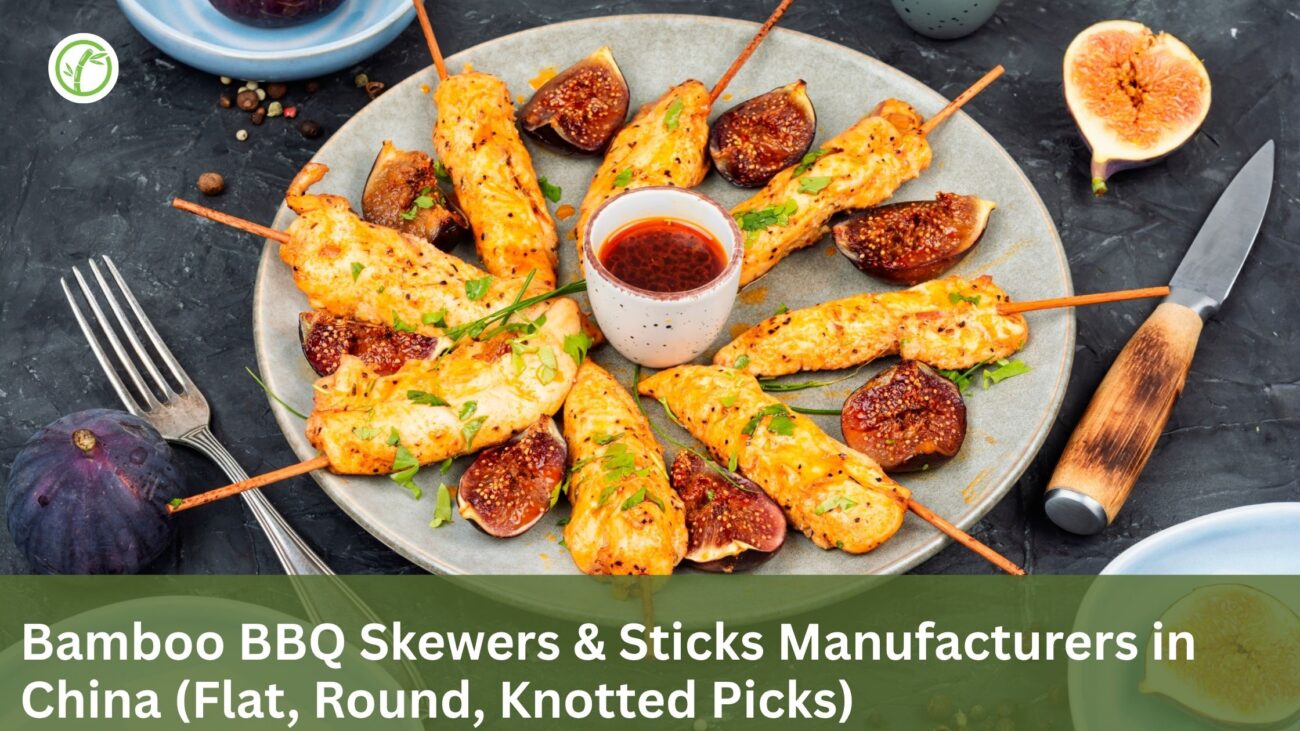
The top bamboo BBQ skewer and stick manufacturers in China include Friendly Bamboo, HANKAI Bamboo Product Company, Jiangxi Xizhu Bamboo Industry, Greenwood (Dalian), Bamborn, Panda Bambu, SENYANGWOOD, and FRbamboo (Fujian Hongkai). Skewer sourcing differs from chopstick sourcing in one important way: shape determines function, not just style. Flat, round, and knotted picks solve different food-service problems, and picking the wrong one for your menu causes more returns than picking the wrong supplier does.
Flat, Round, and Knotted Picks: What the Shape Actually Does
Flat (paddle) skewers have a rectangular cross-section, usually 2.5–6mm wide, sold in lengths from 15cm to 40cm+. The flat profile grips meat and vegetables so they don’t spin freely while grilling; this matters most for shish kebab, satay, and koobideh-style skewers where a round stick would let heavy pieces rotate and cook unevenly.
Round skewers have a cylindrical cross-section, typically 2.0–5.0mm diameter, in the same general length range. They’re the default choice for lighter, more delicate items, fruit, marshmallows, cocktail garnishes, where the round profile inserts more easily and doesn’t need to resist rotation.
Knotted (looped) skewers have a small twisted or looped head at one end, formed by hand-bending baked bamboo. The knot serves two functions: it stops small or soft food (like cocktail onions or cheese cubes) from sliding off the end, and it visually signals to the customer that the pick is unused, similar to how connected Twin chopsticks signal an unopened pair.
| Style | Cross-Section | Typical Diameter/Width | Best Use | Weak Point |
| Flat/Paddle | Rectangular | 2.5–6mm | Kebabs, satay, koobideh — anything that must not spin | Splits along the grain more easily than round under lateral pressure |
| Round | Cylindrical | 2.0–5.0mm | Fruit, marshmallows, cocktails, light appetizers | Rolls/spins under heavier or unevenly balanced food |
| Knotted/Looped | Round with formed head | 2.0–3.0mm | Small pieces needing a stopper; sanitation-sensitive service | Hand-forming means less dimensional consistency than machine-cut styles |
1. Friendly Bamboo
Friendly Bamboo is a China-based manufacturer and exporter of eco-friendly disposable bamboo, wood, and bagasse products, operating for over 12 years and shipping to more than 30 countries. Bamboo skewers are one part of a full tableware catalog the company produces in-house, alongside cocktail picks, chopsticks, cutlery, plates, straws, and toothpicks, positioning it as a single-source option for buyers who’d otherwise need separate factories for skewers versus tableware.
Address: Hui Ding Bamboo Industry, Dashageng E-commerce Industrial Park, Huoshan County, Lu’an City, Anhui Province, China, located in the same bamboo-growing county as HANKAI Bamboo below, which matters if you’re consolidating multiple orders from Anhui-based factories into one container.
Company type: Manufacturer and exporter.
Product categories: Bamboo skewers, cocktail picks, fruit forks, fruit sticks, toothpicks, chopsticks, cutlery, plates, straws, and bamboo poles.
Pros:
- Selects first-layer bamboo skin (the outer, denser fiber layer) specifically for skewers, which improves insertion smoothness and reduces splintering compared to using inner-layer bamboo
- Publishes certifications (FSC, FDA, ISO) directly on-site, along with detailed MOQ and pricing benchmarks for related product lines, reducing the back-and-forth typically needed to get this information from a factory
- Offers private-label and custom branding across the same catalog that includes skewers, so a buyer building a branded tableware line doesn’t need a second supplier
- Broad category range (skewers, cocktail picks, cutlery, chopsticks, plates) reduces the number of suppliers a buyer needs to manage
- Detailed on-site documentation of shipping logistics (FOB/CIF terms, phytosanitary certificates, sea vs. air freight timelines) specific to bamboo product exports
Cons:
- As a multi-category tableware manufacturer, skewers are one product line among several rather than the company’s sole specialty
- Standard MOQs on related bamboo product lines start in the hundreds of thousands of units for bulk-bag formats, which may be high for a small first-time buyer testing the category
Related pages: wholesale bamboo cutlery (lists skewers among related product lines), bulk order process, and test report & certificates for compliance documentation.
2. HANKAI Bamboo Product Company
HANKAI is a bamboo products manufacturer based in Huoshan, Lu’an City, Anhui Province, a region locally known as the “Bamboo Sea” for its bamboo forest density. The company has over 20 years of experience converting raw bamboo into finished products in-house, owns its own forest supply rather than sourcing bamboo from third parties, and produces a full range spanning chopsticks, skewers, sticks, and tableware.
Address: Huoshan, Lu’an City, Anhui Province, China.
Company type: Manufacturer, vertically integrated from raw bamboo forest to finished product.
Product categories: Disposable bamboo chopsticks, bamboo paddle skewers, BBQ bamboo sticks, toothpicks, incense sticks, cotton bamboo sticks, and bamboo tableware (knives, forks, spoons, plates, sushi mats).
Pros:
- Owns 80,000 acres of bamboo forest directly, giving raw-material control that trading-company-style suppliers don’t have
- Operates a 40,000 square meter factory with roughly 200 employees, indicating real production scale rather than a reseller operation
- Holds ISO9001, CE, LFGB, and SGS certifications, covering both quality management and EU food-contact compliance
- OEM/ODM services available for buyers needing custom specifications rather than catalog-standard skewers
Cons:
- Broad product range across chopsticks, skewers, sticks, and tableware means paddle skewers are one line among many rather than a specialized focus
- Public information on skewer-specific MOQ and per-unit pricing is less detailed on company materials than on some newer, more digitally documented competitors
3. Jiangxi Xizhu Bamboo Industry Co., Ltd. (formerly Chongyi Lvjie Bamboo Industry)
Jiangxi Xizhu Bamboo Industry operates out of Ganzhou City, Jiangxi Province — a region with abundant bamboo resources — under two linked factory names: the original Chongyi Lvjie Bamboo Industry Co., Ltd. and the newer Jiangxi Xizhu Bamboo Industry Co., Ltd. The factory exports roughly 60% of its production to Japan, South Korea, Canada, Europe, the Americas, and Southeast Asia, with skewers manufactured in specific end-use formats rather than generic round sticks alone.
Address: No. 79, Guantian Park, Chongyi Industrial Park, Ganzhou City, Jiangxi Province, China.
Company type: Manufacturer and exporter, ~30,000 square meters of factory space, about 100 employees.
Product categories: Bamboo chopsticks, incense sticks, BBQ skewers, teppo/flat sticks, toothpicks, fruit picks, cutlery, and bamboo charcoal.
Pros:
- Holds ISO9001:2015 and ISO 22000 certification, covering both quality and food safety management systems
- Reports annual sales exceeding USD 10 million, indicating established transaction volume with international buyers
- Manufactures skewers in specific end-use formats (double blunt-end for corn dogs, flat ends for satay/yakitori) rather than only generic round sticks
Cons:
- MOQs on many listed skewer products run into the hundreds of thousands of pairs/pieces per order — high for buyers who aren’t ordering at large scale
- Company has operated under two different registered names (Chongyi Lvjie and Jiangxi Xizhu), which can complicate due diligence and contract paperwork if not clarified upfront
Also read –Bamboo Chopsticks Manufacturers in China
4. Greenwood (Dalian) Industrial Co., Ltd.
Greenwood has been designing and producing biodegradable bamboo cutlery and skewers for over 20 years since its founding in 2000, growing into one of the larger-scale operations on this list with 5 production plants and 1 R&D center. The company recently opened a new factory in Bangladesh, giving it a second-country manufacturing base alongside its original Dalian operation — relevant for buyers wary of concentrating all sourcing in a single country.
Address: 1-1 Yinquan Street, Jinzhou District, Dalian, China.
Company type: Manufacturer, 5 production plants plus 1 R&D center covering 40,000+ square meters, plus a newer Bangladesh factory.
Product categories: Bamboo and wooden BBQ skewers (knotted, gun/loop, flat), wooden cutlery, bagasse tableware, coffee stirrers, straws, toothpicks, sushi boats/cones, and wooden plates.
Pros:
- Reports an annual output of up to 6 billion pieces across its product range, indicating very large-scale production capacity
- Holds FSC, BSCI, BRC, and SGS certification on skewer products specifically, not just at the company level
- Recently opened a Bangladesh factory, giving buyers a second-country sourcing option under the same company umbrella — useful for buyers managing tariff or supply-chain risk tied to China-only sourcing
- Publishes an active blog covering food-grade standards, testing requirements, and buying guidance specific to bamboo/wood cutlery and skewers
Cons:
- Scale of operations (5 plants, multiple countries) can mean longer internal coordination time for highly custom or small-batch orders compared to a single-site factory
- Wide product catalog spanning cutlery, tableware, and skewers means skewers compete for factory attention with several other major product lines
5. Bamborn (Fujian Bamborn Materials Co., Ltd.)
Bamborn is a Fujian-based manufacturer known primarily for bamboo kitchenware — cutting boards, bowls, trays, and utensils — rather than skewers specifically, with skewers and sticks offered as part of that broader kitchenware and dinnerware catalog. The company blends traditional bamboo craftsmanship with CNC shaping and a documented carbonization step aimed at improving hardness and moisture resistance.
Company type: Manufacturer specializing primarily in bamboo kitchenware, with skewers as a secondary product line.
Product categories: Bamboo dinnerware, kitchenware, panels, plywood, furniture, and skewers/sticks.
Pros:
- Uses carbonization as part of its standard manufacturing process specifically to enhance hardness and moisture resistance, a step not all generalist kitchenware factories apply to their stick/skewer lines
- CNC shaping and multi-step sanding process aimed at a smooth, splinter-free finish
- Fully integrated production line supports large OEM/ODM orders with in-house R&D for custom design requests
Cons:
- Skewers are a minor line within a kitchenware-focused catalog (cutting boards, bowls, trays are the company’s primary emphasis), so buyers should confirm skewer-specific capacity and lead times directly rather than assuming parity with its core kitchenware production
- MOQ starts at 300–500 sets for kitchenware items generally, which may not translate directly to skewer-specific order minimums — get a skewer-specific quote rather than relying on the general MOQ figure
6. Panda Bambu
Panda Bambu is a manufacturer and exporter of disposable bamboo and wooden products that treats skewers as a dedicated, well-documented product line rather than a minor add-on to a tableware catalog. The company publishes unusually specific technical detail on its own site — down to how knot thickness affects chopstick and skewer quality — and supplies both bamboo and birch wooden skewers to serve buyers with different machining requirements.
Company type: Manufacturer and exporter specializing in disposable bamboo and wooden products.
Product categories: Round skewers, paddle/flat skewers, knot skewers, loop skewers, ball picks, corn dog skewers, decorative skewers, garden sticks, chopsticks, cutlery, and toothpicks.
Pros:
- Skewers are manufactured to LFGB and SGS-PCP standards specifically, not just a general company-wide claim
- Low MOQ starting at 50 cartons, which is more accessible for smaller or first-time buyers than the 100,000+ unit minimums seen at several competitors on this list
- Offers both bamboo and birch wooden skewers from one factory, useful for buyers who supply automated kebab machines that require the higher machining precision of birch
- Explicitly documents the trade-offs between knot thickness (chopsticks with a knot are often thicker at 4.5–4.8mm vs. 4.0–4.5mm without), a level of technical detail not commonly published elsewhere
Cons:
- As a broad disposable-tableware exporter, skewer buyers are one segment of a much larger multi-category client base
- Public certifications focus on LFGB/SGS-PCP; buyers needing BRC or FSC-specific documentation should confirm availability directly, as it isn’t prominently listed for the skewer line
7. SENYANGWOOD
Established in 1988, SENYANGWOOD is one of the longest-operating manufacturers on this list and, unlike most competitors here, focuses specifically on bamboo and wooden skewers rather than a general bamboo tableware catalog. That narrower focus has let the company build out a fuller range of standard lengths and tip styles than a generalist tableware factory typically offers.
Company type: Manufacturer, established 1988, specialized in bamboo/wooden skewers and sticks.
Product categories: Disposable grill/kabob sticks, bamboo BBQ skewers in multiple standard lengths (15cm–30cm+), sharpened-tip and blunt-tip variants.
Pros:
- Nearly four decades of specialization specifically in skewers, longer than any other manufacturer on this list
- Offers free samples before bulk commitment, standard practice but explicitly documented
- Multiple standard length options (15, 18, 20, 25, 30cm) covering most common foodservice use cases without requiring custom tooling
Cons:
- Long operating history is specific to skewers/sticks; the company does not appear to offer the broader tableware catalog (plates, cutlery, chopsticks) that several competitors bundle in, so multi-category buyers will need a second supplier
- Public certification and factory-scale details are less prominently documented online than more recently established competitors with stronger digital marketing presence
8. FRbamboo (Fujian Hongkai Bamboo and Wood Products Co., Ltd.)
Address: Factory in Fujian Province, with export operations headquartered under Xiamen Forever Rise Imp. and Exp. Co. (established 2016) in Xiamen.
Company type: Manufacturer, operating since 2008, with FSC Chain-of-Custody certification for bamboo and wood products updated in 2015.
Product categories: Bamboo skewers and sticks alongside a wider bamboo and wood homeware range, produced with a documented equipment list including carbonizing tanks, kiln drying, hot-press, CNC routers, and UV painting lines.
Pros:
- Registered capital of 26 million CNY signals a more capitalized operation than many smaller family-run factories in this category
- Employs 64 skilled workers and 6 experienced carpenters among its 84 total staff, a relatively high ratio of skilled-to-total labor for a factory this size
- Publishes its specific manufacturing equipment list (carbonizing tanks, CNC routers, vacuum film packaging), giving buyers more concrete insight into process capability than a general company description
Cons:
- Smaller total headcount (84 employees) than several larger competitors on this list, which may limit capacity for very high-volume single orders
- Primary public positioning emphasizes home bamboo/wood products broadly rather than food-service skewers specifically, so food-grade documentation for skewers should be confirmed directly rather than assumed from the general FSC certification
Frequently Asked Questions
Because skewers hold food during active cooking, not just during eating. A round skewer under a heavy, unevenly weighted kebab will spin on the grill, causing uneven cooking — flat skewers exist specifically to solve that problem.
SENYANGWOOD and Panda Bambu both treat skewers as a dedicated, well-documented product line rather than a minor addition to a wider tableware catalog.
It can simplify container consolidation — inland trucking to the same port or inspection point becomes more efficient when multiple suppliers are geographically close, which can reduce combined freight costs for buyers ordering from more than one factory.
Generally yes. Knotted/looped skewers require hand-forming the bent head after the bamboo is baked, which introduces more size and shape variation than fully machine-cut round or flat styles.
Not necessarily — low MOQ reduces upfront risk for testing a product, but per-unit pricing is typically higher at low volumes. Buyers with predictable, larger ongoing demand often get better landed cost from factories with higher MOQs and larger-scale production.
Yes. Most manufacturers in this list, including Friendly Bamboo, HANKAI, and Greenwood, support custom branding on packaging and, in some cases, laser engraving or hot-stamping directly on paddle/teppo-style skewer handles.