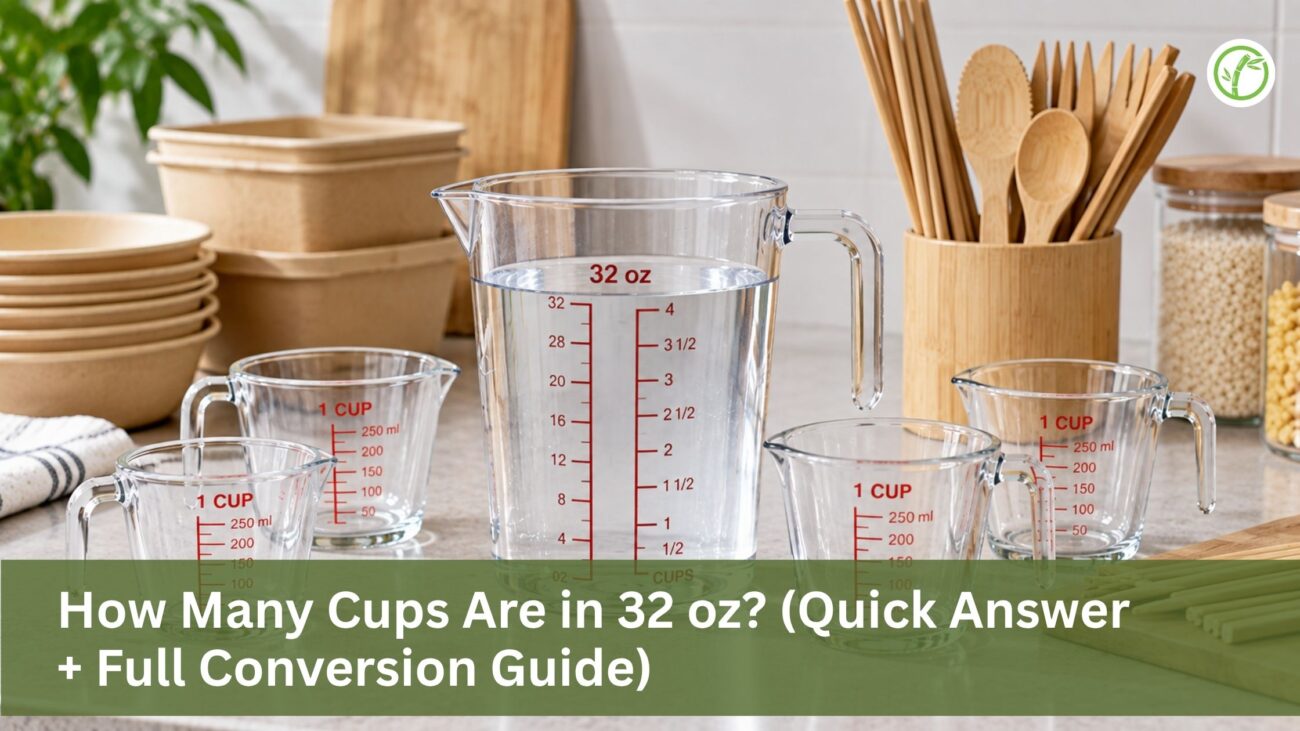
How many cups are in 32 oz? For any liquid water, milk, juice, coffee 32 fl oz always equals exactly 4 cups, because 1 cup is fixed at 8 fluid ounces. This conversion never changes for liquids, whether you’re measuring a recipe, a water bottle, or a pitcher of iced tea. The one thing to watch for: this rule applies to fluid ounces, not dry ounces 32 oz of flour or sugar measures out to a different number of cups, which we’ll cover further down.
How Many Cups Are in 32 oz? Quick Answer
32 fl oz = 4 cups. The formula behind it is simple:
cups = ounces ÷ 8
32 ÷ 8 = 4, every time, for any liquid.
| Fluid Ounces (fl oz) | Cups |
| 8 oz | 1 cup |
| 16 oz | 2 cups |
| 32 oz | 4 cups |
| 48 oz | 6 cups |
| 64 oz | 8 cups |
| 128 oz | 16 cups (1 gallon) |
What’s a Fluid Ounce, and What’s a Cup?
A fluid ounce (fl oz) measures liquid volume how much space a liquid takes up, not how heavy it is. One fluid ounce equals 29.57 milliliters. You’ll see it on drink bottles, milk cartons, sauces, and dressings. A small juice box is often around 6 fl oz, a regular coffee cup runs 8–12 fl oz, and a sports drink bottle is typically 28–32 fl oz.
A cup is the standard US kitchen unit, fixed at 8 fl oz, or 236.59 ml. It’s the unit most home recipes use for water, milk, oil, broth, and smoothies, and with some accuracy caveats covered below, dry ingredients too.
32 oz Is How Many Cups? The Conversion, Step by Step
If you want to work it out yourself rather than just take the answer, there are two easy ways to get there.
Method 1 — Divide by 8:
- Start with the ounce amount: 32
- Divide by 8 (the number of fl oz in one cup): 32 ÷ 8
- Result: 4 cups
Method 2 — Multiply by the conversion ratio: 32 oz × (1 cup / 8 oz) = 4 cups
Both methods land on the same answer, so use whichever is easier to picture. Once you know 8 oz = 1 cup, every other conversion follows the same pattern: 2 cups = 16 oz, 3 cups = 24 oz, 4 cups = 32 oz.
Quick Tips for Getting the Conversion Right Every Time
- Anchor on one fact: 8 oz = 1 cup. Every other liquid conversion in this guide builds off that single number, so it’s the one worth committing to memory.
- Use a dual-marked measuring cup. Most standard measuring cups show both cup lines and ounce lines on the same container, so you can cross-check either unit instantly instead of doing mental math mid-recipe.
- Read at eye level, not from above. Looking down at a measuring cup on the counter distorts how full it actually looks bend down or lift the cup to read the line straight on.
- Practice once with plain water. Filling a 32 oz bottle and pouring it into a set of measuring cups is the fastest way to actually see what 4 cups looks like, rather than just knowing the number.
- Weigh dry ingredients instead of estimating. Since 32 oz of a dry ingredient doesn’t reliably convert to a fixed cup count (see below), a kitchen scale is the more accurate tool the moment you’re measuring flour, sugar, or rice rather than a liquid.
How Many Cups Is 32 oz Compared to Other Common Sizes?
| Fluid Ounces | Cups |
| 8 oz | 1 cup |
| 16 oz | 2 cups |
| 24 oz | 3 cups |
| 32 oz | 4 cups |
| 48 oz | 6 cups |
| 64 oz | 8 cups |
| 128 oz | 16 cups |
Reverse Conversion: Cups to Ounces
Going the other direction uses the same 8:1 relationship, just multiplying instead of dividing:
- 1 cup = 8 oz
- 2 cups = 16 oz
- 4 cups = 32 oz
- 8 cups = 64 oz
32 oz in Metric, Pints, Quarts, and Gallons
| Unit | Equivalent to 32 oz |
| Milliliters | 946.35 ml |
| Liters | ≈0.95 L (often rounded to 1 L) |
| Pints | 2 pints |
| Quarts | 1 quart |
| Gallons | 0.25 gallon (¼ gallon) |
| UK Imperial fl oz | ≈33.8 imperial fl oz |
Worth knowing if you’re following a recipe from outside the US: the UK fluid ounce (28.41 ml) is slightly smaller than the US fluid ounce (29.57 ml), so 32 US fl oz isn’t quite the same volume as “32 fl oz” on a UK label.
How Many Cups in 32 oz of Dry Ingredients?
This is where the 4-cup answer stops applying, and it’s worth understanding why. Fluid ounces measure volume how much space something takes up. Dry ounces measure weight — how heavy something is. Those are two different properties, so a fixed weight doesn’t translate to a fixed volume unless the material’s density stays constant. Picture 32 oz of popcorn next to 32 oz of dense wet sand: the popcorn fills a much larger container for the same weight, because it’s far less dense. Bakery ingredients don’t swing quite that dramatically, but the same principle is exactly why 32 oz of flour and 32 oz of sugar don’t fill the same number of cups.
Because ingredients differ in density, 32 oz by weight fills a different number of cups depending on what you’re measuring:
- 32 oz of all-purpose flour ≈ 7.25 cups
- 32 oz of granulated sugar ≈ 4.5 cups
- 32 oz of uncooked rice ≈ 6.65 cups
- 32 oz of butter ≈ 4 cups (dense enough to land close to the liquid conversion)
For dry ingredients, a kitchen scale gives a far more accurate result than trying to convert ounces to cups by formula; that’s true for baking especially, where precision affects the outcome more than in most cooking.
Practical Uses of a 32 oz Measurement
32 oz shows up constantly once you start looking for it:
- In the kitchen: baking liquids (milk, water, buttermilk), soup bases and sauces, smoothies and iced coffee batches, and meal-prep jars. A standard quart mason jar holds exactly 32 oz.
- Everyday products sized around 32 oz: large sports drink bottles, insulated water tumblers, reusable smoothie cups, big takeout drink cups from restaurants, food containers for soup or noodles, and the standard quart-size mason jar. Once you recognize these sizes, you can gauge a portion without reaching for a measuring cup at all. A full 32 oz water bottle is, by definition, exactly 4 cups.
- Food service and catering: 32 oz (one quart) is a common portioning size for soups, sauces, and beverage servings, which is exactly where the container itself, not just the measurement, starts to matter.
Serving or Packaging in 32 oz? Here’s What to Use
If you’re the one filling 32 oz containers rather than just measuring into them a café pouring quart-size soup takeaways, a caterer batching 32 oz drink servings, a meal-prep brand shipping quart jars of sauce the container is doing as much work as the measurement. Plastic quart containers and cups are exactly the kind of single-use plastic item facing tightening restrictions across US cities and counties and outright bans in the EU, which means a supply chain built around plastic 32 oz containers is one regulatory update away from becoming a sourcing emergency.
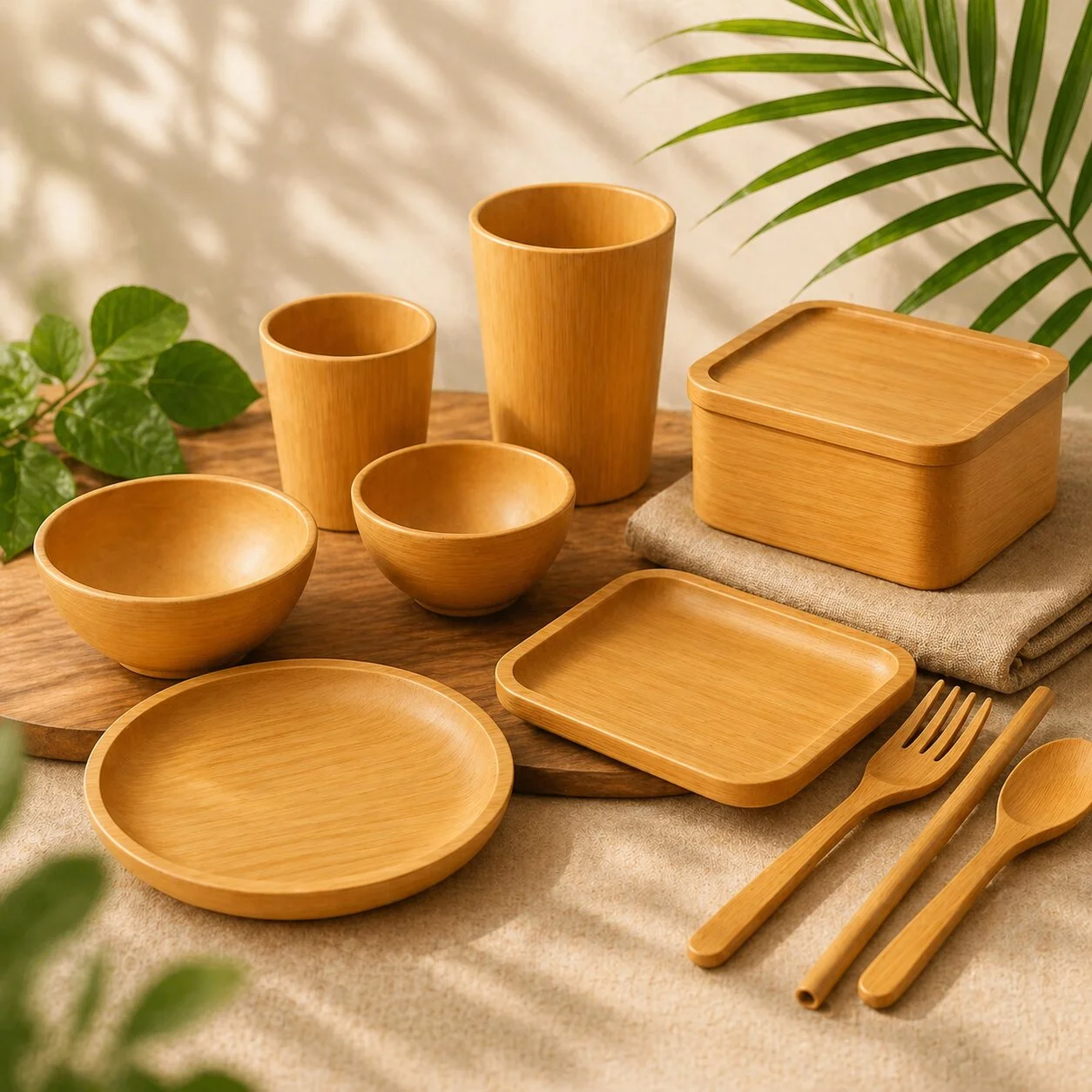
Compostable bagasse boxes, cups, and trays are built for exactly this kind of hot, wet, or oily 32 oz portion; they’re microwave-safe, freezer-safe, and handle sauces and soups without going soggy the way a paper-based container would. And if your 32 oz measurement is a drink rather than a meal a large iced coffee, a smoothie, a 32 oz bubble tea batch a standard paper or plastic straw won’t hold up for the full serving, or won’t handle the diameter a thick drink needs; a wider-diameter bamboo straw is built specifically for that.
Restrictions on single-use plastic packaging are only getting tighter through 2026, and switching your 32 oz packaging line before a ban forces the decision is a far easier transition than doing it under a compliance deadline. Browse bagasse boxes, cups, and trays sized for meal-prep and takeaway portions, or bamboo cups and tableware for a more premium, dine-in-facing presentation, and request a bulk quote to get your 32 oz packaging line sorted before your next order, not after a new restriction lands.
Frequently Asked Questions
Yes — for any liquid, 32 fl oz always equals 4 cups, because 1 cup is a fixed 8 fl oz.
32 oz of water is 4 cups, and this is exact — water’s density doesn’t introduce any variation the way dry ingredients do. A full 32 oz water bottle, in other words, always holds exactly 4 cups, which works out to roughly half of the commonly recommended daily water intake for adults.
For liquid ingredients in a baking recipe (milk, water, oil), 32 oz is 4 cups. For dry ingredients like flour or sugar, the cup count is different — 32 oz of flour is closer to 7.25 cups, so always check whether your recipe means fluid or dry ounces.
A US gallon holds 128 fl oz, so four 32 oz containers make one gallon (128 ÷ 32 = 4).
Two reliable options: use any container you already know holds 32 oz (a quart mason jar, for instance), or use a kitchen scale — 32 oz of water weighs almost exactly 946 grams, since water’s density makes weight and fluid volume line up closely. If you have a set of standard 8 oz cups on hand, filling four of them gets you to 32 oz just as precisely.
For most healthy adults, drinking 32 oz in one sitting is generally fine, particularly after exercise, though drinking it very quickly can feel uncomfortable — spreading intake steadily through the day is the more comfortable approach. 32 oz is also roughly half of the commonly cited daily water intake recommendation for adults, which is a useful reference point if you’re tracking hydration using a 32 oz bottle.
Yes — in US measurements, 1 quart = 32 fl oz = 4 cups, all describing the same volume.
For water and most liquids close to water’s density, 32 oz by weight is very close to 32 fl oz by volume — roughly 4 cups either way. For anything denser or lighter than water, weight and fluid-ounce volume won’t match exactly, so a measuring cup is more reliable for liquids specifically.
Fluid ounces measure volume, while dry ounces measure weight — and different dry ingredients pack differently into a cup depending on density. That’s why 32 oz always means 4 cups for liquids, but never assumes a fixed cup count for dry goods.