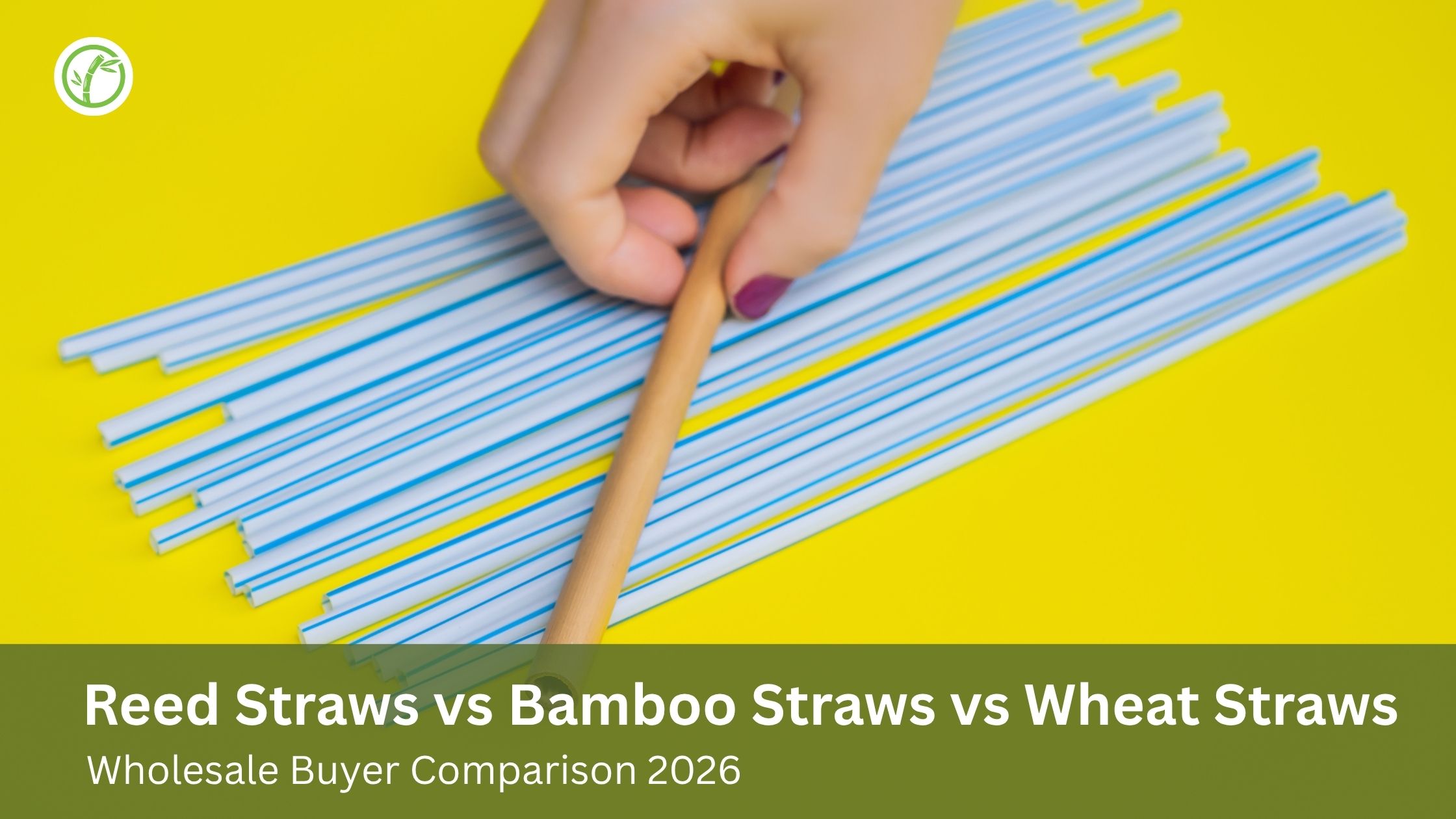
Bamboo straws are the best choice for reusable, dine-in service and thick drinks like bubble tea; wheat straws are the cheapest natural-stem option for standard beverages, and reed straws sit in between as a slightly sturdier single-use alternative. All three outperform paper straws, which soften in 10–20 minutes, by holding their structure for hours. The right pick depends on whether you need reusability, budget, or the widest possible diameter for thick beverages.
Bamboo straws are the best choice for reusable, dine-in service and thick drinks like bubble tea; wheat straws are the cheapest natural-stem option for standard beverages, and reed straws sit in between as a slightly sturdier single-use alternative. All three outperform paper straws, which soften in 10–20 minutes, by holding their structure for hours. The right pick depends on whether you need reusability, budget, or the widest possible diameter for thick beverages.
Quick Comparison Table
| Factor | Bamboo | Reed | Wheat |
|---|---|---|---|
| Wholesale price (bulk) | $0.05–$0.15/pc | $0.02–$0.045/pc | $0.01–$0.025/pc |
| Reusable | Yes — 50–100+ uses | No — single use | No — single use |
| Diameter range | 6–12mm | 4–8mm | 3–5mm |
| Handles bubble tea/boba | Yes, at 10–12mm | Partial, at 6–8mm | No — too narrow |
| Biodegrades in | 90–180 days | 4–8 weeks | 4–6 weeks |
| Soggy in liquid? | No — hours | No — 2+ hours | No — 2+ hours |
| Gluten-free | Yes | Yes | Yes (verified — stem, not grain) |
| Minimum order quantity | 10,000 pcs | 50,000 pcs | 50,000 pcs |
| Best for | Dine-in reuse, boba, premium branding | Eco-purist cafés, cocktail bars | Budget paper-straw replacement |
What’s the Difference Between Reed, Bamboo, and Wheat Straws?
All three are natural, plastic-free drinking straws made from plant material, and all three solve the core problem with paper straws: sogginess. Beyond that, they diverge on cost, diameter, and reusability.
Bamboo straws are cut and sanded from mature bamboo culms. They are the only one of the three designed for repeat washing and reuse, and they come in the widest diameters (up to 12mm), which is the only size that handles bubble tea and thick smoothies without collapsing.
Reed straws are sections of dried, hollow reed stem with almost no processing, no pulping, no molding, no chemicals. They are single-use, sit at a mid-range price, and are positioned as the “purest” natural straw because the plant itself is the finished product.
Wheat straws are made from the dried stem left over after wheat grain is harvested, genuine agricultural waste. They are the thinnest (3–5mm) and cheapest of the three, priced the same as paper straws, but only suit standard-viscosity drinks.
Bamboo Straws: Best for Reusable and Premium Service
Bamboo straws are cut from mature Moso bamboo, sanded smooth, and available in both reusable and single-use disposable formats. They currently sell wholesale from $0.05 to $0.15 per straw depending on diameter and finish, with a minimum order of roughly 10,000 pieces.
Available bamboo straw types:
- Natural Bamboo Straws — Standard golden-tan colour with visible grain, 200mm length, 6–12mm diameter options.
- Green Bamboo Straws — Retain the bamboo’s natural green outer layer (not dyed), popular in tropical-themed bars.
- Yellow Bamboo Straws — Warm golden tone from controlled heat treatment, suited to lighter-coloured drinks.
- Biodegradable Thin-Diameter Straws (6mm) — Matches conventional plastic-straw thickness, eases the transition for customers.
- Wide-Diameter Straws (10–12mm) — The only format in this comparison that reliably handles bubble tea and thick smoothies without the tapioca pearls jamming.
- Box-Packed Straws — Retail-ready packaging for hotel gift shops and eco-product retail.
Pros of Bamboo Straws
- Reusable 50–100+ times with proper washing, which drops the effective per-drink cost to a fraction of a cent for dine-in operations.
- Only option that handles bubble tea and thick smoothies — at 10–12mm diameter, the wide bore lets tapioca pearls and thick blended drinks pass through, something no paper straw at any thickness can do.
- Completely taste-neutral, even in delicate drinks like specialty coffee, fresh juice, and cocktails.
- Strongest structural integrity of the three — holds shape for hours in hot or cold liquid without softening or cracking.
- Widest branding surface for laser engraving, since the diameter and wall thickness support a legible, durable logo.
- Broadest certification support, including FSC, FDA 21 CFR 177, ISO 9001, ISO 14001, and PFAS-free testing.
- Works across the widest range of formats: reusable dine-in, single-use takeaway, and retail-boxed gift sets.
Cons of Bamboo Straws
- Highest per-unit cost of the three straw types.
- Requires cleaning equipment (a straw brush) and staff time if used as reusable rather than single-use.
- Natural diameter varies by roughly ±1mm since each straw is cut from a real bamboo culm, so batches are sorted by range rather than machined to an exact size.
Bamboo Straw Wholesale Pricing
| Product | Volume | Price Per Straw |
|---|---|---|
| Natural straws (6–8mm, 200mm) | 10,000+ pcs | $0.05–$0.10 |
| Wide straws (10–12mm, 200–230mm) | 10,000+ pcs | $0.08–$0.15 |
| Green or yellow bamboo straws | 10,000+ pcs | $0.08–$0.15 |
| Box-packed straws (per box, 10–12 straws) | 2,000+ boxes | $0.80–$1.50 |
| Custom-branded / private label | 10,000+ pcs | $0.10–$0.20 |
Buyers sourcing bamboo straws for bubble tea, cocktail bars, or dine-in reuse can browse the full range on FriendlyBamboo’s bamboo straws wholesale page, which includes diameter charts, cleaning guidance, and custom branding options such as laser engraving and private label.
Reed Straws: A Sturdier Single-Use Alternative
Reed straws are cut directly from dried reed stems with essentially no manufacturing step beyond cleaning, cutting, and sanitizing. They are priced between paper and bamboo, from roughly $0.02 to $0.045 per straw, with a 50,000-piece minimum order.
Pros of Reed Straws
- Holds firm in liquid for 2+ hours without sogginess.
- Fastest biodegradation of the more durable straw types at 4–8 weeks.
- Taste-neutral, with no plant or papery flavor transfer.
Cons of Reed Straws
- Single-use only — unlike bamboo, reed straws cannot be washed and reused, so the cost is spent fresh on every drink.
- Narrower diameter range (4–8mm) than bamboo, which limits it to standard and moderately thick drinks; it cannot reliably handle bubble tea the way a 12mm bamboo straw can.
- Higher minimum order than bamboo (50,000 vs. 10,000 pieces), which is a bigger upfront commitment for smaller buyers testing a new eco straw line.
- Less brand surface for custom work — reed’s thinner wall is not well suited to laser engraving the way wider bamboo straws are, so branding is generally limited to the wrapper or box rather than the straw itself.
- No reuse economics: because it is disposed of after one drink, the effective per-serve cost stays flat rather than dropping over time the way a washed bamboo straw’s cost does.
Also read – Bamboo BBQ Skewers & Sticks Manufacturers in China
Wheat Straws: The Cheapest Natural-Stem Option
Wheat straws are made from the dried stem left behind after wheat grain is harvested, agricultural waste rather than a purpose-grown crop. They are the most affordable of the three, priced from $0.01 to $0.025 per straw, matching paper straw pricing, with a 50,000-piece minimum order.
Pros of Wheat Straws
- Lowest cost of the three, on par with plain paper straws.
- Thinnest natural-stem diameter (3–5mm), closest to the feel of a conventional plastic straw.
- Verified gluten-free, since the protein is in the wheat kernel, not the stem.
Cons of Wheat Straws
- Cannot handle thick or textured drinks at all — the 3–5mm diameter is too narrow for bubble tea, milkshakes, or thick smoothies, ruling it out for a large share of the beverage market that bamboo covers easily.
- Single-use only, with no reuse economics to offset the per-drink cost over time, unlike bamboo’s 50+ reuse cycle.
- Thinnest wall of the three, which means it is the least sturdy option if a buyer is choosing based on structural strength rather than price alone.
- Highest minimum order relative to unit price — 50,000 pieces at a few cents each is still a meaningful upfront spend for a straw that can only serve part of a drinks menu.
- Limited to one practical diameter band, so operations with a varied drinks menu (juice, smoothies, boba) would still need a second straw type for thicker drinks.
Reed vs Bamboo vs Wheat: Side-by-Side Performance
| Factor | Bamboo | Reed | Wheat |
|---|---|---|---|
| How natural | Cut and sanded stem | Plant stem, minimal processing | Plant stem, minimal processing |
| Soggy in liquid | No — hours | No — 2+ hours | No — 2+ hours |
| Taste transfer | None | None | None |
| Reusable | Yes, 50–100+ uses | No | No |
| Diameter for thick drinks | Yes, 10–12mm | Partial, 6–8mm | No |
| Biodegrades in | 90–180 days | 4–8 weeks | 4–6 weeks |
| MOQ | 10,000 pcs | 50,000 pcs | 50,000 pcs |
| Price (bulk) | $0.05–$0.15/pc | $0.02–$0.045/pc | $0.01–$0.025/pc |
Which Straw Should You Choose?
Choose bamboo if you run dine-in service, serve bubble tea or thick smoothies, or want a straw that pays for itself through reuse. Browse bamboo straws wholesale for the full diameter and packaging range.
Choose reed if you want a single-use straw with a slightly sturdier feel than wheat and a strong “purest natural origin” story for cocktail bars or eco-purist cafés — but budget for the 50,000-piece minimum order and note it won’t serve boba-style drinks.
Choose wheat only if your menu is limited to standard-viscosity drinks (water, juice, coffee, cocktails) and price is the deciding factor — it cannot substitute for bamboo or reed on anything thick.
Frequently Asked Questions
No. Both hold their structure for 2+ hours in liquid, compared to 10–20 minutes for paper. Neither, however, can be reused the way bamboo straws can.
No. Bubble tea requires a wide bore (typically 10–12mm) for tapioca pearls to pass through. Reed tops out around 6–8mm and wheat around 3–5mm, so only bamboo straws in this comparison reliably handle boba.
Wheat straws are the least expensive at $0.01–$0.025 per straw, the same range as plain paper straws, but with none of the sogginess.
Bamboo, at roughly 10,000 pieces, versus 50,000 pieces for both reed and wheat — a meaningful difference for a smaller buyer testing a new straw line for the first time.