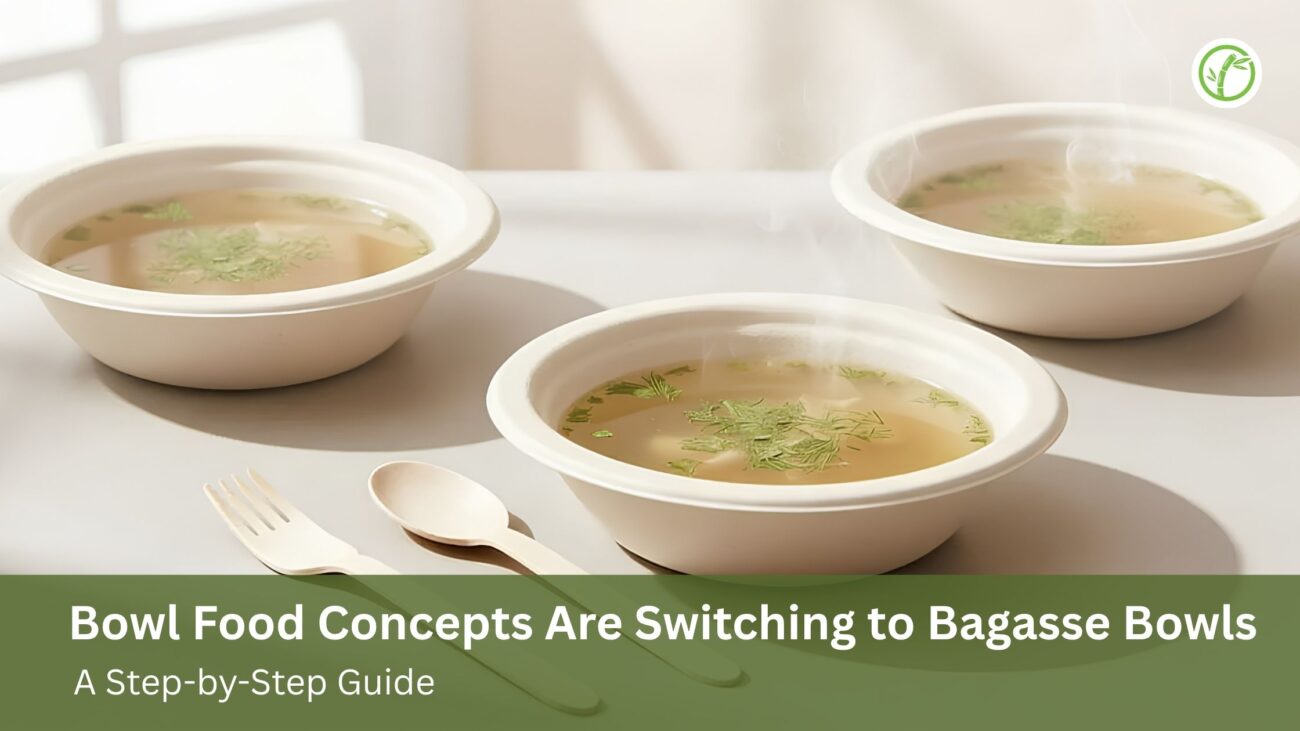
The bowl food category is one of the fastest-growing segments in the food service industry. From açaí bars to poke bowl chains, ramen specialists to Korean bibimbap concepts, grain bowl cafés to nourish bowl delivery brands, the bowl format has become the defining food presentation of the health and wellness dining movement.
It has also, until recently, had a packaging problem. Bowl food is difficult to package sustainably. It involves liquid components, such as sauces, broths, and dressings, that challenge the paper’s grease resistance. It is served hot or cold, depending on the concept, demanding thermal performance across a wide range. It is dense and heavy relative to its volume, requiring structural rigidity. And it is, above all else, a highly visual product; the bowl is photographed and shared extensively, which means the container is in every shot.
Bagasse bowls solve all of these problems simultaneously. This article explains why, in practical and operational terms, and guides bowl food operators through the specification and sourcing decisions that matter most.
Why Bowl Food Has Unique Packaging Requirements
Liquid and Sauce Containment
Bowl food almost universally involves sauces, dressings, broths, or high-moisture ingredients. A poke bowl has soy-based dressings and wet proteins. An açaí bowl has blended fruit that releases moisture as it sits. Ramen has hot broth. A grain bowl has tahini or vinaigrette. None of these are appropriate for standard paper packaging — uncoated paper absorbs liquid and fails structurally; PFAS-coated paper handles grease but introduces chemical concerns.
Bagasse achieves liquid and grease resistance through compressed fibre density rather than chemical coating — the same property that makes sugarcane structurally water-resistant in nature. A bagasse bowl holds a wet poke bowl for 45–60 minutes without structural compromise or leaching. This is the fundamental functional requirement for bowl food packaging, and bagasse meets it without the compromises that paper alternatives require.
Thermal Performance Across Hot and Cold Applications
The bowl food category spans an unusually wide temperature range. Açaí bowls are served near-frozen. Ramen and pho are served at a near-boiling point. Grain bowls and poke are served at ambient or chilled temperatures. A packaging solution that requires different materials for different temperature applications creates procurement complexity and visual inconsistency across the menu.
Bagasse performs reliably across the full temperature range from freezer storage to 120°C hot food contact. A single bagasse bowl specification can serve an açaí bowl concept and a ramen bar equally well, which is particularly valuable for multi-concept food hall operators or businesses with diverse menus.
Structural Rigidity for Dense, Heavy Portions
Bowl food portions are inherently heavy — a fully loaded poke bowl or grain bowl weighs 400–600 g. Customers carry these bowls from a counter to a table or eat them standing, often with one hand. The container needs to hold its shape under this load without flexing, bending, or losing its structural integrity over the 15–20 minutes of a typical eating experience.
Bagasse bowls are dimensionally stable under load in a way that paper alternatives are not. The compressed fibre structure maintains its shape throughout the eating experience, even with hot, wet contents that would cause paper to progressively soften and deform.
Photography and Brand Presentation
Bowl food is the most photographed food category on Instagram and TikTok. The container is in every shot — at the point of handover, on the customer’s desk, at the table, in the flat-lay setup. The packaging is part of the product presentation in a very literal sense.
Bagasse bowls have a visual quality that paper alternatives do not. The natural off-white colour and slightly textured surface provide a neutral, premium backdrop for colourful bowl food. The bowl holds its shape in photographs — it does not sag or distort. And the natural material communicates the same values health, naturalness, sustainability — that bowl food concepts are built around.
Bowl-by-Bowl: How Bagasse Performs Across the Major Concepts
Açaí Bowls — Blended açaí releases moisture as it sits. Bagasse resists this moisture without softening, keeping the bowl presentable for 30–45 minutes, longer than a customer typically takes to consume the product.
Poke Bowls — Raw fish, pickled vegetables, and soy-based sauces are all moisture-intensive. Bagasse handles all three without leaching or structural failure. The flat-bottomed format keeps the bowl stable on any surface.
Ramen and Pho — Hot broth is the most demanding application for any bowl sustained high temperature plus high liquid volume. Bagasse bowls rated to 120°C handle hot broth service for the duration of a standard restaurant sitting without deformation or taste transfer.
Grain and Nourish Bowls — Ambient temperature service with oil-based dressings. Bagasse’s natural grease resistance handles vinaigrette, tahini, and olive oil-based dressings without softening. The visual presentation stays clean throughout the meal.
Korean Bibimbap — Rice, vegetables, and gochujang — high moisture with some heat. The bagasse bowl format closely mirrors the traditional stone bowl aesthetic in its natural colour and texture, which works well for Korean concepts prioritising presentation authenticity.
Buddha and Falafel Bowls — Hummus, tahini, and roasted vegetable moisture. Bagasse handles oil-rich ingredients without the PFAS coating required for comparable performance in paper alternatives.
Bagasse Bowl Specifications: What to Know Before You Order
Size and Volume
- 12 oz / 350 ml: Small bowl — suitable for children’s portions, side dishes, small açaí servings
- 16 oz / 470 ml: Medium bowl — the standard for individual açaí, smaller poke bowls, snack portions
- 24 oz / 710 ml: Large bowl — the primary format for full-size poke, grain bowls, ramen, bibimbap
- 32 oz / 940 ml: Extra-large bowl — suited to generous portions, family-size servings, noodle soup formats
Shape and Base
- Round with straight sides: The most common format — stackable, stable, and visually clean
- Round with tapered sides: Easier to grip for eat-standing formats; slightly more premium appearance
- Oval: Popular for Japanese and Korean presentations; provides a longer food surface for linear arrangements
- Flat-bottomed vs. slightly domed: Flat-bottomed is preferred for delivery (stability in transit); a slightly domed base provides a premium feel for dine-in
Lid Compatibility
For delivery and takeaway formats, lid compatibility is critical. Confirm that your chosen bowl has a compatible lid available from the same supplier — either a flat bagasse lid or a clear PLA dome lid (for açaí and cold presentations where visibility matters). Test the lid seal with your actual contents before ordering at volume — a lid that lifts under delivery conditions is a customer satisfaction problem that no amount of sustainable packaging messaging can overcome.
Wall Thickness and Insulation
Premium bagasse bowls have a wall thickness of 3–4 mm, which provides meaningful insulation for both hot and cold applications. For ramen and hot soup formats, this thickness extends the comfortable eating temperature window by 5–8 minutes compared to thinner alternatives. For açaí and cold formats, it slows the warming effect of the customer’s hands on the bowl contents.
Food Safety Certification
For bowl food concepts serving raw fish (poke, sushi bowls), allergen-sensitive ingredients, or any application involving direct food contact with acidic ingredients (citrus dressings, vinegar-based pickles), food-contact certification is non-negotiable. Request LFGB (EU/UK) or FDA (US) test reports and keep them in your food safety management documentation.
Sourcing Bagasse Bowls at Bowl Bar Volume
For bowl food concepts ordering at meaningful volume, factory-direct wholesale sourcing delivers significant advantages over retail or distributor supply. Sourcing bagasse bowls wholesale direct from a manufacturer typically reduces per-unit cost by 35–55% compared to purchasing through a hospitality supply chain. At a bowl bar doing 150 covers per day, this difference amounts to USD 60–120 per month in packaging savings — material money over a trading year.
Volume Planning
For a bowl food concept doing 150 covers per day (takeaway and dine-in combined):
- Daily bowl usage: 150 bowls
- Monthly usage: ~4,500 bowls
- Quarterly order (with 10% buffer): ~15,000 bowls
- At factory-direct pricing of USD 6–9 per 100 units: USD 900–1,350 per quarter
- At distributor pricing of USD 12–18 per 100 units: USD 1,800–2,700 per quarter
- Quarterly savings from factory-direct sourcing: USD 900–1,350
Over a full trading year, the savings from factory-direct versus distributor sourcing for bowls alone approach USD 4,000–5,000. This is before accounting for savings on lids, cups, and other packaging items sourced from the same supplier.
BOWL FOOD OPERATORS — RECOMMENDED BAGASSE SUPPLIER
Friendly Bamboo — Factory-Direct Bagasse Bowls for Every Bowl Concept
For açaí bars, poke bowl chains, ramen operators, and grain bowl concepts, Friendly Bamboo supplies certified bagasse bowls and the complete packaging range, factory-direct with the sizes, certifications, and pricing consistency that volume bowl food operations require.
- Full bowl size range 12 oz through 32 oz in round and oval formats
- Lid options: bagasse flat lids and PLA dome lids for cold presentation formats
- PFAS-free certified, no chemical coatings, safe for raw fish and acidic ingredients
- FDA and LFGB food-safety certified, with test documentation on request
- Factory-direct pricing 35–55% below typical distributor cost at bowl bar volumes
- Consistent quality across repeat orders essential for high-frequency bowl service
- Complete eco-packaging range cups, straws, boxes, cutlery from one supplier
Browse the bowl range: friendlybamboo.com — Bagasse Bowls Wholesale
Completing the Bowl Food Packaging Setup
Cups for Cold Drinks and Smoothies
Most bowl food concepts also serve cold drinks, smoothies, cold-pressed juices, iced matcha, and iced coffees. Bagasse cups wholesale in 16–24 oz formats are the natural companion to bagasse bowls on the counter, same material, same natural aesthetic, same compostability credentials. Using matched bagasse cups and bowls from the same supplier creates a cohesive, all-natural packaging identity that reinforces the brand story every time a customer picks up their order.
Straws for Cold Drink Service
For cold drinks and smoothies, the straw question is as relevant for bowl food concepts as for any other food service format. Paper straws soften in cold-pressed juice and thick smoothies. Bagasse straws wholesale maintain their structure in cold, thick, and acidic liquid, the formats most commonly served alongside bowl food, and complete the all-natural packaging story at the drink end of the counter. Wide-bore bagasse straws are available for thick smoothies and açaí drinks where a standard straw diameter is insufficient for comfortable liquid delivery.
The Brand Story: Turning Your Packaging into a Marketing Asset
Bowl food is, more than almost any other food category, defined by its values as much as its flavours. The customers choosing açaí bowls and poke over fast food are making a deliberate lifestyle statement. They pay attention to ingredients, sourcing, and increasingly packaging. For bowl food operators, the packaging is not a logistical necessity to minimise; it is a brand statement to maximise.
The Visual Identity Opportunity
A bagasse bowl with a clean logo on the lid, held in a photograph against the vibrant colours of a poke bowl, communicates the entire brand story in a single image: natural, sustainable, premium, considered. Several of the fastest-growing bowl food chains have invested in custom-printed bagasse packaging as a core element of their visual identity not as a marketing expense, but as a brand investment that pays back in social media organic reach.
Custom printing on bagasse bowls and lids is available from most manufacturers at volume (typically 10,000+ units per SKU). For a concept doing 150 covers per day, a 10,000-unit print run represents approximately 67 days of stock a reasonable production run that brings the cost of branded packaging within reach of independent operators, not just chains.
Communicating Compostability to Customers
Customers who choose bowl food are disproportionately likely to compost at home and to make purchasing decisions based on packaging sustainability. Making the compostability of your packaging explicit through a statement on the bowl, the lid, or an insert card converts a procurement decision into a customer engagement point.
- Simple copy that works: ‘This bowl is made from sugarcane fibre, home-compostable within 6 months.’
- QR code on the lid linking to your sustainability page or the supplier’s certification documentation
- Counter signage: ‘Our packaging is 100% bagasse, a sugarcane byproduct, not a tree.’
Delivery Platform Positioning
For bowl food concepts with a significant delivery or collection channel, the delivery platform listing is where the packaging story first reaches the customer. Explicitly mentioning compostable bagasse packaging in your listing description and using the platform’s eco-friendly filters where available improves discoverability among the sustainability-conscious demographic that disproportionately orders bowl food online.
Final Thoughts
The bowl food category and bagasse packaging are a natural match not just because of the material’s functional properties, but because of the values alignment. Bowl food customers are the most eco-conscious demographic in food service. They notice packaging, they comment on it, and they make repeat purchase decisions partly based on it.
Bagasse bowls give bowl food operators a packaging solution that is functionally superior to paper across every demanding performance criterion — moisture, heat, rigidity, food safety — while delivering a visual and brand quality that reinforces the health-forward, natural-ingredient proposition at the centre of every bowl food concept.
The packaging switch is one of the most coherent brand decisions a bowl food operator can make. The material earns its place at every counter it appears on — and it does so while keeping the certification, the compostability, and the customer story completely clean.