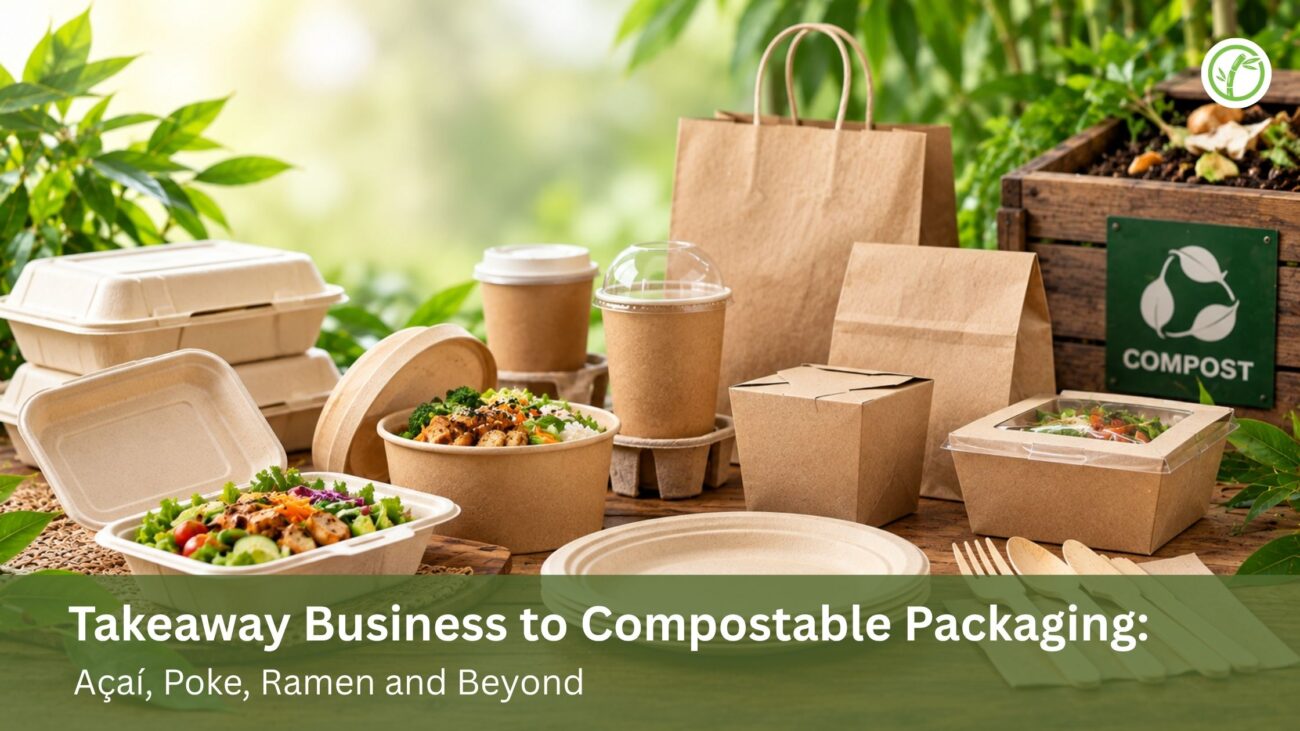
Switching your takeaway business to 100% compostable packaging sounds like a large project. In practice, it is a series of straightforward individual product decisions, each with a clear bagasse or natural-material alternative, a certified supplier, and a procurement process that fits within a single ordering cycle.
The complication is not the switch itself. The complication is knowing which products to prioritise, which certifications to look for, how to manage the cost transition, and how to communicate the change credibly to customers who are increasingly sophisticated about the difference between genuine compostability and greenwashing.
This guide walks through the complete transition process, product by product and step by step. Whether you are running a single-site Indian takeaway, a fast-casual burger concept, a poke bowl operation, or a multi-location pizza delivery business, the framework is the same. The specific products change; the process does not.
Why the Takeaway Packaging Transition Is Urgent in 2025
The Regulatory Pressure
Single-use plastic packaging bans are not a future concern; they are a current operational reality for any takeaway business serving regulated markets. The EU Single-Use Plastics Directive, the UK Plastic Packaging Tax, the proposed US federal packaging regulations, and state-level bans across California, New York, and Washington have fundamentally changed the compliance landscape for takeaway packaging.
The direction of travel is consistent and accelerating: more bans, broader scope, higher penalties. A takeaway business that completes the switch to compostable packaging now removes plastic compliance management from its risk register permanently, rather than managing it reactively as each new regulation comes into force.
The Customer Expectation Shift
Consumer research from the food delivery and takeaway sector consistently shows that sustainable packaging is now a decision factor for a meaningful and growing segment of customers. For delivery platforms, green credentials are increasingly surfacing in listings. For collection customers, the unboxing experience at home, opening a kraft box rather than a polystyrene container, is part of the product experience that drives repeat orders and review quality.
Takeaway businesses that have made the visible switch to compostable packaging report consistent positive comments in online reviews. Several delivery platform operators have noted that businesses with explicit eco-packaging descriptions see higher conversion rates among the under-35 demographic, now the largest online food ordering segment.
The Cost Trajectory
Compostable packaging is still more expensive than its plastic equivalent at equivalent volumes. But the gap is narrowing as production scales and competition increase among suppliers. At factory-direct wholesale pricing, the per-unit premium for compostable over plastic typically runs 15–45%, depending on product category, a cost that translates to less than USD 0.20 per order for most takeaway formats.
For a takeaway charging USD 12–25 per order, a packaging cost increase of USD 0.10–0.20 per order represents less than 1% of the average order value. This is the cost of a genuine, communicable sustainability credential, arguably the best marketing spend available at that price point.
The Complete Takeaway Packaging Audit: What Needs to Change
Before starting the transition, map every packaging item currently in use. A standard takeaway packaging audit covers:
- Main food containers (hot food boxes, clamshells, meal trays)
- Side dishes and portion pots
- Soup and liquid containers (bowls, cups with lids)
- Cutlery and utensils
- Bags and carrier packaging
- Sauce and condiment portions
- Napkins
- Straws (if applicable)
- Labels and tape (if applicable)
Not all of these require a bagasse solution. Some napkins and carrier bags have well-established paper alternatives. Other sauce pots, labels have specific compostable solutions that are improving rapidly. The highest-impact items, and the ones with the clearest bagasse solutions, are the main food containers, the cutlery, and the meal trays.
Product-by-Product: The Bagasse Solution for Every Takeaway Format
Hot Food Boxes and Clamshells
The polystyrene or plastic clamshell is the single most common takeaway packaging item and the highest-priority switch for most operations. Bagasse boxes wholesale are available in single-compartment and multi-compartment clamshell formats, the direct functional replacement for polystyrene and plastic boxes. Bagasse boxes are heat-stable to 120°C (suitable for direct microwaving), grease-resistant without plastic coating, and structurally rigid under hot, saucy food. Available in sizes ranging from small portion boxes (500 ml) through to large family-size formats (1,500+ ml), with hinged-lid and separate-lid variants.
Key specification point: Confirm the lid-to-base seal quality before ordering at volume. A leaking lid on a delivery order is a customer experience failure that negates all the positive sustainability messaging. Test with your actual food items, particularly anything with liquid sauce or oil.
Meal Trays and Cafeteria Formats
For operations serving set meal formats, combo trays, or any application where food is presented in a divided tray rather than a closed box, bagasse trays wholesale are the appropriate format. Available in single-cavity and multi-compartment (3, 4, and 5 section) configurations, bagasse trays provide a stable, heat-tolerant base for mixed meal presentations. The compartmented format eliminates the need for multiple separate containers in a meal deal — reducing packaging volume and assembly time simultaneously.
Bagasse trays are particularly popular in school and institutional catering, meal prep delivery businesses, and any takeaway format offering a protein-starch-vegetable combination meal. The natural off-white surface photographs well for meal prep and delivery marketing content.
Cutlery and Utensils
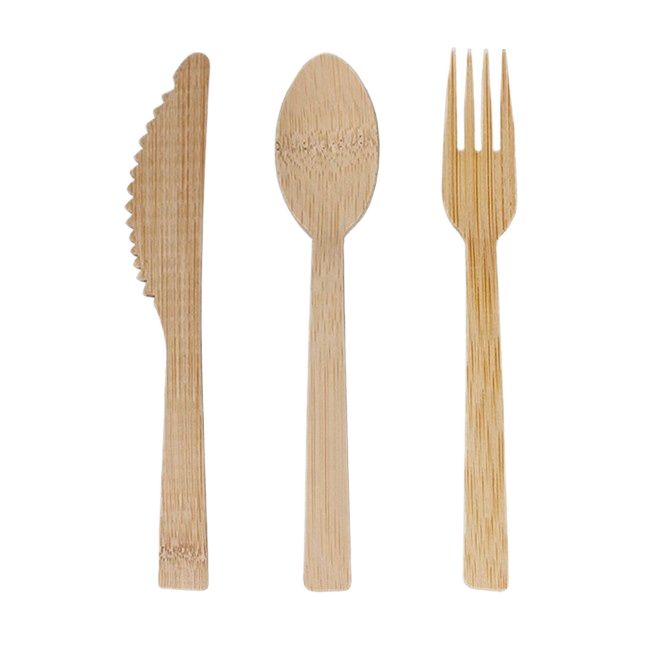
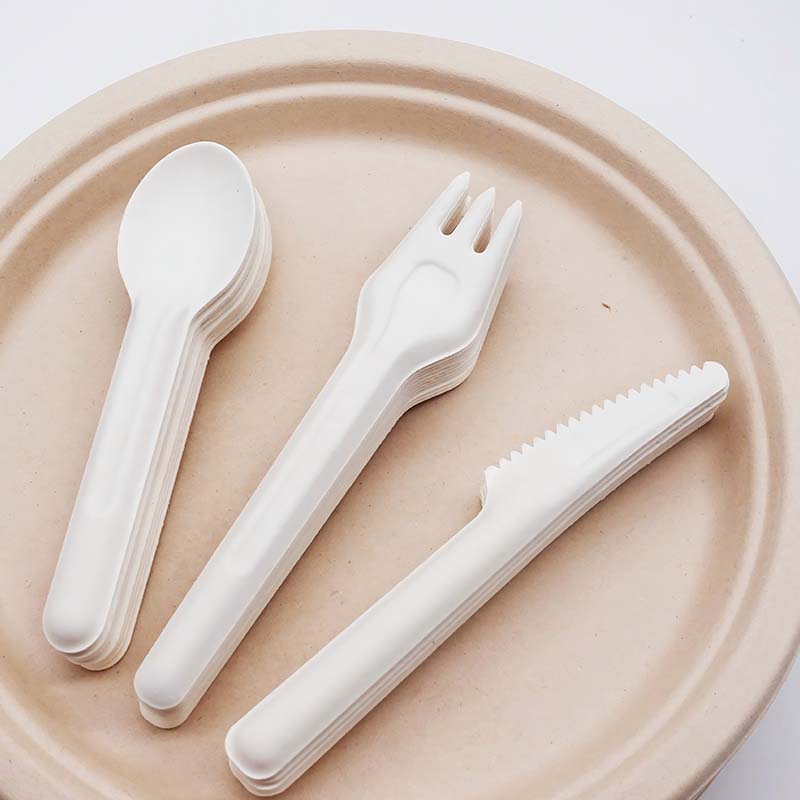
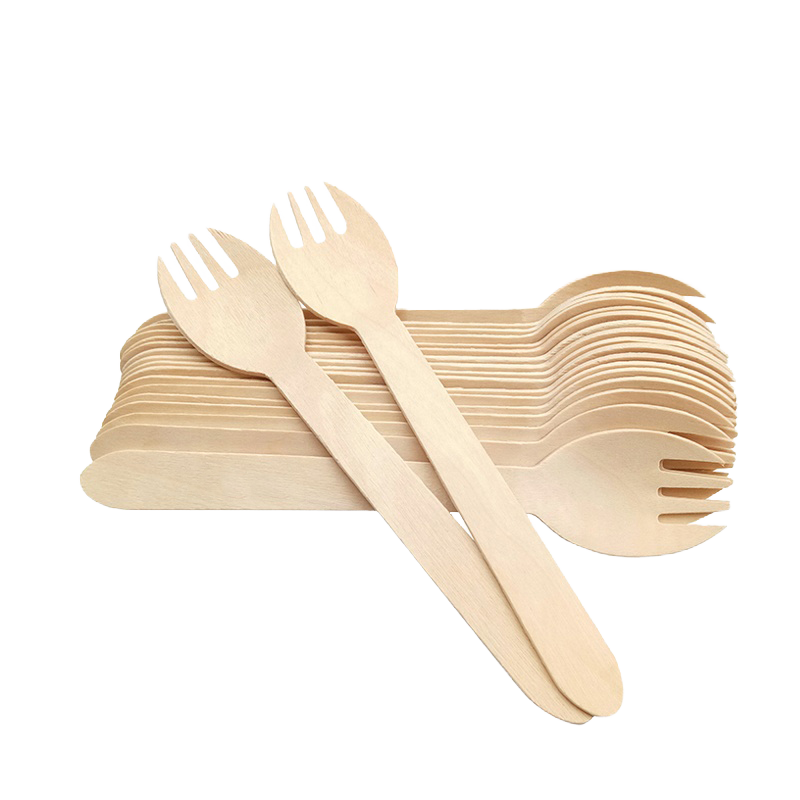
Disposable plastic cutlery in takeaway bags is the most heavily regulated single-use plastic item in most markets and the one most likely to generate compliance notices. Bagasse cutlery wholesale provides a compostable alternative in fork, knife, spoon, and combo-set formats. Bagasse cutlery is notably more heat-stable than paper alternatives; it does not soften or warp when used with hot food and has better structural strength than lightweight wooden alternatives for denser food applications.
For takeaway formats where cutlery is always included (rice dishes, pasta, noodles), a pre-packaged bagasse cutlery kit in kraft wrap is the most efficient format, one item in the bag rather than three. For formats where cutlery is optional (pizza, burgers), a ‘cutlery on request’ policy can reduce total cutlery spend while improving your sustainability metrics.
Bowls and Soup Containers
For soup, ramen, pho, congee, and any liquid-heavy dish, the bowl format is the critical item. Standard paper soup cups with plastic lids are a hidden plastic item in many ‘eco-friendly’ takeaway setups. The lid is almost always plastic, and many paper bowls have plastic liners. Bagasse bowls with bagasse or PLA lids eliminate the plastic component while providing better heat retention and structural rigidity than paper alternatives.
Carrier Bags
Paper carrier bags with twisted paper handles are the standard sustainable alternative to plastic carrier bags and are already widely adopted. If you are still using plastic carrier bags, this switch should happen simultaneously with or before the packaging transition. It is the most visible item and the most straightforward replacement.
Sauce and Condiment Pots
Small individual sauce pots are one of the harder takeaway packaging items to replace, as sustainably compostable PLA and bagasse options exist, but can be more expensive at small volumes. As a practical first step, consider switching to a ‘sauce on the side in the box’ format, placing sauces directly in a small corner of the main box rather than in a separate pot, which reduces both packaging volume and cost.
The 8-Step Transition Plan
STEP 1 Complete the Packaging Audit List for every item, your monthly quantity, and the current supplier cost per unit.
Do this systematically — every item, every format. Include items that seem trivial (sauce pots, tape). Calculate monthly spend per category so you can prioritise by impact and by cost.
STEP 2: Identify Your Top 3 Priority Items. Focus on volume, visibility, and regulatory risk.
For most takeaway businesses, the top three are: (1) the main food container (box or clamshell), (2) cutlery, and (3) the carrier bag. These three items typically account for 60–80% of total packaging spend and represent the highest regulatory and brand risk.
STEP 3 Request Samples from Certified Suppliers. Never bulk-order without physical testing.
Request samples in every format and size you need. Test each sample with your actual food: load it with your hottest, sauciest dish and hold it for 15 minutes at room temperature. Test the lid seal. Test cutlery with your food texture. Reject any product that fails before it reaches a customer.
STEP 4: Verify Certifications Request documentation — not claims.
- FDA compliance letter or LFGB test report for food contact safety
- EN 13432 or ASTM D6400 certificate for industrial compostability
- PFAS-free confirmation in writing
- File all documentation in your food safety management system
STEP 5: Calculate the True Cost Difference. Per-order packaging cost, not per unit.
The relevant cost metric for a takeaway business is not the price per individual item — it is the total packaging cost per order. Calculate this for your current plastic setup and your proposed bagasse setup. For most takeaway formats, the difference is USD 0.08–0.22 per order. Decide whether to absorb this cost, add a small surcharge, or offset it through reduced cutlery waste (cutlery-on-request policy).
STEP 6 Place Your Trial Order 1–2 months of projected volume for each priority item.
Do not attempt a full-catalogue switch in a single order cycle. Transition your top priority item first, validate it in live service, then move to the next. This approach limits disruption and gives you real-world data on performance before committing to full-season volumes.
STEP 7 Update Your Messaging: Tell customers what you’ve changed and why.
- Update your delivery platform listings to include eco-packaging credentials
- Add a card or sticker to orders: ‘Our packaging is 100% compostable bagasse dispose of in your food waste or garden compost’
- Update your website and social media profiles
- Brief your staff so they can answer customer questions about the packaging
STEP 8 Complete the Transition Move remaining items category by category over 3–6 months.
Once your priority items are running smoothly, work through the rest of the audit list category by category. Set a 3–6 month target for full-catalogue transition. Review your packaging cost quarterly — as your volumes with a single supplier grow, pricing improves.
RECOMMENDED SUPPLIER FOR TAKEAWAY PACKAGING TRANSITIONS
Friendly Bamboo — Complete Compostable Packaging for Takeaway Operations
For takeaway businesses making this transition, Friendly Bamboo supplies the complete bagasse packaging range factory-direct — boxes, trays, bowls, plates, cups, cutlery, and straws — with the certifications, consistent quality, and pricing that takeaway operations need to make the switch practical and commercially sustainable.
- Complete clamshell and box range — single and multi-compartment formats in all standard sizes
- Multi-section meal trays — 3, 4, and 5-compartment options for combo meal formats
- Bagasse cutlery sets — fork, knife, spoon, and combo kits in kraft wrap
- PFAS-free certified, FDA and EN 13432 compliant — full documentation on request
- Factory-direct pricing with low MOQs — accessible for single-site and multi-location operations
- Custom printing available at volume — your branding on certified compostable packaging
Start your transition: friendlybamboo.com — Bagasse Packaging Wholesale
Cost Management: Making the Numbers Work
The Cutlery-on-Request Strategy
Research from the food delivery sector consistently shows that 25–35% of takeaway orders with included cutlery do not use it — customers who order for home consumption already have their own cutlery. Switching to a cutlery-on-request model (customers indicate preference on your ordering platform or in-store) reduces cutlery consumption by 20–30% at most operations, partially offsetting the per-unit cost increase of switching to bagasse.
Volume Consolidation
Sourcing all your compostable packaging from a single factory-direct supplier rather than multiple distributors delivers two cost benefits: better combined-volume pricing (often 15–25% improvement over ordering individual categories separately) and reduced shipping costs (one freight invoice instead of several). Build your full packaging requirement into a quarterly order rather than a monthly replenishment to maximise both benefits.
Transparent Pricing to Customers
Several takeaway businesses have successfully introduced a small ‘eco-packaging contribution’ — typically USD 0.10–0.25 per order — displayed transparently on the menu. Customer acceptance is consistently high when the contribution is framed specifically around packaging rather than as a general price increase, and several operators report that it actually improves customer satisfaction by signalling that the business has thought carefully about its environmental impact.
Communicating the Transition: What Works
In-Order Insert Cards
A small card in each order — printed on recycled paper — explaining the packaging switch is one of the highest-read pieces of print marketing a takeaway business can produce. Customers who open their order and find an insert explaining that the packaging is 100% compostable bagasse consistently respond positively in reviews and social media posts.
Delivery Platform Profile Update
Most major delivery platforms (Deliveroo, Uber Eats, DoorDash, Just Eat) now surface eco-friendly credentials in business profiles and search filters. Updating your profile to reflect compostable packaging — with specific details about the materials used improves discoverability among eco-conscious customers who filter for sustainable businesses.
Social Media Before-and-After
A single post showing your old plastic packaging alongside your new bagasse packaging consistently generates strong engagement in the food business category. The visual contrast is compelling, the story is clear, and eco-conscious followers respond with the kind of sharing behaviour that drives organic reach. This post is worth producing on your transition date and repurposing for anniversaries.
Final Thoughts
The switch to 100% compostable packaging is not a complex project. It is a series of straightforward product decisions, each backed by certified materials, available from established wholesale suppliers and manageable within a normal procurement cycle.
The 8-step framework in this article works for operations of any size — from a single-site takeaway completing the transition in one quarter to a multi-location chain rolling out category by category over six months. The key disciplines are consistent: audit first, sample before ordering, verify certifications, and communicate the change to customers who will reward you for it.
The takeaway businesses that have completed this transition are not going back. The regulatory pressure is not relenting, the customer expectation is not declining, and the cost gap between compostable and plastic is not widening. If anything, the economics of the switch become more favourable every year.
The best time to start is now. The second-best time is after your next plastic packaging order runs out.