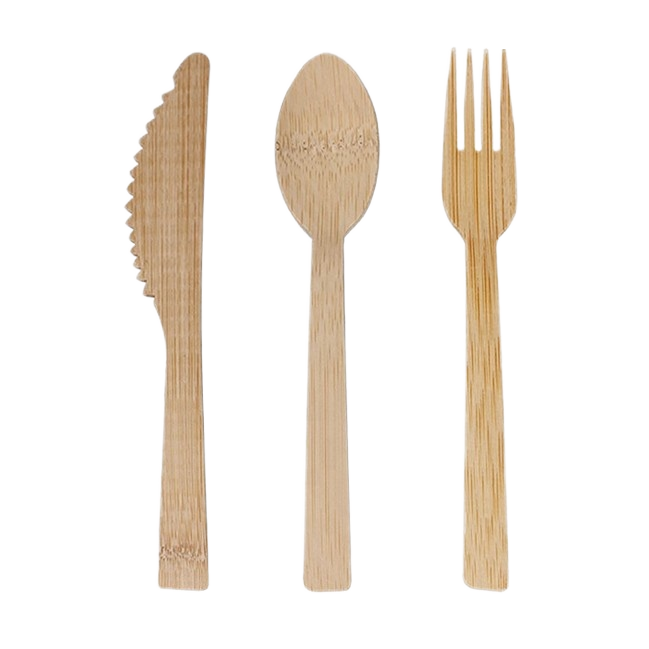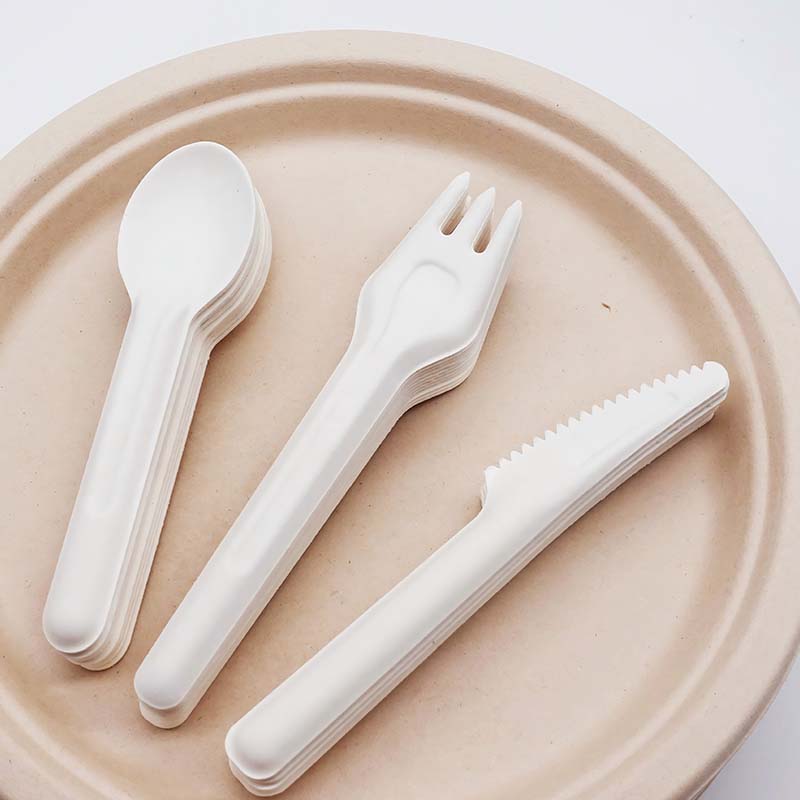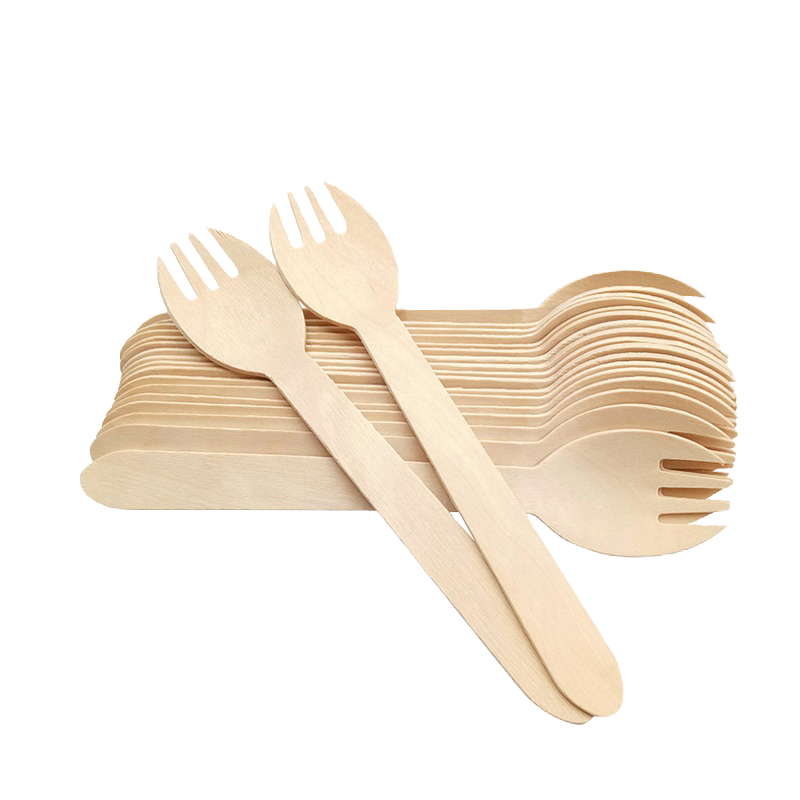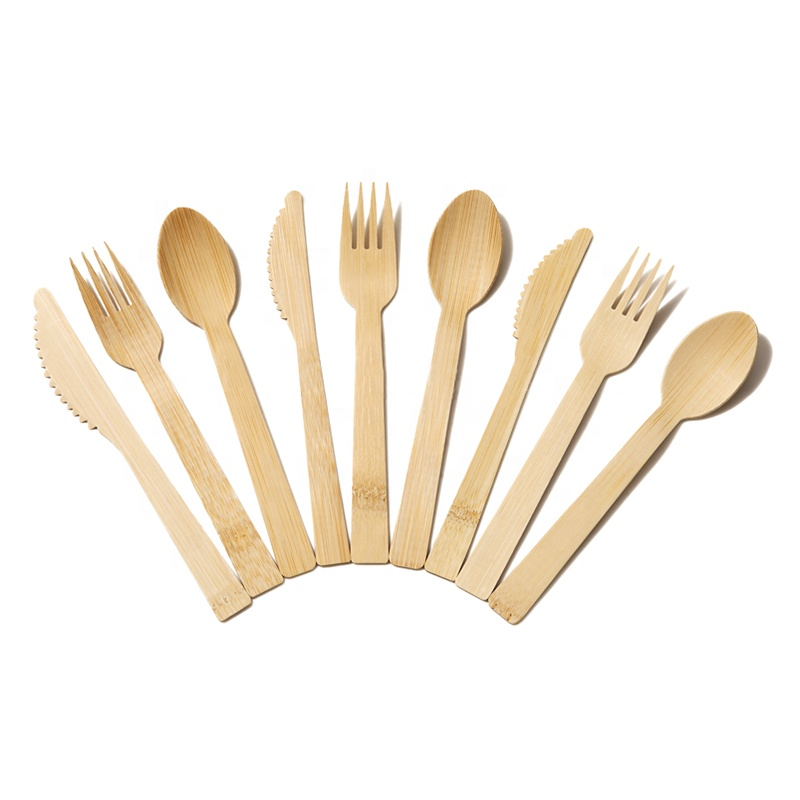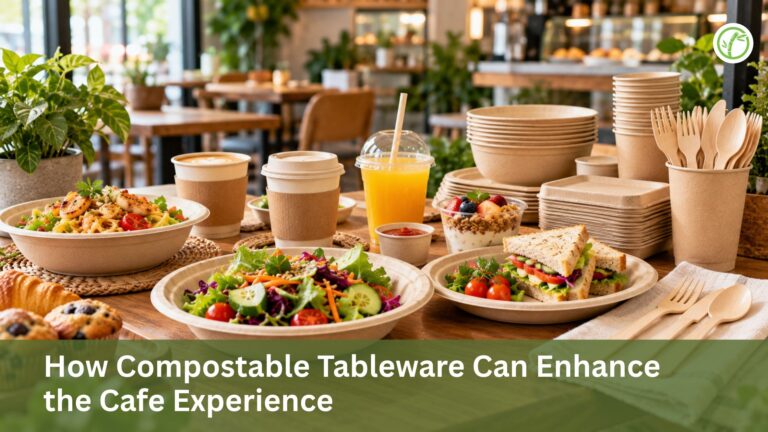


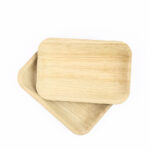



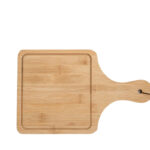


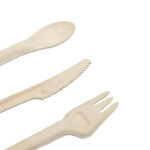

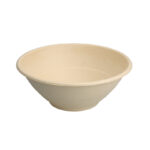

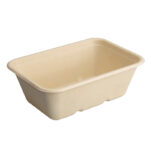


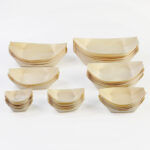
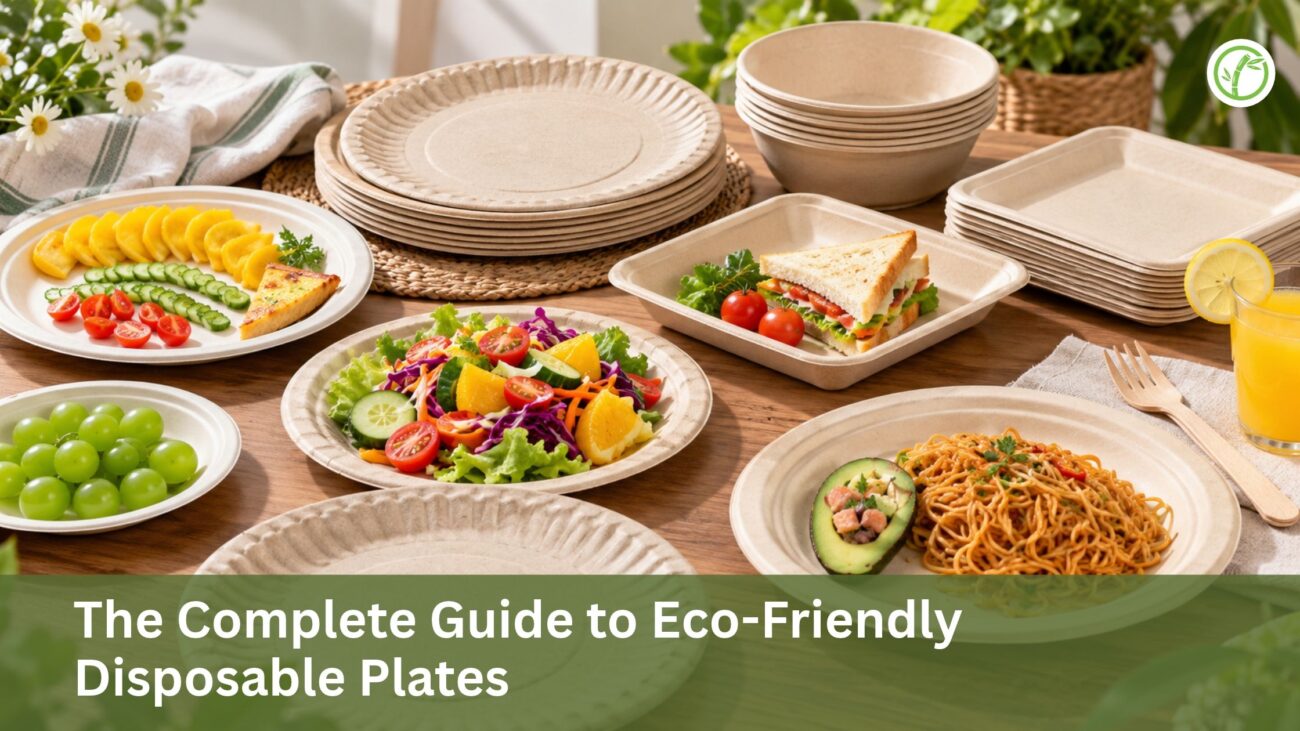
Eco-friendly disposable plates are made from plant materials such as bagasse (sugarcane fiber), solid bamboo, wood veneer, and palm leaf, instead of plastic or foam. The material tells you what a plate is made of; only a named certificate tells you whether it will compost, and words like “biodegradable” or “eco” on their own prove very little.
Key takeaways
- Four main materials are used for eco-friendly disposable plates: bagasse, solid bamboo, wood veneer and palm leaf. Each suits different food and events.
- Watch for lookalikes. Plastic-lined plates and melamine “bamboo fiber” plates look natural but aren’t plastic-free.
- Certificates that mean something: BPI and TÜV OK compost for compostability, FSC for responsible sourcing, food-contact test reports for safety.
- Claims that mean little on their own: “eco-friendly,” “natural,” “plant-based” and “biodegradable” without a standard named.
- Rules differ by market. The EU bans single-use plastic plates, including bioplastic and plastic-lined ones; California restricts “compostable” and “biodegradable” claims.
What are eco-friendly disposable plates made from?
| Material | What it is | Strengths | Limits | Heat and microwave |
| Bagasse | Sugarcane fiber left after juice extraction, molded under heat and pressure | Rigid, handles hot and saucy food, many shapes including compartment plates | Plain look; quality varies between factories | Friendly Bamboo’s is rated microwave-safe to 120°C for short reheating |
| Solid bamboo | Thin bamboo pressed into shape, with visible grain | Premium look, stiff, good for presentation | Higher cost; not for reheating meals | Short warm-ups only |
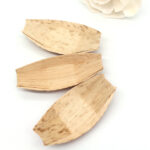
| Bamboo skin (sheath) | The natural outer sheath of the bamboo shoot, pressed into bowls and plates | Distinctive natural look | Varies piece to piece | Not microwave-safe |
| Wood veneer | Thin birch or poplar sheets pressed into plates | Light, rigid, rustic look | Can soften with very wet food over time | Short warm-ups only |
| Palm leaf | Fallen areca palm sheaths, washed and heat-pressed | Strong, distinctive texture | Each plate looks slightly different; supply depends on the harvest | Check the maker’s rating |
| Molded pulp (wood or bamboo) | Pulped plant fiber molded like bagasse | Similar to bagasse | Grease resistance depends on the formulation | Check the maker’s rating |
None of these materials is automatically compostable in a legal sense. That depends on the finished plate’s certification, which the next sections explain.
Which plates look eco-friendly but aren’t?
Five types are sold with natural-looking designs or green wording but carry hidden plastic or chemical concerns.
- Plastic- or PLA-lined fiber plates. A thin plastic or PLA film makes a fiber plate grease-proof, but it also makes the plate plastic in legal terms. The EU’s Single-Use Plastics Directive covers plates with plastic linings, and England’s ban on single-use plastic plates includes plates with plastic coatings or linings.
- Melamine “bamboo fiber” plates. Bamboo powder bound with melamine resin. They’re often glossy and brightly printed. They aren’t compostable, and the FDA advises against heating food in melamine dinnerware in the microwave.
- PLA plates. Made from plant-based plastic. They compost only in industrial facilities, soften at around 55–60°C, and are banned as single-use plastic in the EU and England.
- Plastic and foam plates. Banned for single use in the EU and England, and restricted in many US cities and states.
- Fiber plates with fluorinated grease barriers. Some molded fiber products have used PFAS to resist grease. The FDA announced in 2024 that PFAS grease-proofing substances are no longer being sold for food contact in the US, several US states ban intentionally added PFAS in food packaging, and EU PFAS limits for food-contact packaging have applied since August 2026. Ask for a product-specific PFAS test report.
For the difference between bio-based, biodegradable and compostable materials, see our guide to bio-based, biodegradable and compostable plastics.
What do eco-labels on eco-friendly disposable plates really mean?
Each recognized label proves one specific thing. None of them proves everything, so read them together.
| Label | Issued by | What it proves | What it doesn’t prove |
| BPI Certified Compostable | Biodegradable Products Institute (US) | The product meets ASTM D6400 or D6868 for commercial composting | That it composts at home, or that your local facility accepts it |
| OK compost INDUSTRIAL | TÜV Austria | The product meets EN 13432 for industrial composting | Home compostability |
| OK compost HOME | TÜV Austria | The product breaks down in home composting conditions | Performance in every real home bin |
| Seedling | European Bioplastics, via certifiers | EN 13432 industrial compostability | Home compostability |
| CMA Approved | Compost Manufacturing Alliance | The product broke down in field trials at working compost facilities | Acceptance by facilities outside the program |
| FSC | Forest Stewardship Council | Wood or bamboo comes from responsibly managed sources, tracked by chain of custody | Compostability or food safety |
| USDA Certified Biobased Product | USDA BioPreferred program | The percentage of plant-based content, by radiocarbon testing | Compostability |
| Glass-and-fork symbol | EU marking | The item is intended for food contact | That it passed any safety test |
| FDA or LFGB test report | Accredited laboratory | Food-contact safety for that market | Any environmental benefit |
What EN 13432 actually tests
The European standard behind most industrial compostability labels requires a material to disintegrate within 12 weeks and reach at least 90% biodegradation within six months at around 58°C, with tests for heavy metals and toxicity in the finished compost.
Home compostability is harder to achieve. In the UK’s Big Compost Experiment, 60% of plastics certified as home compostable did not fully disintegrate in real home bins.
How to verify a label
- Look for a certificate or registration number next to the logo.
- Search the issuer’s public database for that number and check that it names the exact product and maker.
- Ask the supplier for the certificate itself, not a logo on a spec sheet.
Also read: Guide to Bamboo Skewer Sizes and Types
Which plate claims mean little on their own?
Some words on packaging sound specific but aren’t backed by any standard. Others are legally restricted in some markets.
| Claim | When it’s supported | Red flag |
| “Eco-friendly” or “green” | Paired with a specific, provable benefit | Used alone; the US FTC warns against broad, unqualified environmental claims |
| “Natural” or “plant-based” | The material is plant-derived | Says nothing about linings, binders or what happens after use |
| “Biodegradable” | A standard, environment and timeframe are named | No standard named; California prohibits the claim unless specified standards are met |
| “Compostable” | A BPI, OK compost or equivalent certificate covers the exact product | No certificate number; California requires ASTM-standard certification |
| “Home compostable” | An OK compost HOME or equivalent certificate | Industrial certificate only |
| “PFAS-free” or “no added PFAS” | A recent lab test on the finished product | No test report available |
| “Plastic-free” | No plastic in the plate, lining or binder | Fiber plates with a film lining; melamine composites |
| “Chemical-free” | Never, as a literal claim | Everything is made of chemicals; treat it as marketing |
If you resell plates under your own brand, the claims on your packaging are your responsibility. Keep the supplier’s certificates and test reports on file for every claim you print.
How do you choose eco-friendly disposable plates for your event or business?
Match the material to the food first, then check the rules in the market where the plates will be used.
| Use | Best material | Why |
| Hot, saucy takeaway meals | Bagasse | Rigid and grease-resistant; handles short microwave reheating |
| Buffets | Bagasse heavy-base or compartment plates | Holds full portions without bending; compartments keep sides apart |
| Plated events and canapés | Solid bamboo, palm leaf or wood | Premium look for presentation |
| BBQs and picnics | Bagasse compartment or wood | Strong enough for mixed plates outdoors |
| Desserts and cake | Small bamboo, wood or bagasse plates | Light portions, good presentation |
| Food customers may reheat | Bagasse | Rated for short microwave use; bamboo skin and solid bamboo aren’t for reheating |
For microwave details by material, see our guide to whether disposable plates are microwave-safe. To size your order, see how many plates per guest.
Market rules to check
- EU and England: single-use plastic plates are banned, including bioplastic and plastic-lined plates. Bagasse, solid bamboo, wood and palm leaf are accepted.
- California and several other US states: “compostable” and “biodegradable” claims are restricted to products meeting specified standards.
- US states with PFAS laws, and the EU: ask for PFAS documentation on fiber plates.
What eco-friendly disposable plates does Friendly Bamboo supply?
| Range | Sizes and styles | Notes |
| Bagasse plates | 5–12 inches; round, oval, square, heavy-base and 3-compartment | Packed 500 or 1,000 per carton depending on size; minimum order of 10 cartons; microwave-safe to 120°C for short reheating |
| Bamboo plates | 7, 9 and 10 inches | For serving and presentation; short warm-ups only |
| Wooden plates | 6, 8, 9 and 10 inches | For serving and presentation; short warm-ups only |
| Palm leaf plates | Available | Sizes on request |
Documents and certification status
To be clear about what our plates do and don’t carry:
- Sourcing: FSC chain of custody certificate RR-COC-003046.
- Food contact: FDA, LFGB and EN 13130 food-contact test reports.
- PFAS: test reports are available on request for specific products.
- Compostability: our plates are made from plant materials, but they don’t currently carry a BPI or OK compost certificate. If you plan to print “compostable” on your packaging, that claim needs a certificate for the exact product.
Samples are free, with shipping paid by the buyer, and are usually ready in about 7 days.
Frequently asked questions
Plates made from bagasse, solid bamboo, wood veneer or palm leaf, with no plastic lining or melamine binder. For a compostability claim, look for a BPI or OK compost certificate covering the exact plate.
Bagasse is a plant fiber that breaks down, but a plate can only be called compostable if it carries a certificate such as BPI or OK compost. Whether it actually gets composted also depends on local food-waste collection.
Solid bamboo plates are a natural material that breaks down over time. Melamine “bamboo fiber” plates are not biodegradable and should not be confused with solid bamboo.
It means the product has been certified as meeting ASTM standards for commercial composting in the US and Canada. It does not mean the plate will compost in a home bin.
No. The EU treats single-use plates with a plastic lining as plastic products, and these are banned under the Single-Use Plastics Directive.